The Government Found a Way to Change School Policy Without Banning Anything
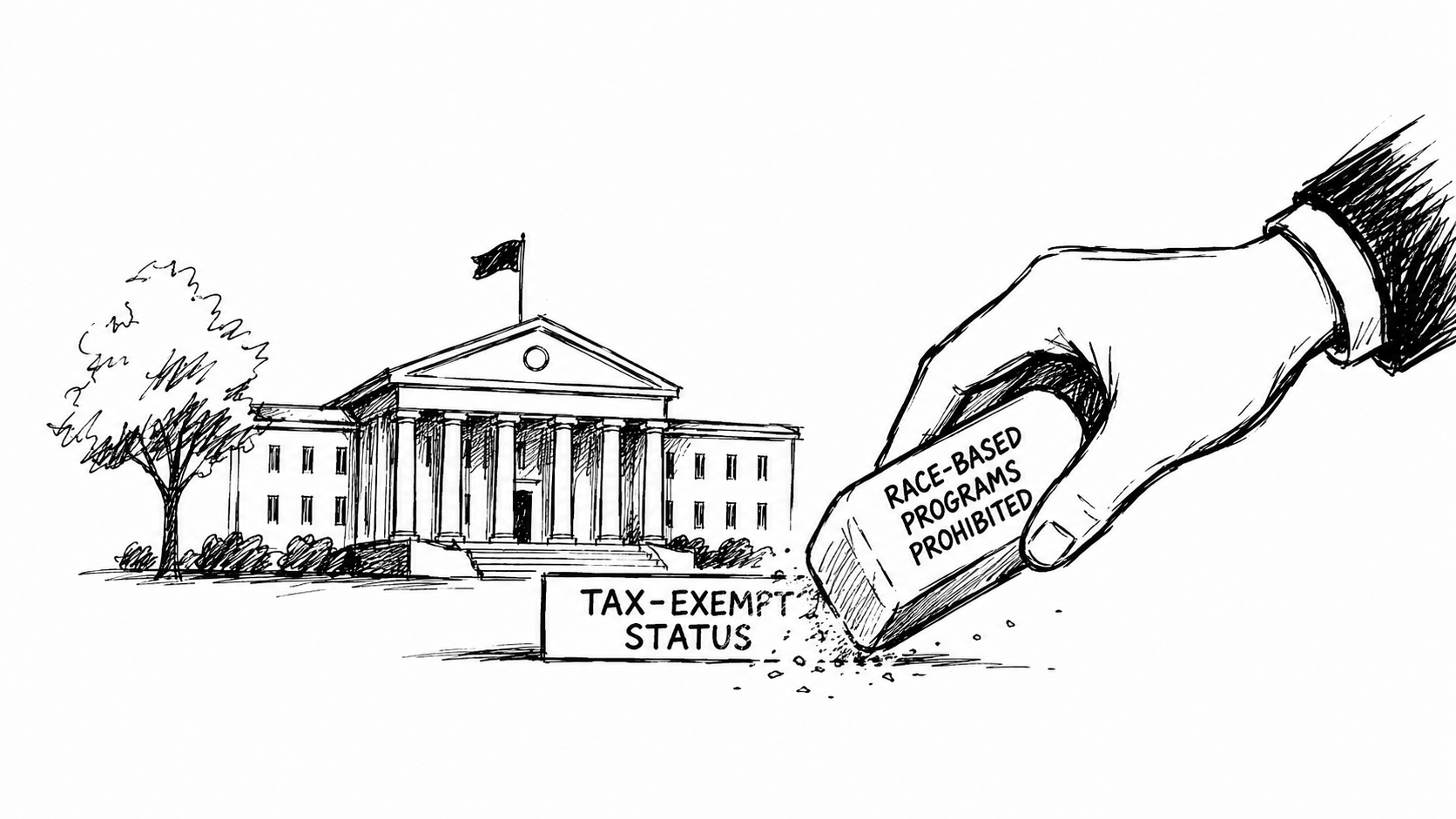
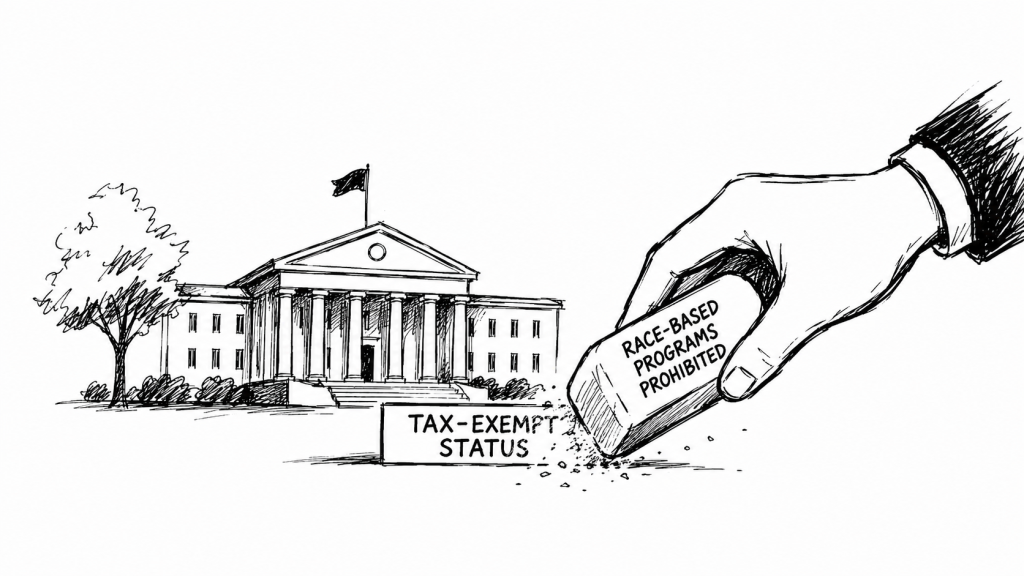
A proposed Treasury rule would tie federal tax exemption to how private schools treat race. The mechanism is the story: not a prohibition, but a price.
The Treasury Department and the Internal Revenue Service proposed a regulation Thursday that would deny or revoke 501(c)(3) tax-exempt status for private educational institutions that adopt, maintain or enforce policies discriminating on the basis of race, color, or national or ethnic origin. The rule reaches admissions, scholarships, loans, athletics and every other school-administered program. Treasury and the IRS estimate it could affect as many as 18,000 institutions, from elementary schools to graduate and trade schools. If finalized, it would apply to tax years beginning on or after May 31, 2027.
The proposal would also eliminate existing IRS guidance that permitted schools to favor certain racial preferences in admissions, facilities, programs, scholarships and financial assistance. Institutions could still expand opportunity using race-neutral criteria: family income, geography, first-generation status, individual hardship, military-family status, academic achievement.
Nothing in the rule makes a race-conscious scholarship illegal. It makes one expensive.
What Exemption Actually Buys
Tax exemption is easy to mistake for a formality. It is closer to infrastructure.
A 501(c)(3) designation allows donors to deduct their gifts, which is the foundation institutional fundraising is built on. It exempts endowment earnings from tax, which is how endowed scholarships compound rather than erode. It lowers borrowing costs, which determines what a school can afford to build. Remove it and an institution becomes a taxable entity with a diminished donor incentive, a smaller effective endowment return and more expensive debt, all at once.
That combination is why the mechanism is more consequential than a ban would be. A prohibition invites immediate litigation and a clear defendant. A condition on tax status invites something quieter: a general counsel advising a board that the exposure is not worth the program, months before anyone has been penalized, and without any institution ever being found to have violated anything.
The behavior changes at the threat, not the enforcement.
The Precedent Cuts in an Unfamiliar Direction
Treasury and the IRS ground the proposal in three Supreme Court decisions: Brown v. Board of Education, Bob Jones University v. United States and Students for Fair Admissions v. Harvard.
The Bob Jones citation is the load-bearing one. In that case, the university lost its tax exemption over its ban on interracial dating and marriage, and the Court held that the IRS could deny exempt status to institutions operating contrary to established public policy. That decision established the mechanism now being invoked: tax exemption conditioned on conduct the government deems consistent with public policy, with the IRS holding jurisdiction to make the determination.
What has changed is the content of the policy, not the tool. The same instrument that removed a benefit from an institution enforcing racial separation is now proposed to remove it from institutions that direct resources toward students of color. Treasury Secretary Scott Bessent, announcing the proposal, indicated that renaming such programs as equity or inclusion initiatives would not shield them.
Students for Fair Admissions ended race-conscious admissions at colleges and universities in 2023. This proposal extends the logic of that ruling from what an institution may consider to what an institution may fund, and attaches a financial consequence rather than a legal one.
Who Is Actually in Scope
The rule reaches private institutions. Public universities do not hold 501(c)(3) status the way private ones do and are not the stated target. But most public university endowments and gift processing sit inside separately incorporated foundations that do hold 501(c)(3) status, and the proposal’s treatment of those entities is not addressed in the announcement. Whether the rule reaches them determines whether this is a policy about private higher education or about higher education.
Among private institutions, the nation’s private HBCUs are directly within reach — though the obvious framing of that is wrong. HBCUs do not restrict admission by race and have not throughout their modern history. Their student bodies include white, Latino and international students. What they maintain, in common with most private colleges, are scholarships and programs designated for particular populations, many established by donors decades ago and many administered through outside intermediaries.
That raises a question the proposal does not answer. An endowed scholarship carries the terms its donor set, sometimes generations ago, and those terms are legally binding on the institution holding the fund. When a school can no longer lawfully execute a restriction without risking its exemption, the money does not simply become unrestricted. Modifying a charitable trust generally requires a court, and the outcome depends on state law and the specific instrument. Institutions facing that question will be doing so one fund at a time.
The Window
The proposal enters a notice-and-comment period before it can be finalized, and it will likely face litigation if it is. The comment period is the interval in which the rule can still be shaped, and it is the part of the process least covered and least used.
May 2027 is not a compliance deadline so much as a decision deadline. Institutions will make most of the consequential choices well before it, reviewing scholarship terms, restructuring programs and in many cases quietly ending things rather than defending them. Scores of universities have already closed or rebranded diversity offices and ended scholarships and clubs for minority students under pressure that carried no formal penalty at all.
That is the pattern worth naming. The measure of this rule will not be how many institutions lose their exemption. It will be how many change before anyone has to.