Texas Is Paying for Free School Meals. Families Still Have to Ask.

Federal food assistance cuts are pushing Texas campuses out of the program that fed every student automatically. A new state law fills part of the gap — for families who complete the paperwork.
Access Shift
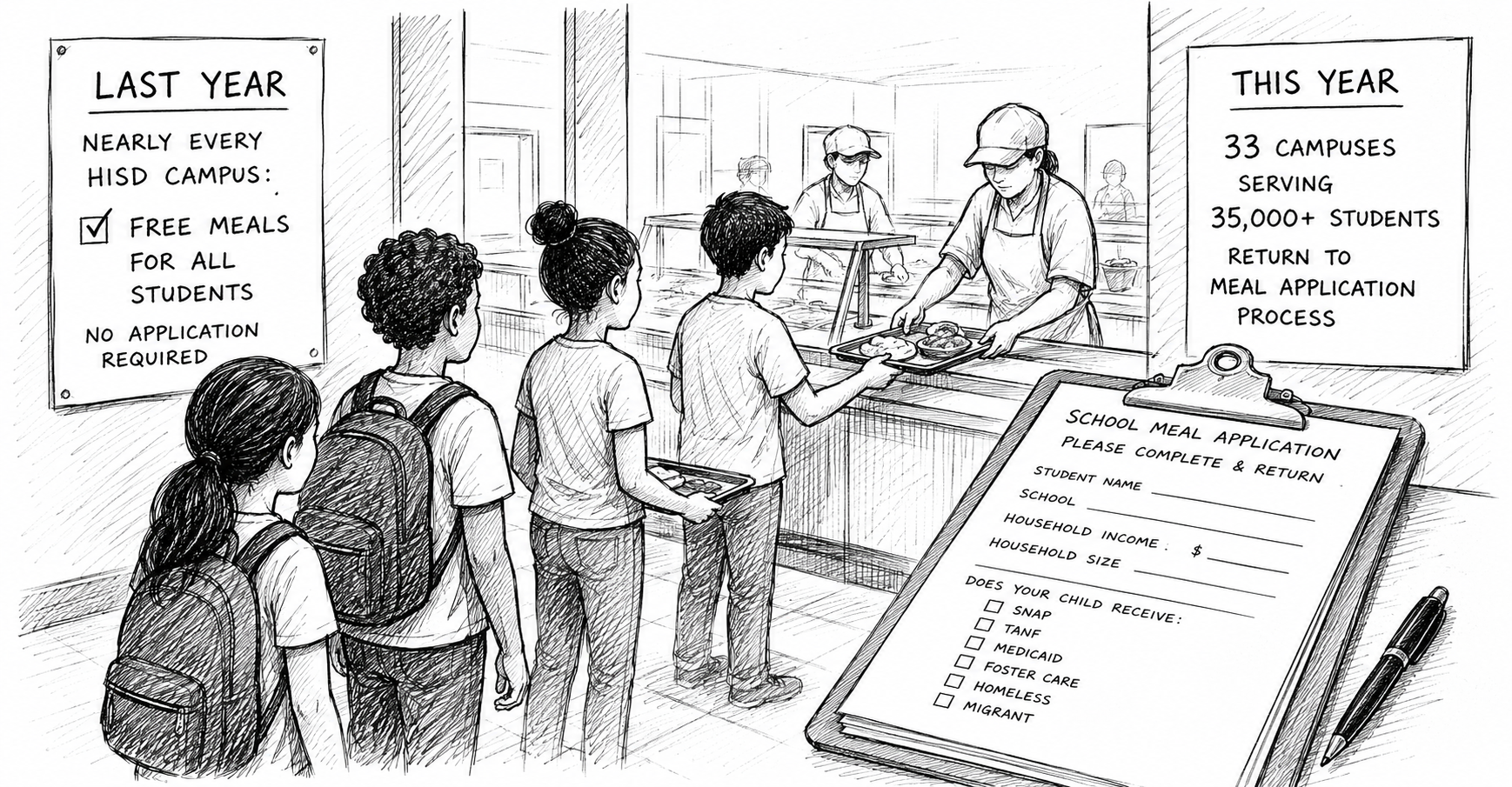
Last school year, nearly every campus in the Houston Independent School District served free breakfast and lunch to every student, no application required. Only seven campuses out of roughly 260 did not participate. This year, 33 campuses serving more than 35,000 students have returned to the standard meal application process.
The district was direct about why. A spokesperson said the campuses no longer meet federal requirements for the Community Eligibility Provision, and that the determination follows federal program guidelines rather than any decision the district made.
Nothing changed about the students. What changed was a number in a federal formula.
The Formula Underneath the Cafeteria
The Community Eligibility Provision, created in 2010, allows a school, a group of schools or an entire district to serve free meals to all students without collecting household applications. Eligibility turns on the identified student percentage — the share of enrolled students certified for free meals without an application because their household receives SNAP, TANF or benefits from the Food Distribution Program on Indian Reservations, or because the child is homeless, migrant, in foster care or enrolled in Head Start. In most states, Medicaid data now counts as well.
A campus needs an identified student percentage of at least 25 percent to participate. Federal reimbursement is calculated by multiplying that percentage by a factor of 1.6, an adjustment meant to capture low-income families the direct certification data misses.
That formula makes SNAP enrollment more than a measure of need. It is an input. When fewer households in a school’s attendance zone receive food assistance, the identified student percentage falls, reimbursement falls with it, and at a certain point the program stops covering the cost of the meals it requires the district to serve.
Congress cut SNAP last year. The effect on school cafeterias is arriving now, one campus at a time.
The Food Research & Action Center, which compiles participation data from state agencies, has warned that as children lose SNAP access and drop out of direct certification, schools’ ability to operate community eligibility diminishes — producing hunger at school as well as at home. Participation in the provision reached a record in 2025, serving more than 27 million students. [VERIFY current-year national figure once FRAC publishes it.]
What Texas Did, and What It Did Not Do
Texas responded to a different problem at nearly the same moment.
The 89th Texas Legislature appropriated funding so that students who qualify for reduced-price meals can eat breakfast and lunch at no charge through the 2026-27 school year. Agriculture Commissioner Sid Miller announced the change this summer, framing it as removing obstacles between children and healthy meals. Districts have begun implementing it. Ysleta ISD in El Paso extended free lunch to reduced-price-eligible students at five high schools beginning September 2.
The state benefit is real, and for the families it reaches it is meaningful. But it operates through the mechanism community eligibility was built to bypass. To receive it, a family must complete and submit a school meal application.
The application is where children fall out of the system. Policy analysts describe the form as a source of confusion and administrative burden, and note that it weighs income alone — no accounting for expenses, no exceptions, no waivers. A household absorbing a rent increase or a family member’s medical costs can spend more than it earns and still fail to qualify. [Attribute to Shoemaker DeMio, Center for American Progress, and confirm exact framing.]
So the two policies pull against each other. Federal cuts are removing campuses from the program that fed children without asking. State funding is adding a benefit that requires them to ask. A student at one of the 33 HISD campuses whose family does not file the form now receives neither.
The Number Nobody Has
The open question is how many families complete the application at a campus that never needed one before.
Districts returning to standard counting must build an application process from scratch in communities where, for years, none existed. Families accustomed to their child eating free have no reason to expect a form, and the form arrives with no marketing budget behind it. Return rates at those campuses would show the size of the gap between eligibility and access.
[REPORTING NEEDED: HISD application return rates at the 33 affected campuses, fall 2026. Compare to district-wide rates at non-CEP campuses in prior years.]
[REPORTING NEEDED: Statewide count of Texas campuses that dropped CEP for 2026-27 against 2025-26, via TDA and FRAC state lists. Determine whether losses concentrate by region or district size.]
In San Antonio, North East ISD stopped offering universal free meals at nearly half its campuses this year. The district’s school nutrition director has said the decline in families receiving food assistance was the primary factor, and that continuing the program would have cost the district money it does not have — while the underlying need in those schools has not moved. [VERIFY quotes directly with Sharon Glosson, NEISD.]
What This Is Actually About
Stigma is the part that does not appear in any formula. Universal meals erase the visible difference between students who qualify and students who do not; everyone eats, and no one is marked in the lunch line. Returning to applications restores that line, and restores it in schools where a majority of students likely still qualify.
The larger pattern is familiar to anyone who has watched a benefit fail without being repealed. Eligibility remained. Need remained. What disappeared was the administrative connection between a child and a program that already existed to serve them — a certification that used to happen automatically and now depends on a household noticing a form, understanding it, and returning it.
[Closing paragraph to be finalized after reporting. Suggested direction: the number of Texas children who lose school meals this year will not be measured by how many became ineligible, but by how many stayed eligible and were never counted.