More Workers Are Testing Positive for Cannabis. More Companies Have Stopped Asking.
New data from Quest Diagnostics shows corporate positive rates rising as major employers quietly drop pre-hire marijuana screening — with or without a clear federal signal to do so.
The numbers are moving in two directions at once, and together they tell a story about how corporate marijuana policy is actually being made in America right now.
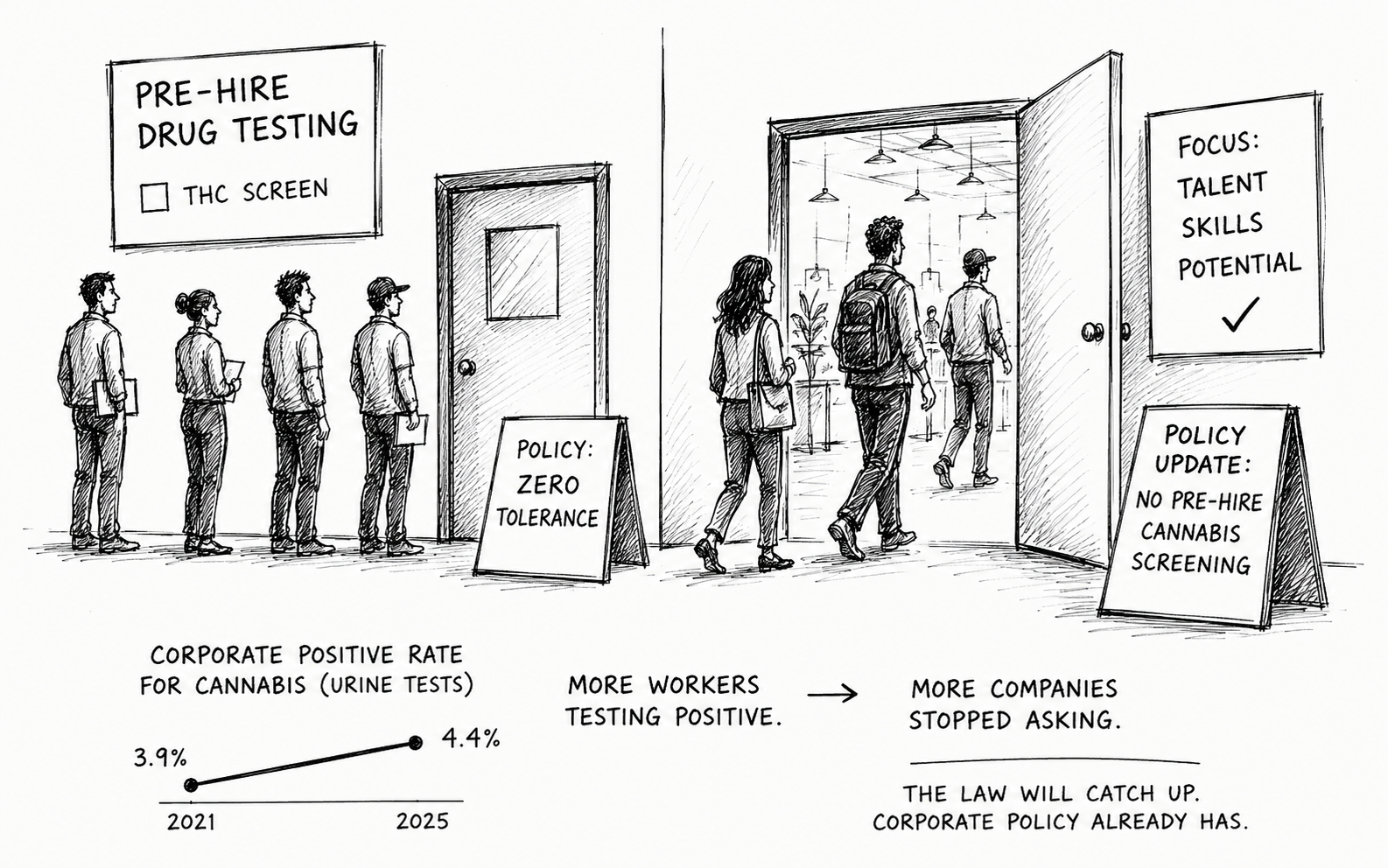
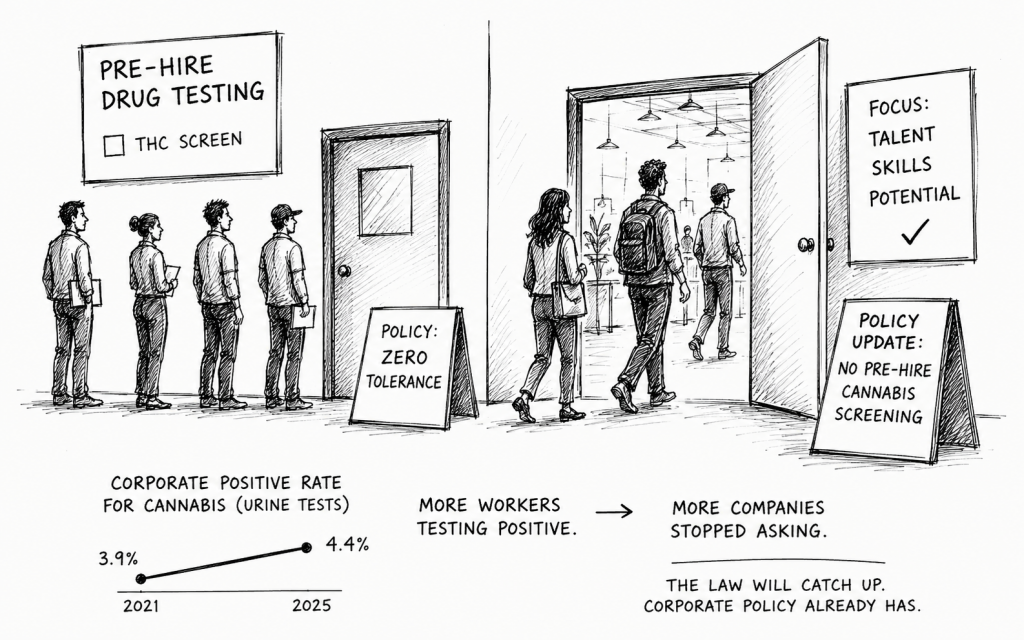
Quest Diagnostics, which processes millions of workforce drug tests annually, reported that 4.4% of corporate urine tests came back positive for cannabis last year — up from 3.9% in 2021. That modest uptick represents a real shift in who is showing up to work, and what is showing up with them. At the same time, several of the country’s largest employers — Citigroup, Home Depot, and Amazon among them — have eliminated or significantly narrowed pre-hire marijuana screening. They are not waiting for a federal mandate to change course. They are responding to something more immediate: a labor market that makes rigid drug testing policies expensive.
The federal picture has grown more complicated, though not yet resolved. In April 2026, Acting Attorney General Todd Blanche issued an order placing FDA-approved marijuana products and state-licensed medical marijuana products in Schedule III of the Controlled Substances Act — a partial reclassification that followed a December 2025 executive order directing research into medical marijuana. Broader DEA hearings on rescheduling recreational cannabis ran through mid-July. Recreational marijuana and non-licensed products remain Schedule I, meaning the legal landscape for most working adults is still split: legal in dozens of states, federally restricted, and increasingly irrelevant to what the private sector actually does.
That gap matters. When companies like Amazon drop cannabis from their pre-hire screening, they are not making a legal statement — they are making a workforce calculation. Cannabis-using applicants represent a significant share of the available talent pool, particularly in states where recreational use is legal. A company that screens them out is narrowing its own hiring funnel in a market where labor has been the constraint, not capital.
What is emerging is not a coherent national policy on cannabis and work. It is a patchwork of individual corporate decisions, driven by competition for workers, shaped by geography, and largely uncoupled from the federal status of the substance itself. Quest’s data captures the outcome: more workers are using cannabis legally under state law, more of them are landing jobs anyway, and the urinalysis that was once a standard part of onboarding is becoming, in many industries, a relic of a compliance posture that no longer serves the companies that maintained it.
The law will eventually catch up. Corporate cannabis policy already has.