Congestion Pricing Worked. The Tradeoffs Didn’t Disappear.
New York’s tolling system has reduced traffic and generated hundreds of millions for transit. It has also revealed something more uncomfortable: policies designed around averages can impose disproportionate costs on the workers least able to change how they move through the city.
Six months into New York’s congestion pricing experiment, the results are in — and they’re good.
Traffic entering Manhattan’s central business district has fallen roughly 11%. The MTA has collected over $500 million in toll revenue, providing a dedicated funding stream for infrastructure upgrades that have been deferred for decades. Commute times into Lower Manhattan have improved. Bus service has become more reliable. Early air quality monitoring shows vehicle emissions beginning to decline in the zone.
By nearly every systemwide metric, congestion pricing is doing what it promised. And that is exactly why the next conversation needs to be harder than the first one.
Who Changed Their Behavior — and Who Had No Choice
Congestion pricing works by assuming people respond to price signals. That assumption is correct. It is also incomplete.
The people most able to respond to a congestion charge are the ones with the most flexibility: office workers who can switch to the subway, tourists who can plan around transit schedules, businesses with the pricing power to absorb additional costs across thousands of transactions or pass them to customers. For these groups, congestion pricing is an inconvenience at worst — a nudge toward a behavior that was already available to them.
Then there is everyone else.
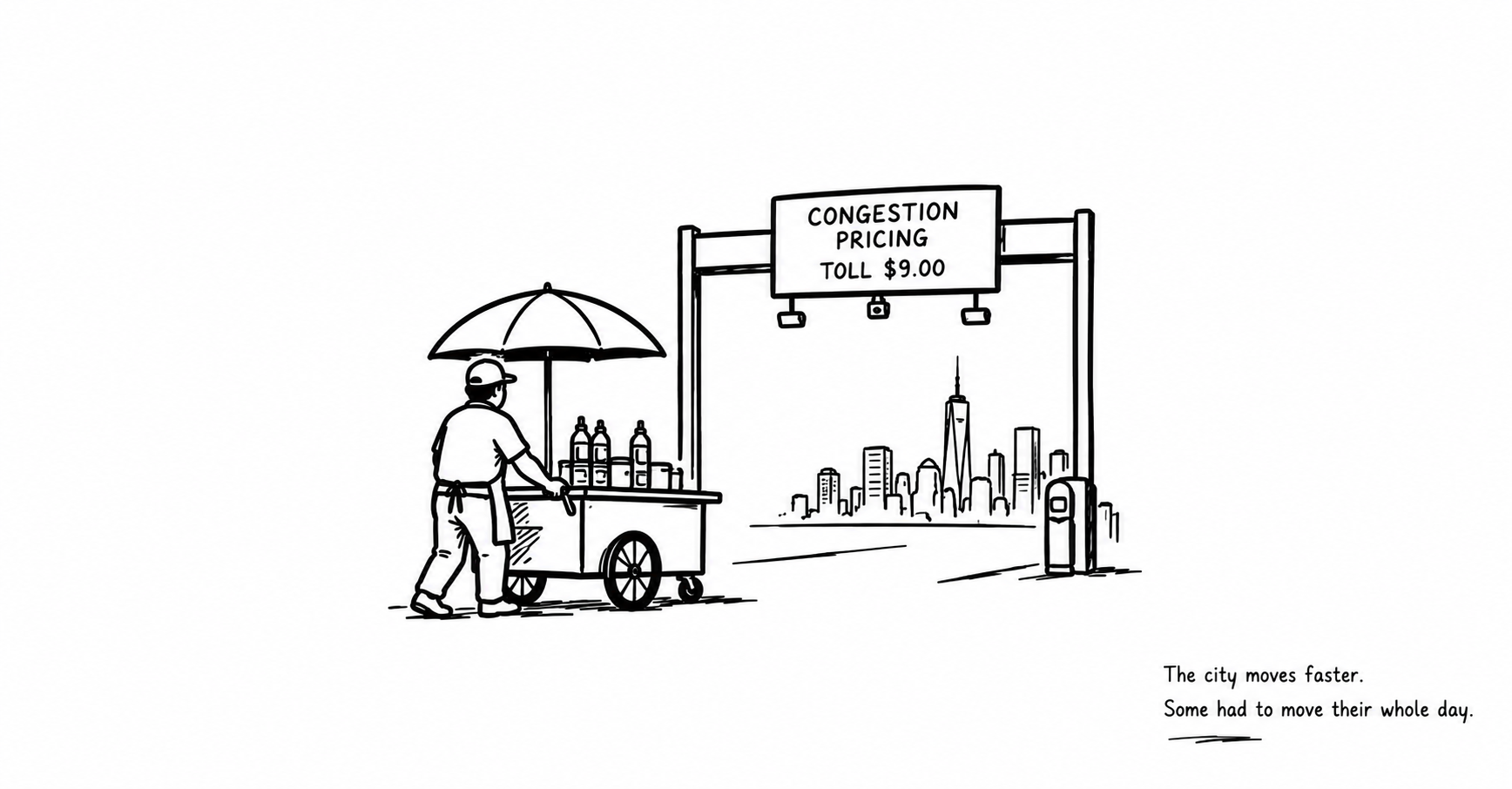
Business Insider documented in detail how independent street vendors, food-cart operators, and small business owners restructured their entire workdays to avoid congestion charges. Some now enter Manhattan before dawn to beat the tolling window. Others consolidate deliveries, reduce inventory, or simply absorb tolls that were never part of their cost model.
A street vendor transporting grills, propane tanks, and product cannot carry that business onto the subway. A home health aide traveling between multiple clients across boroughs on a fixed care schedule may have no transit option that reaches each destination on time. A florist delivering wedding arrangements, a plumber responding to calls, an electrician hauling tools and materials — none of them have the option to simply choose a different mode.
The congestion zone doesn’t distinguish between someone choosing to drive less and someone restructuring an entire livelihood around avoiding a toll. It just processes a transaction.
The Equity Problem Embedded in Price Mechanisms
This is not a new critique of market-based policy. It is the same tension that appears every time a pricing mechanism is applied to a resource that people access unequally.
In London, where congestion pricing has been in place since 2003, Transport for London built a low-income discount program into the scheme from the beginning. Stockholm’s system, introduced in 2006, includes geographic exemptions for residents on certain islands with no viable transit alternatives and has been adjusted repeatedly based on empirical evaluation of burden distribution.
New York’s implementation was more politically fraught, and the resulting design reflects that. The exemptions that exist — for people with disabilities meeting a specific income threshold, for vehicles already paying bridge and tunnel tolls entering from certain directions — were shaped as much by political negotiation as by systematic analysis of who carries the highest burden.
That means some of the workers most exposed to congestion pricing’s costs received no relief, while some exemptions went to groups whose flexibility was never in question.
The Accountability Gap
There is a deeper governance issue here that rarely surfaces in the transit-vs-drivers framing that dominated the public debate.
The people who designed and approved congestion pricing — legislators, MTA officials, transportation planners — are not, as a group, the people most affected by its costs. The policy was built by institutions with data on aggregate traffic flow, projected revenue, and systemwide transit ridership. It was not built with detailed data on the occupational profile of people who enter the congestion zone in commercial vehicles, the transit access of home health workers in outer-borough neighborhoods, or the capitalization of the independent vendors who feed the city every morning.
Policy built without that data reflects the population it does have data on. That tends to be the higher-income, higher-flexibility commuter whose transit alternatives were always viable.
The workers absorbing the steepest adjustment costs are frequently the ones least represented in the planning process.
What Success Actually Requires
None of this means congestion pricing was a mistake. Pricing scarce road space is economically rational — roads are finite public resources, and unpriced access to them subsidizes congestion in ways that harm transit riders, pedestrians, cyclists, and the urban environment. The revenue funding MTA capital investment is real money going toward real improvements that benefit riders across the system, including many of the low-income New Yorkers the equity critique is meant to protect.
But declaring congestion pricing a success at the six-month mark — because traffic is down and revenue is up — is measuring the easy half of the policy.
The harder half is distributional. Who is paying for the system twice: once in tolls they cannot avoid, and again in lost income or restructured livelihoods? What does the data actually show about which occupations carry the highest burden per dollar earned? Are current exemptions tracking economic reality, or the political economy of 2023?
A credit program targeted at small commercial operators with revenues below a defined threshold. Expanded transit frequency serving neighborhoods with documented access gaps. Annual review of exemption criteria tied to empirical burden analysis. These are not idealistic additions to the policy — they are what the policy needs to remain defensible over time.
Congestion pricing has proven that New York can use market incentives to reduce traffic. The next test is whether the city can manage those incentives without making access to the urban economy a function of who can most easily absorb — or reroute around — the cost.
That’s a harder problem. It’s also the one that determines whether this is good transportation policy or just good transportation policy for some.
Sources: MTA congestion pricing performance reports; Business Insider reporting on the impact of congestion pricing on New York City street vendors and small businesses; Transport for London scheme evaluation data; Stockholm congestion tax review, 2006–present; regional transportation data through July 2026.