The Trader Joe’s Tote Is Becoming a Global Status Symbol
Trader Joe’s released a new run of striped pastel mini tote bags on June 17, and within hours, shoppers were lining up around the block for a $2.99 grocery bag. Alice Gibbs, senior life and trends reporter for Newsweek, reported that a Las Vegas location had more than 475 people in line before 8 a.m., New Jersey shoppers began queuing at 7:30 a.m. for a 9 a.m. opening, and most stores sold out within the hour even with purchase limits capping buyers at four bags each. “It was worth the wait because it’s $2.99 each instead of paying more from the resellers,” Rachel Ghiamina, a Houston shopper, told Newsweek after her husband found the line already wrapped around the corner before the store opened. The same week, Trader Joe’s filed suit against sellers of counterfeit totes online, with company spokesperson **Nakia Rohde** telling Newsweek the chain “sells its products only in its own stores to ensure authenticity.”
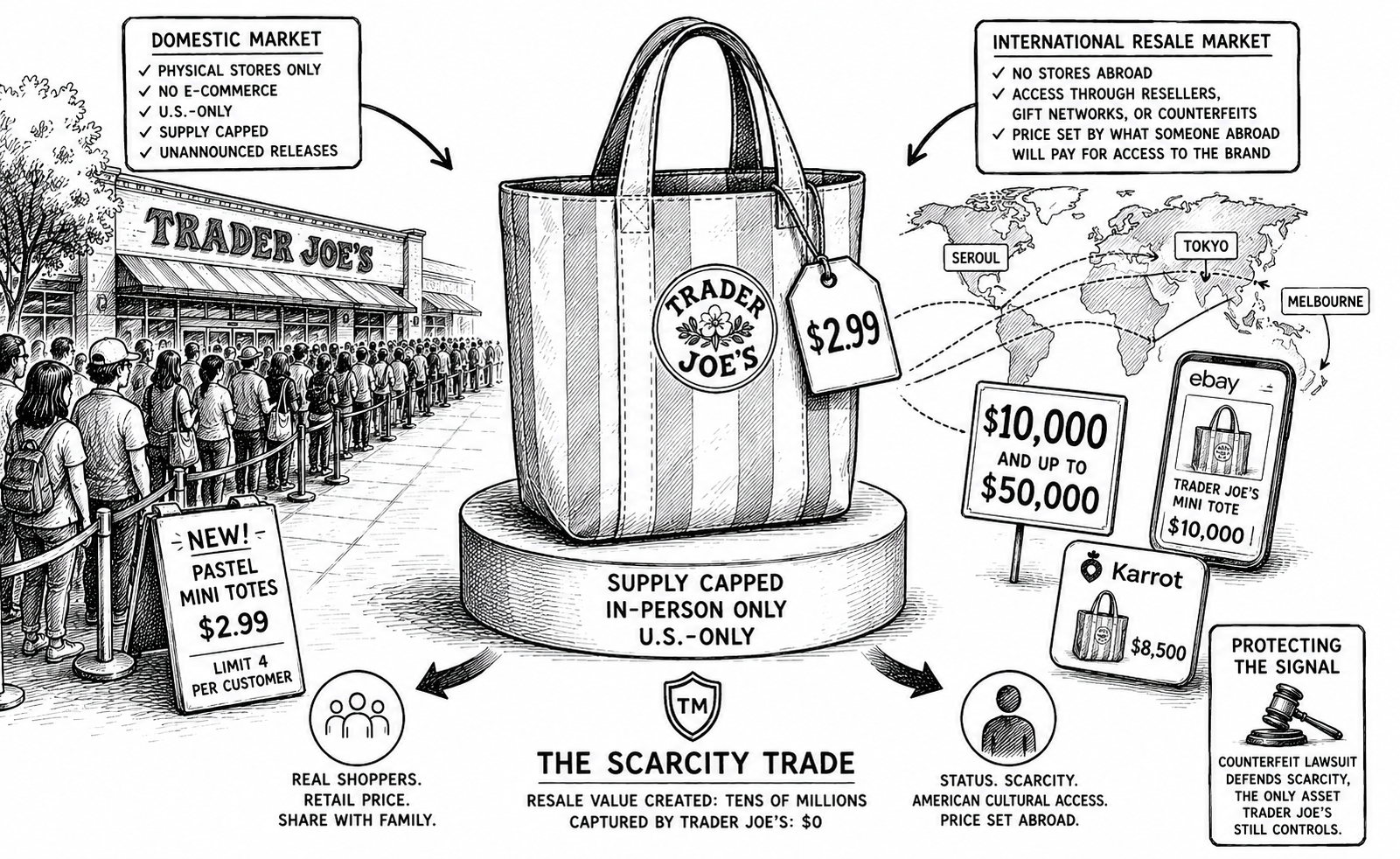
Trader Joe’s manufactures the scarcity driving these lines on purpose. The totes sell exclusively in physical stores, the chain runs no e-commerce platform and operates no locations outside the United States, and each release is capped in quantity and unannounced until it hits shelves. That combination — U.S.-only, in-person-only, supply-capped — turns a $2.99 canvas bag into the raw material for a resale market the company itself never enters. The Wall Street Journal’s Maura Brannigan reported that the bags are now carried in Seoul, Melbourne, Tokyo, and across Europe, where they resell on platforms like eBay and Korea’s Karrot market for as much as $10,000, with some listings reaching $50,000. None of that markup reaches Trader Joe’s.
Two markets built on the same scarcity now run in parallel, and they price the bag completely differently. Domestically, the totes move through ordinary retail at $2.99, with shoppers like Ghiamina buying the legal four-bag limit to share with family. Internationally, where Trader Joe’s has chosen not to operate, the only path to a tote runs through resellers, gift networks, or counterfeiters, and the price is set by whatever someone abroad will pay for proximity to the brand. USA Today Network reported that Eunice Lee, 47, and her daughter Yeriel Lee, 15, bought 24 totes at a Long Island store specifically to send to relatives in South Korea, where the chain has no stores at all. Michelle Gabriel, a lecturer at the Yale School of the Environment, told the Journal the appeal is structural, not aesthetic: “They represent a limitation. Trader Joe’s aren’t in every city and aren’t on every corner. That already imparts a scarcity that… can be used in service of status.” A bag that signals nothing in Ohio signals American cultural access in Seoul, precisely because the company decided not to sell there directly.
The counterfeit lawsuit protects that second market, not the first. Trader Joe’s doesn’t lose money when a $2.99 bag resells for $10,000 — it was never going to capture that markup either way, no matter who sells the bag next. What the company does lose, if knockoffs flood the market unchecked, is the scarcity itself, the one input behind the whole arrangement that it can’t simply restock. A cheap counterfeit sold abroad doesn’t just confuse a buyer; it deflates the exact status signal the entire resale economy depends on. Defending the trademark is how a company that gave away its margin on every legitimate resale protects the only asset it still controls: how rare the real thing is allowed to feel.
Trader Joe’s generated tens of millions of dollars in resale value this month and collected none of it. That is the trade the company has made on purpose: every viral sellout produces global brand attention a traditional ad budget couldn’t buy, while resellers and diaspora gift-givers absorb the markup and the shipping. The next version of this bag doesn’t need a bigger marketing campaign. It needs the company to keep deciding, deliberately, not to sell it where the demand actually is.