
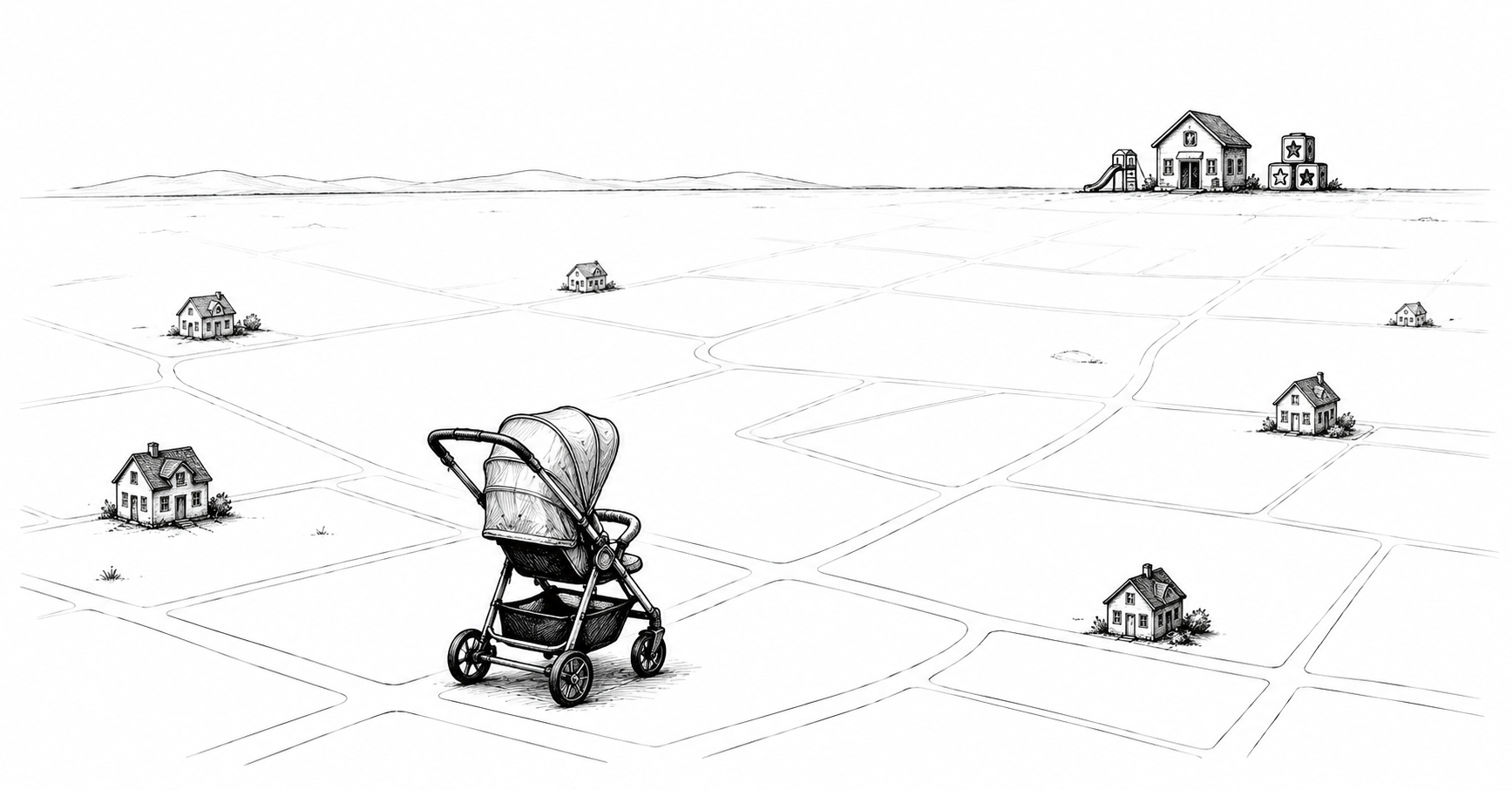
The Child Care Desert Map — Where Working Parents Run Out of Options
When child care availability is mapped against where parents actually work and live, what does the resulting gap reveal about whose labor force participation is treated as optional infrastructure versus essential?

The United States has a child care shortage. That statement is true and insufficient. A shortage implies scarcity affecting everyone equally. What actually exists is distribution: some neighborhoods have functional child care access; others have none. The distribution correlates directly with income, race, and geography in ways that determine who can afford to work and who cannot.
Mapping reveals the mechanism. Child care deserts exist where working parents need them most. Urban neighborhoods with large populations of low-income families often have fewer available slots than those neighborhoods’ demand requires. Rural areas often lack providers entirely. Suburban areas built around the assumption that one parent (historically mothers) would stay home sometimes have limited hours or availability. Meanwhile, neighborhoods with higher household incomes have more capacity, longer hours, and greater flexibility.
That distribution isn’t accidental. Child care provision is heavily dependent on subsidies, which flow unequally. Private providers locate where they can achieve profitability, which means serving customers able to pay full rates. Public subsidies are limited and often require families to jump through eligibility verification processes that themselves create barriers to access. Non-profit providers operating in low-income neighborhoods often run at thinner margins and are more vulnerable to funding cuts. The economics of child care provision systematically underserve the communities where affordability is most critical.
The structural consequence is that labor force participation becomes conditional on access to infrastructure unevenly distributed by geography and income. A parent in a low-income neighborhood with limited child care options faces real constraints on working; a parent in a well-serviced neighborhood doesn’t. When you map child care availability against labor force participation rates, the correlation is visible. Communities with child care deserts have lower rates of dual-income households and lower rates of single-parent workforce participation. That isn’t because parents in those communities don’t want to work. It’s because the infrastructure that makes working possible doesn’t exist there.
That gap has economic consequences extending far beyond individual families. A parent unable to work because child care isn’t available reduces household income, increases poverty risk, and reduces consumer spending and local tax revenue. A parent able to access child care enters the workforce, increases earnings, and expands the economic activity of their community. The difference between a child care desert and a child care-rich neighborhood is the difference between constrained economic mobility and open pathways to it.
The question that reveals the structural nature of this gap is: who is assumed to be working? In neighborhoods where child care infrastructure is robust and flexible, the assumption is that parents (especially mothers) work and therefore need accessible, affordable care. In neighborhoods where infrastructure is sparse, the implicit assumption is that someone stays home. That assumption has historically fallen most heavily on mothers, particularly low-income mothers and mothers of color. When infrastructure is designed (or left undesigned) around that assumption, it becomes a mechanism that makes workforce participation literally harder for the groups the system assumes should stay home.
Removing that barrier requires treating child care not as a private market good or a parent problem, but as public infrastructure. That’s not a new idea. It’s how education is treated. Public schools exist because there’s a consensus that child supervision and education are infrastructure, not individual purchases. Child care could be mapped the same way. Until it is, the geography of child care access will continue to determine whose participation in the labor force is possible and whose participation is constrained.