Lululemon’s Great Wall Drum Wasn’t a Knowledge Gap. It Was an Authority Gap.
The brand says it lacked the expertise to catch the mistake. The 2,000-person production chain that built the event says otherwise.

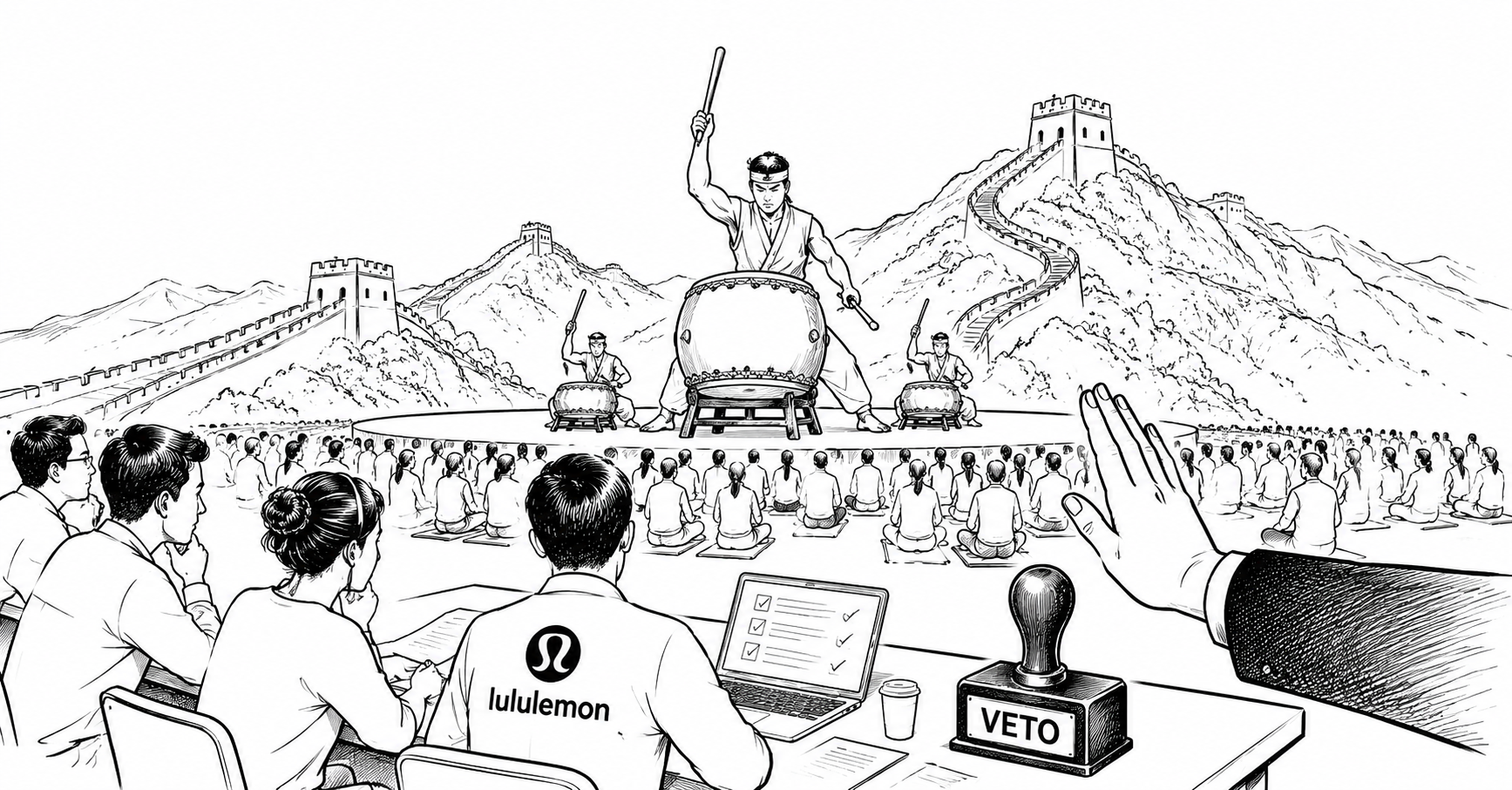
Lululemon staged a 2,000-guest yoga festival at the Huanghuacheng Water Great Wall outside Beijing on May 30, with Chinese actor Zhu Yilong performing alongside a drum troupe in front of a crowd laid out across one of the country’s most recognized national landmarks. Zhu joined the HiiKo Drum Group in what the brand promoted as a traditional Chinese drum, or Dagu, performance. Chinese percussionist Xu Yang and others identified the instrument as a Japanese Taiko drum instead — and argued the two should never be confused, particularly at a site as symbolically loaded as the Great Wall. The backlash drew in arguments tied to Japanese imperialism and wartime history, and the topic crossed 50 million views on Weibo within days. Lululemon apologized, saying that “due to limitations in our professional knowledge, we were unable to fully identify potential controversies initially.”
That explanation does not hold up against the scale of the production it’s describing. A 2,000-person activation on a national monument requires location permits, vendor contracts, a performer roster, and a timeline long enough that multiple people touched the percussion choice before it reached the wall. Zhu’s own studio publicly called on Lululemon to verify the entire process and to review, analyze, and follow up on the matter — a request that only makes sense if the failure happened somewhere inside a chain Zhu’s team assumed should have caught it. The error wasn’t that no one in Lululemon’s production process knew the difference between a Dagu and a Taiko drum. It’s that whoever did know didn’t have the standing to stop the rollout before it reached the Great Wall.
This is the same mechanism that has now hit multiple Western brands expanding into China inside a single year, even though the specific failures look different on the surface. Lemaire’s April 2026 fragrance campaign for its “Objets Senteur” collection paired a braided linen object with a long gown and a pair of scissors — imagery that read to Chinese consumers as a reference to the Qing Dynasty queue hairstyle, a hairstyle forcibly imposed on Han Chinese men and tied to a specific history of national humiliation. Lemaire apologized, acknowledging it had not sufficiently weighed how the imagery would land across different cultural contexts. In both cases, a creative decision with real cultural weight moved through a production process without anyone positioned to flag it having the authority to pull it before launch.
What that gap costs doesn’t land evenly. Lululemon absorbs a news cycle, a deleted press release, and a Weibo apology, and its broader China growth strategy continues — the company has called China its fastest-growing major market and isn’t walking that strategy back over one event. The HIIKO Drum Troupe that performed alongside Zhu also apologized, suspending all external use and promotion of the disputed drums — a smaller organization absorbing reputational cost for a sourcing decision it may not have made unilaterally. The harder cost lands on the next Western brand trying to build trust with Chinese consumers who have now watched several of these incidents accumulate inside a year, each one teaching the same lesson: brands treat cultural accuracy as a marketing input rather than a launch requirement.
The fix, if Lululemon and the brands behind it actually make one, won’t look like cultural sensitivity training. It will look like a structural change to who can stop a launch — someone with real veto authority sitting inside the approval chain before a high-visibility activation reaches a national monument, not a consultant brought in afterward to explain what went wrong.
— SSC Culture Desk | Social Storytellers Collective