Los Angeles Is Testing Whether Mega-Events Can Break Car Dependency
When transit is made direct, legible, and event-aligned, car culture starts to look less like preference than design failure.
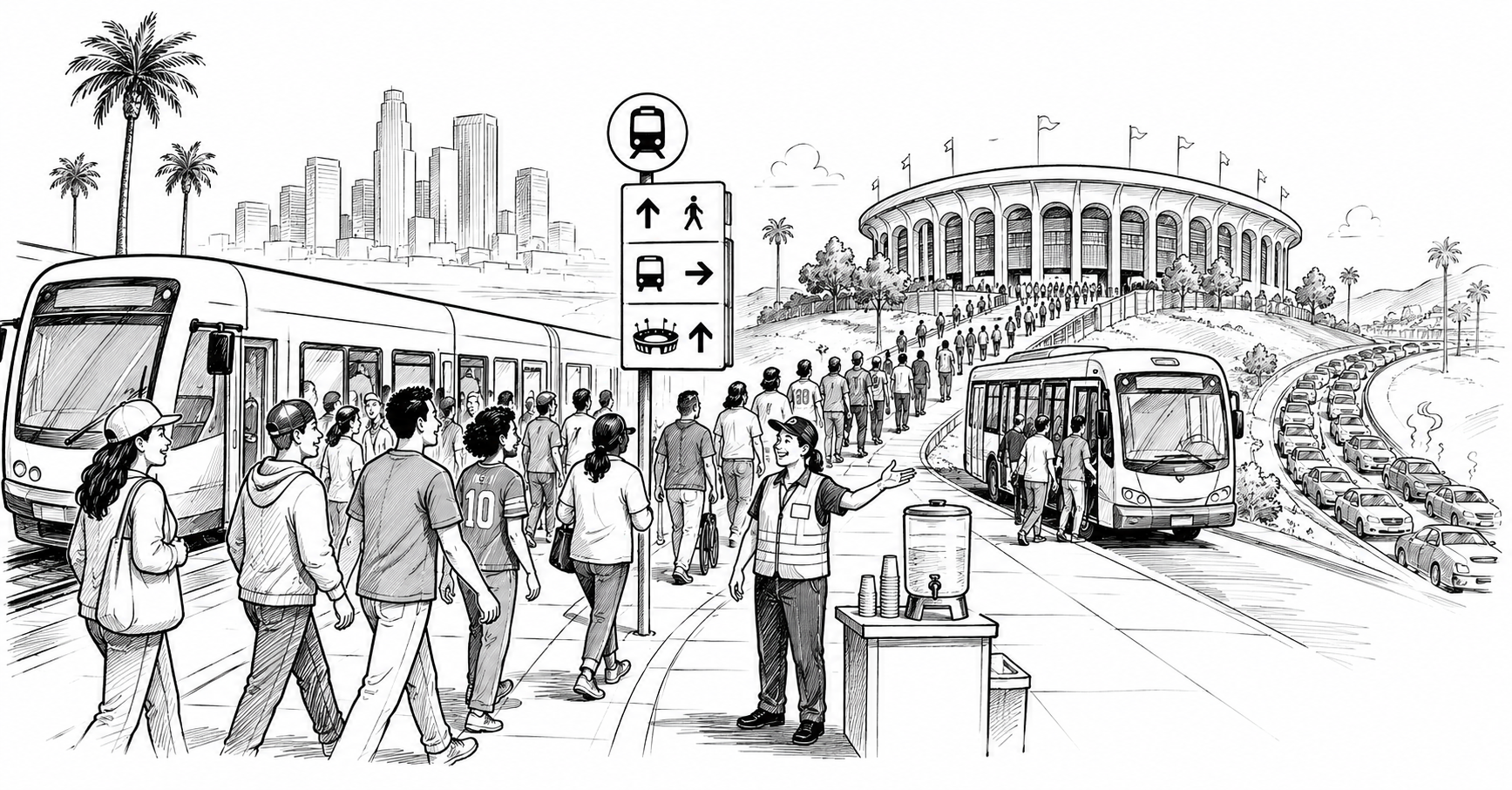
Reuters reporter Ed White reported on June 27 that World Cup fans in Los Angeles are using buses and trains at meaningful levels during the tournament, aided by $3.50 round trips, match-day buses, ambassadors, hydration centers, and connections through Union Station fan zones. More than 20,000 people used buses per match, and more than 52,000 used transit for one Switzerland-Bosnia and Herzegovina game.
Transit adoption follows design. Los Angeles has long been treated as proof that car culture is too ingrained for mass transit to compete. The World Cup is testing a different explanation: people use public systems when the trip is legible, direct, affordable, and aligned with the moment they actually need to travel. The city has not built new infrastructure for the tournament. It has operated the existing infrastructure with more intention, and the ridership numbers show what that difference produces.
LA Metro lowered the friction through match-day routing, simple pricing, visible ambassadors, hydration stops, and fan-zone connections at Union Station. Those details are not amenities. They are design decisions that remove the small uncertainties that usually push people back into cars. Riders are not choosing between a train and a vehicle in the abstract. They are choosing between a trip that feels organized and a trip that does not.
Mega-events force a kind of civic urgency that ordinary riders almost never receive. Visitors need to find stadiums. Police, transit agencies, event organizers, and city officials need a system that works on schedule in front of a global audience. That pressure produces a different operating posture — more staff, clearer signage, faster service, better real-time information. The World Cup is not proving that LA’s transit system is good. It is proving that LA’s transit system can be operated better than it usually is.
That gap is the accountability problem. If the system becomes usable when the city decides to make it usable, low ridership during ordinary time cannot be explained entirely by car preference. Design, frequency, reliability, transfer ease, and the feeling of safety on a platform determine behavior. A system that is confusing and inconsistent produces car dependency and then treats that dependency as cultural inevitability.
The power distribution matters too. In the normal Los Angeles model, access favors people with cars, time, and money for parking. During the World Cup intervention, some of that advantage shifts toward riders who can reach the event through a subsidized, organized public system. That is a small movement, but it is legible. International fans from cities with functional transit are using the system comfortably. Los Angeles residents who depend on it daily experience something closer to the city’s ordinary version.
The test after the tournament will be whether LA Metro keeps any of the design posture alive when the riders are workers, students, patients, and families rather than World Cup visitors. If Los Angeles can run transit well enough for a global sporting event, the argument that it cannot do the same for daily life has less ground to stand on.