Los Angeles County Runs Three Separate Departments to Serve the Same Unhoused Resident. The Resident Has to Navigate All Three.
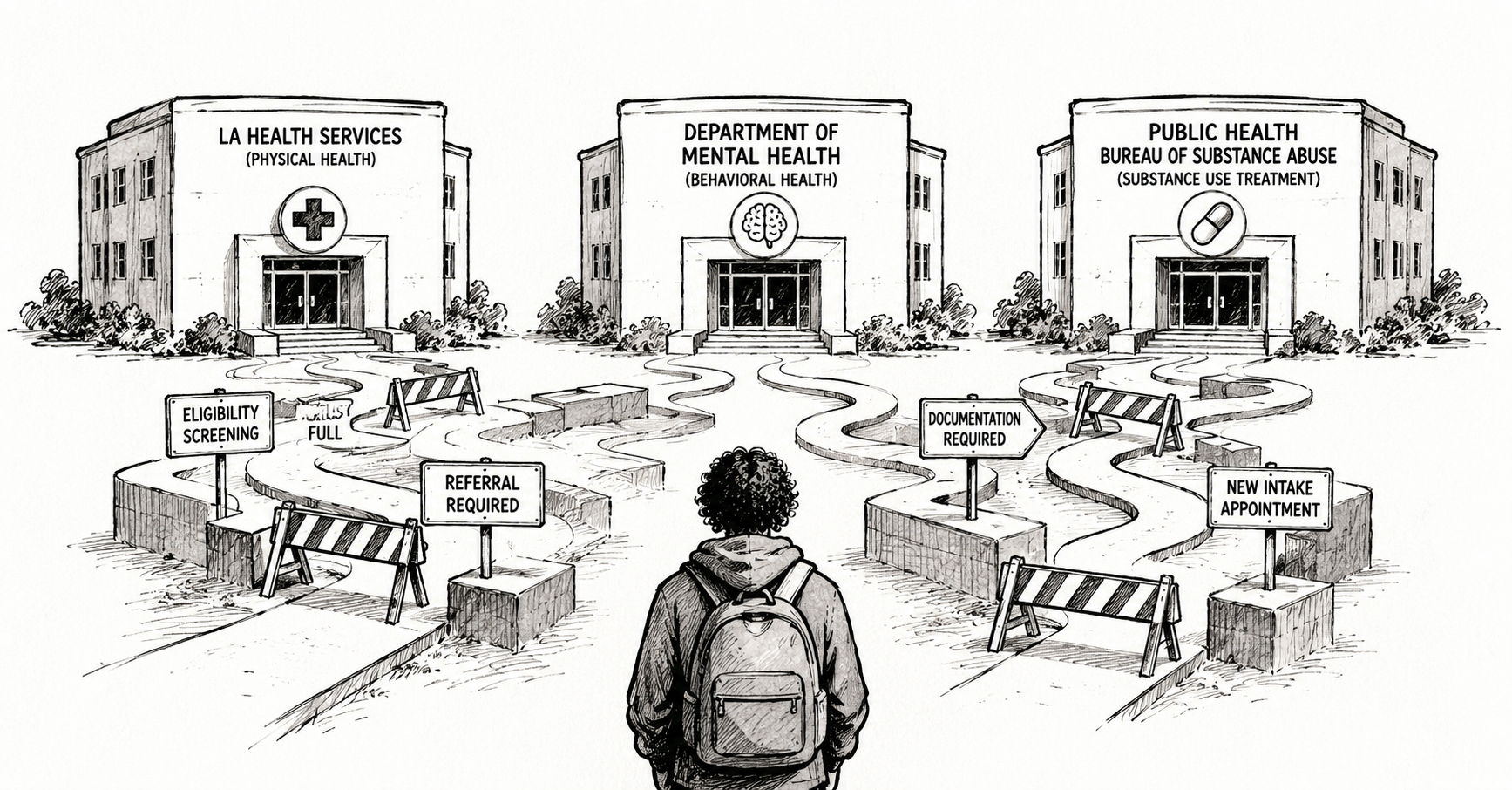
Los Angeles County operates three separate departments responsible for health services to its most vulnerable residents: LA Health Services (physical health and acute care), the Department of Mental Health (specialty behavioral health services), and Public Health’s Bureau of Substance Abuse (substance use treatment and recovery). A 2026 regional market report published by the California Health Care Foundation documents how these three systems, each with its own eligibility criteria, referral processes, and administrative infrastructure, function in parallel rather than as an integrated safety net. For unhoused residents who need all three — the population with co-occurring physical illness, mental health conditions, and substance use disorders — navigating across departmental boundaries is not a minor inconvenience. It is the primary access barrier.
The mechanism is institutional design that predates the populations it now primarily serves. Each of the three departments was built to address a specific category of need within a public health framework that treated physical health, mental health, and substance use as distinct problems requiring distinct administrative responses. That framework made bureaucratic sense in an era when the populations experiencing each need were more segregated. The unhoused population that LA County’s safety net now serves at scale is disproportionately experiencing all three simultaneously — and the three-department architecture has not been restructured to match.
The cost of this fragmentation falls most heavily on the people with the fewest resources to manage it. Navigating three agencies requires knowing that three agencies exist, understanding what each covers and does not cover, submitting to separate eligibility determinations, and managing referrals that cross departmental lines without guaranteed continuity. A housed person with a case manager and stable transportation can manage these requirements. An unhoused person managing acute symptoms in a city where shelter availability is constrained is in a structurally different position. The architecture assumes a level of administrative capacity that the population it is designed to serve is least likely to have.
LA County is not underinvesting in safety net services in absolute terms. The combined budgets of the three departments represent billions in annual public health spending. The problem is not the level of investment — it is the structure through which that investment is deployed. Siloed agencies produce siloed outcomes: a person who enters the system through LA Health Services for a physical health crisis may be referred to the Department of Mental Health, which has its own intake queue, eligibility determination, and waitlist. If substance use treatment is also needed, a third referral follows. At each transition, there is a gap — and in gaps, people lose track of the system, or the system loses track of them.
The CHCF report identifies this fragmentation as a structural feature of LA’s healthcare market, not a temporary gap that coordination efforts can patch around the edges. Structural integration — combining the administrative infrastructure of the three departments, unifying eligibility determination, and building referral continuity directly into service delivery — would require political will and legislative authority that the current structure does not produce incentives for. Each department has its own budget, its own leadership, and its own constituency. Integration threatens all three.
The people LA County’s health safety net was designed to serve will continue to pay the coordination cost until the system is redesigned around their needs rather than the administrative convenience of the agencies serving them.