Paris Pride Was Moved Because Climate Now Controls Civic Life
Extreme heat is becoming a gatekeeper for public assembly, cultural visibility, and city planning.
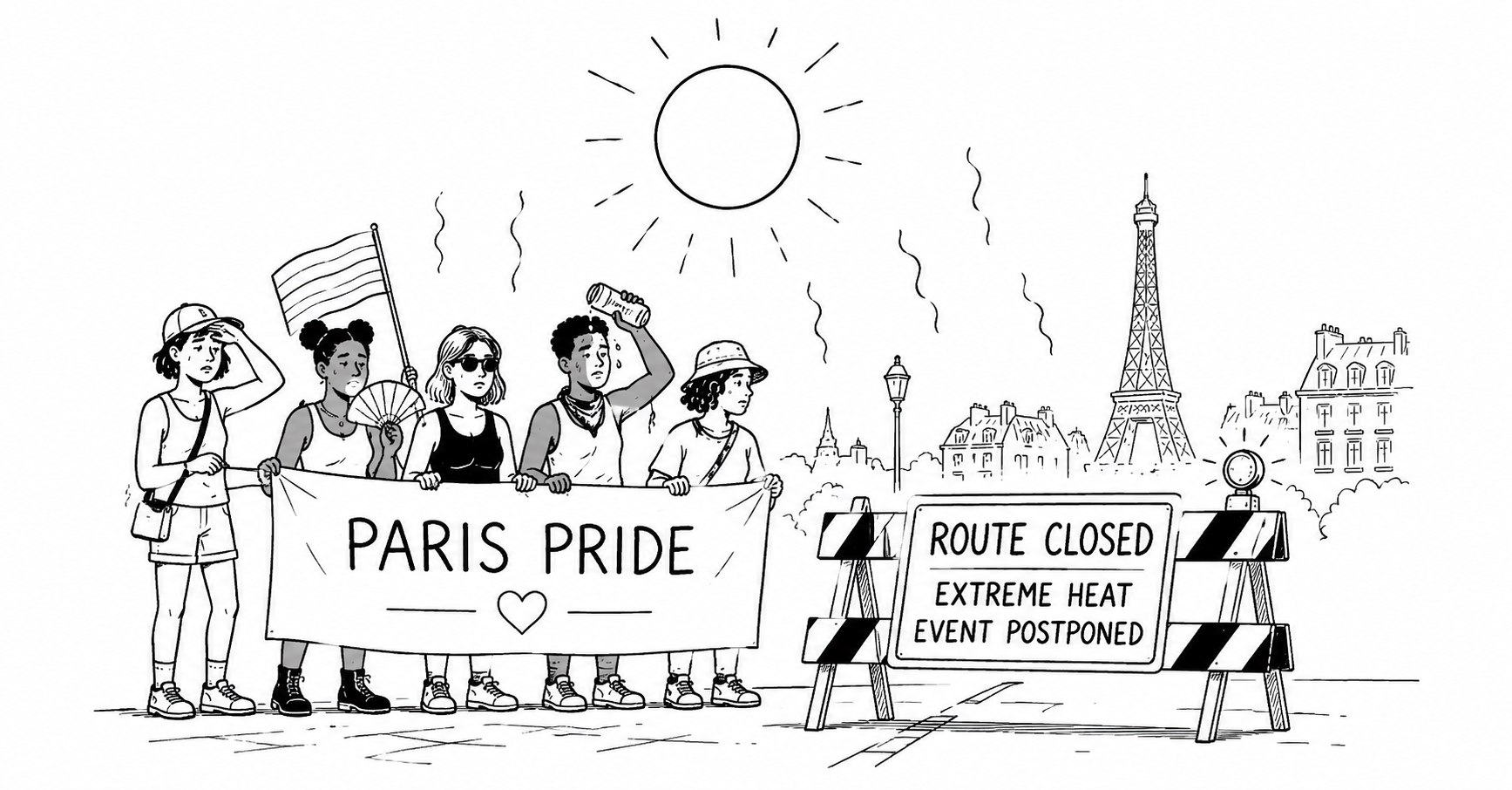
Hugo Lhomedet and Nicolas Delame reported for Reuters that organizers moved the Paris Pride March to September after police ordered Saturday’s event canceled because a heatwave had stretched emergency services and hospitals in the French capital. The march normally draws tens of thousands of people, and police issued the same order to the Solidays music festival and an athletics meeting at Stade Charlety.
Public assembly depends on public capacity. A city can protect the right to gather in law, but gatherings still require ambulances, hospitals, transit, shade, water access, crowd control, and emergency planning. When extreme heat pushes those systems toward saturation, climate becomes a regulator of civic life. The state does not have to debate the meaning of Pride to control whether Pride can occupy the street.
That is the structural shift Paris exposed. Cultural visibility has always depended on access to space, but the risk calculation around space is changing. A march that once required permits, policing, and route planning now also requires heat planning. A festival becomes a medical-capacity problem. A stadium event becomes part of the same emergency grid as dehydration calls, heatstroke, and hospital crowding.
The decision also creates an uneven burden across public life. Some events can move indoors, absorb losses, reschedule, or buy private cooling capacity. Mass civic gatherings do not always have that flexibility. Pride is not simply entertainment on a calendar. It is a recurring public claim by communities whose visibility has historically required occupying streets, not just publishing statements.
The Paris order shows how climate adaptation can narrow democratic space without announcing itself as political restriction. The stated mechanism is safety, and the risk is real. Extreme heat can kill, and public officials have an obligation to limit preventable harm. But when climate disruption becomes routine, safety decisions will increasingly decide which communities gather, which traditions move, and which civic rituals survive in their original form.
The timing matters because June has become part of Pride’s public grammar in many cities. Moving an event to September may preserve the march, but it changes its relationship to the month, the audience, the tourism cycle, and the symbolic calendar that communities have built around visibility. Climate does not need to erase a tradition to alter it. It only needs to make the traditional date harder to defend.
That creates a new planning burden for communities already accustomed to negotiating for public space. Organizers must now anticipate not only political opposition, security costs, and permitting rules, but also the possibility that the climate itself will make the approved plan unusable. The groups with the least money will face the hardest adaptation problem. Climate capacity will become another measure of institutional strength, separating organizations that can redesign an event from those that simply lose the date.
Power moves from organizers and participants to emergency managers, police authorities, and infrastructure systems strained by heat. That does not mean the decision was illegitimate. It means the terms of public life are being rewritten by weather that cities did not fully prepare for. The right to gather is becoming inseparable from the capacity to keep people alive while they gather.
The next phase will force cities to treat public assembly as climate infrastructure. Shade routes, cooling stations, water access, medical surge plans, and heat-adjusted permitting will determine whether major events remain possible during summer months. If those systems are not built, climate will not only change the weather around civic life. It will quietly decide who gets to be visible, when, and under what conditions.