Baltimore’s Population Loss Accelerates as Vacancy and Disinvestment Compound Structural Housing Inequality
When a major city loses population while investing billions in waterfront development, who is the city being built for?
Baltimore has lost 5.7% of its population since the 2020 census, a contraction that tracks alongside Philadelphia’s growth of 5.1% and New York’s growth of 7.7%. The loss is not because Baltimore stopped existing or because the region stopped expanding. It’s because the city that people are leaving is not the city the city is building.
The mechanism is visible in the geography. Baltimore has committed roughly $3 billion to waterfront redevelopment across 230 acres of formerly industrial harbor space. Simultaneously, the city carries roughly 12,000 vacant homes and 21,000 vacant lots in neighborhoods away from the waterfront. Both conditions exist in the same city at the same time. The $3 billion is flowing to one geography; the disinvestment is concentrated in another.
Waterfront redevelopment attracts new capital investment, which attracts affluent residents and commercial activity. The return on that investment is immediate and measurable. Reinvesting in neighborhoods with high vacancy rates and concentrated poverty requires sustained capital and long-term patience for returns that may never materialize at the same scale. Investors and developers (including the city itself allocating tax revenue) therefore concentrate capital where it produces visible, profitable returns.
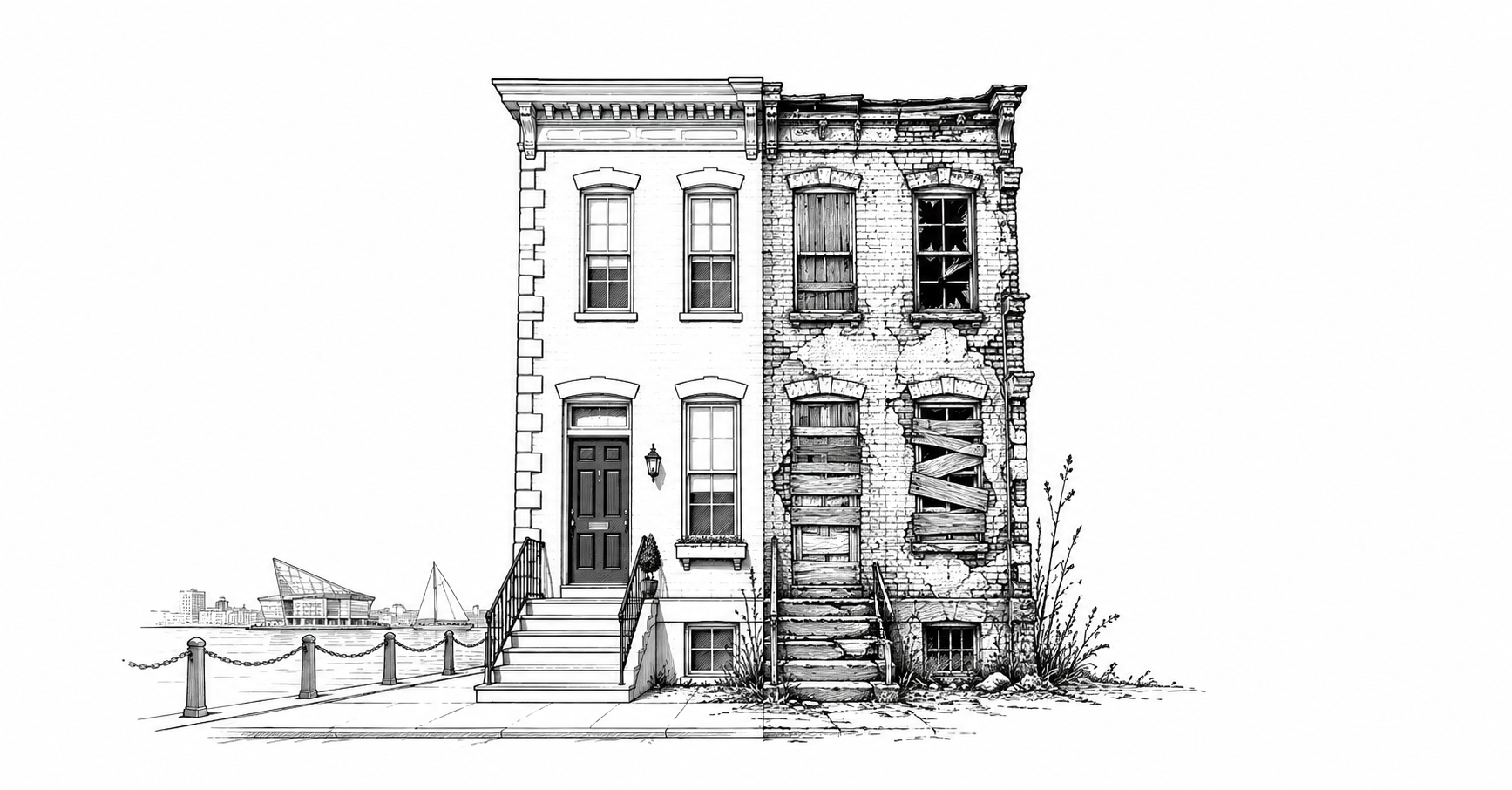
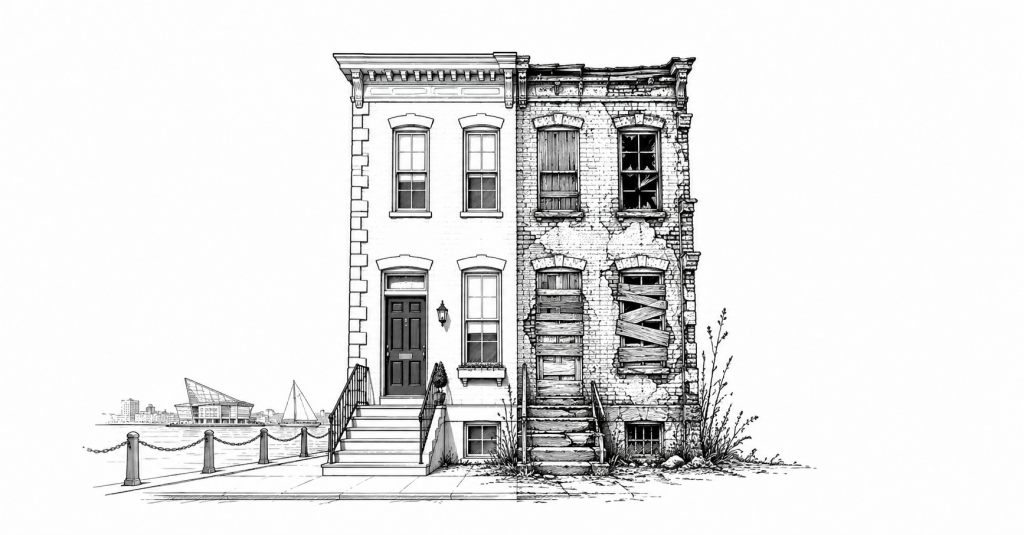
The consequence is spatial. The city becomes two cities. One city, centered on the waterfront and the urban core, is being actively built for with significant capital and attention. That city attracts new residents, generates tax revenue, and produces the kinds of development stories that attract further investment. The other city, in neighborhoods away from the waterfront, experiences disinvestment, population loss, and the visible deterioration of the housing stock. That city’s deterioration attracts less investment, which accelerates population loss.
When people leave Baltimore, they’re not leaving the region. Many are moving to Baltimore County or to nearby cities. The region as a whole may be growing even as the city proper shrinks. That means the population loss in Baltimore is not demographic; it’s geographic redistribution driven by housing market dynamics. People are moving out of the city and into the suburbs, leaving the housing stock behind. When housing stock is left behind because people cannot afford it (relative to what’s available elsewhere) or because the neighborhood is not safe or doesn’t have the services they want, that emptiness tells a story about market sorting and the production of what neighborhoods are valuable.
The structural tension is that Baltimore’s waterfront development is not failing at being waterfront development. It’s succeeding. The question is what success means. Successful waterfront development concentrates capital in visible, high-return areas. That success is inseparable from the spatial concentration that leaves other parts of the city with fewer resources. It’s not that the city could be investing in both the waterfront and the neighborhoods simultaneously. It’s that the investment decisions being made are systematically directing capital toward the waterfront and away from high-vacancy neighborhoods.
That decision will have long-term consequences. A neighborhood losing population and investment loses human capital, institutional stability, and tax base simultaneously. Disinvestment compounds. As neighborhoods deteriorate, property values decline, people leave, services disappear, safety concerns grow, and fewer people choose to stay or move in. The waterfront, meanwhile, becomes more valuable, attracts more capital, and becomes less accessible to the people leaving the neighborhoods. The city physically reorganizes itself around capital concentration.
What’s worth tracking is whether Baltimore’s pattern accelerates or reverses. Cities that continue losing population to suburbs can reach tipping points where disinvestment becomes self-sustaining. But some cities manage to arrest that decline by deliberately redirecting investment toward high-vacancy neighborhoods and treating that reinvestment as infrastructure, not profit-center opportunity. That requires different capital sources and different return expectations. It requires treating population retention as success, not just waterfront development. Until that reframing happens, Baltimore’s population loss will continue to track alongside its capital concentration on the waterfront.