Charlotte’s Parking Fight Is Really a Housing Cost Fight
North Carolina’s push to end parking mandates exposes how car storage gets priced into rent.
Alexandria Sands reported for Axios Charlotte that North Carolina lawmakers are close to passing House Bill 162, which would eliminate off-street parking minimums for developers statewide. The state Senate passed the bill 44 to 1, sending back to the House a measure that would prevent local governments from requiring developers to build a fixed number of parking spaces for new projects.
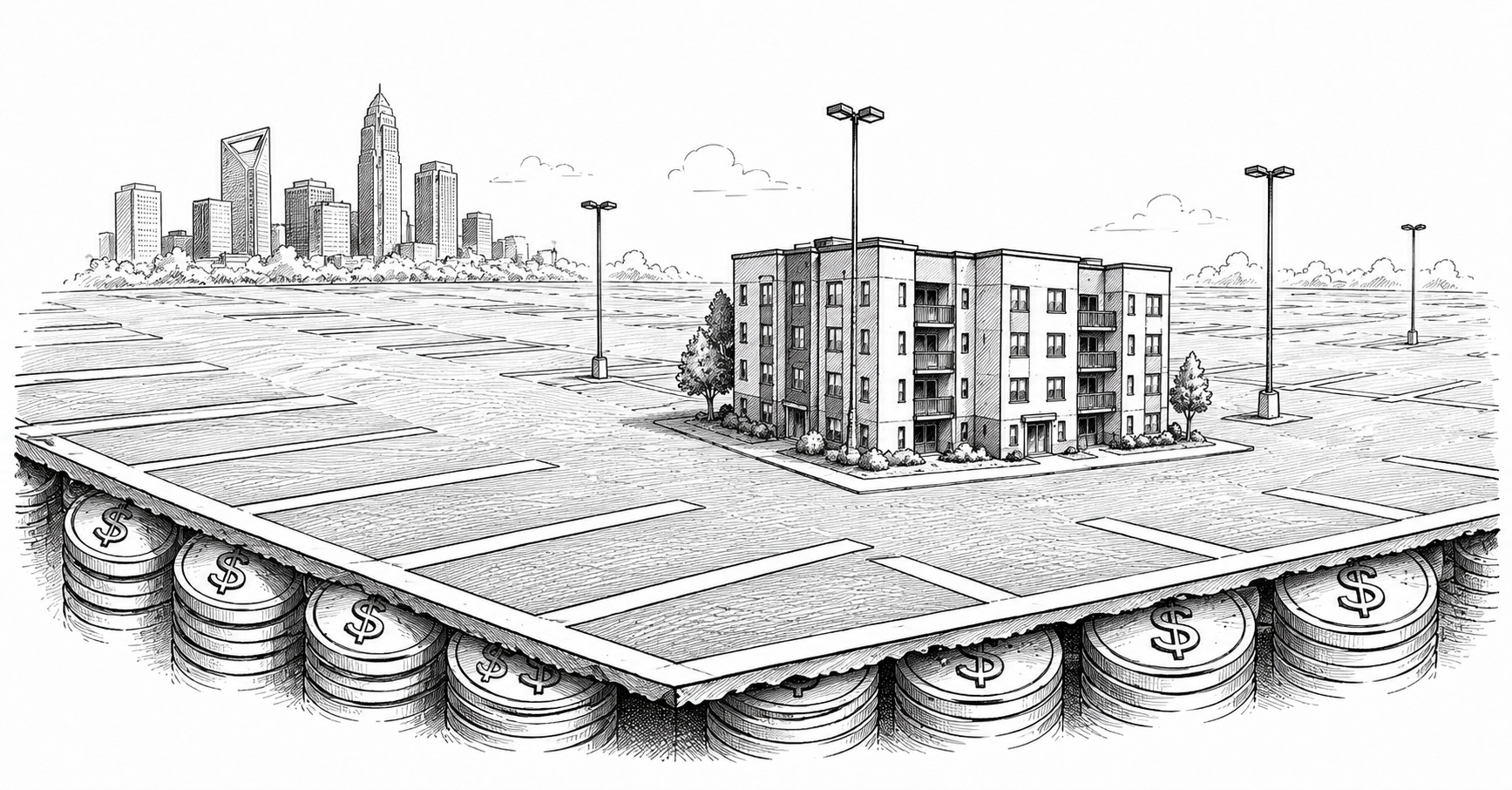
Parking rules decide who pays for land before a building ever opens. A city can say it is regulating cars, but the cost lands inside rent, construction financing, business formation, and stormwater systems. When a local government requires parking, it also requires land to be paved, capital to be spent, and every tenant or customer to help cover the cost whether they own a car or not.
The Charlotte debate shows why land-use policy often hides inside ordinary consumer prices. Sands reported that parking spaces can cost $5,000 to $50,000 each, and those costs are often passed on through higher rent or other prices. A small apartment building with unnecessary parking does not merely have extra asphalt. It has a higher financial threshold for construction, a larger debt load, and fewer ways to make units affordable.
Supporters of the bill are not only developers. Axios reported that the parking reform coalition includes environmentalists, farmers, and business leaders, with groups arguing that excessive paving worsens runoff. Ryan Carter, policy director for Catawba Riverkeeper, told Axios that impervious surfaces like parking lots are a leading cause of water pollution in North Carolina. The group says one inch of rain on an acre of pavement produces 27,000 gallons of runoff.
The opposition is also real. Charlotte leaders who resisted ending parking minimums argued that the city is not yet transit-ready and that residents would still drive, pushing cars into surrounding neighborhoods. That concern names the central contradiction: cities want less car dependence, but many residents still live in systems where driving is the only practical way to work, school, groceries, and child care. Removing a parking mandate does not create a bus route. It removes a construction rule before the mobility system has fully changed.
That is why the state intervention matters. Local governments often defend parking rules as neighborhood protection, but those rules can also freeze outdated assumptions into every new project. The state is saying local scarcity politics should not automatically control housing production. That moves the fight from zoning meetings to a broader argument about affordability, infrastructure, and whether local control can be used to preserve expensive defaults. The political fight is partly about who gets to define a reasonable project before the market ever sees it.
The state bill would move power from local governments that mandate parking to developers and property owners who decide how much parking a project actually needs. That does not guarantee affordability by itself. It does remove one automatic cost driver from every project. The policy shift says storage for private vehicles should not be treated as a universal housing requirement. That alone changes the starting math for smaller projects, infill construction, and buildings aimed at people who need housing more than bundled parking.
If the House concurs and the measure reaches Gov. Josh Stein’s desk, the law would take effect on Jan. 1, 2027. The next fight will be over whether cities pair the change with transit, sidewalks, stormwater investment, and neighborhood protections. Parking reform can lower one barrier to building, but the housing system will still reveal who has enough power to turn regulatory savings into lower costs instead of larger margins.