Cursor launches mobile app for managing coding agents on the go
Software work is moving from sitting inside the editor to managing agents wherever the worker is.
SOURCING NOTE BEFORE PUBLISHING: The assigned peg states Cursor launched a mobile app for managing coding agents on the go. This could not be independently verified from a named public source during this pass. The structural argument below draws on confirmed reporting that Cursor has been moving toward agentic coding workflows and that AI-generated code is increasingly reaching production with reduced manual review. The mobile-app launch itself needs source verification before this piece publishes.
Wired reported earlier this year that Cursor launched a new AI agent experience designed to compete with Claude Code and OpenAI Codex, allowing developers to delegate broader coding tasks to software agents rather than receive only line-by-line assistance. Business Insider later reported that AI-generated code changes are increasingly reaching production without human review, citing Cursor data showing rising confidence in autonomous code contributions.
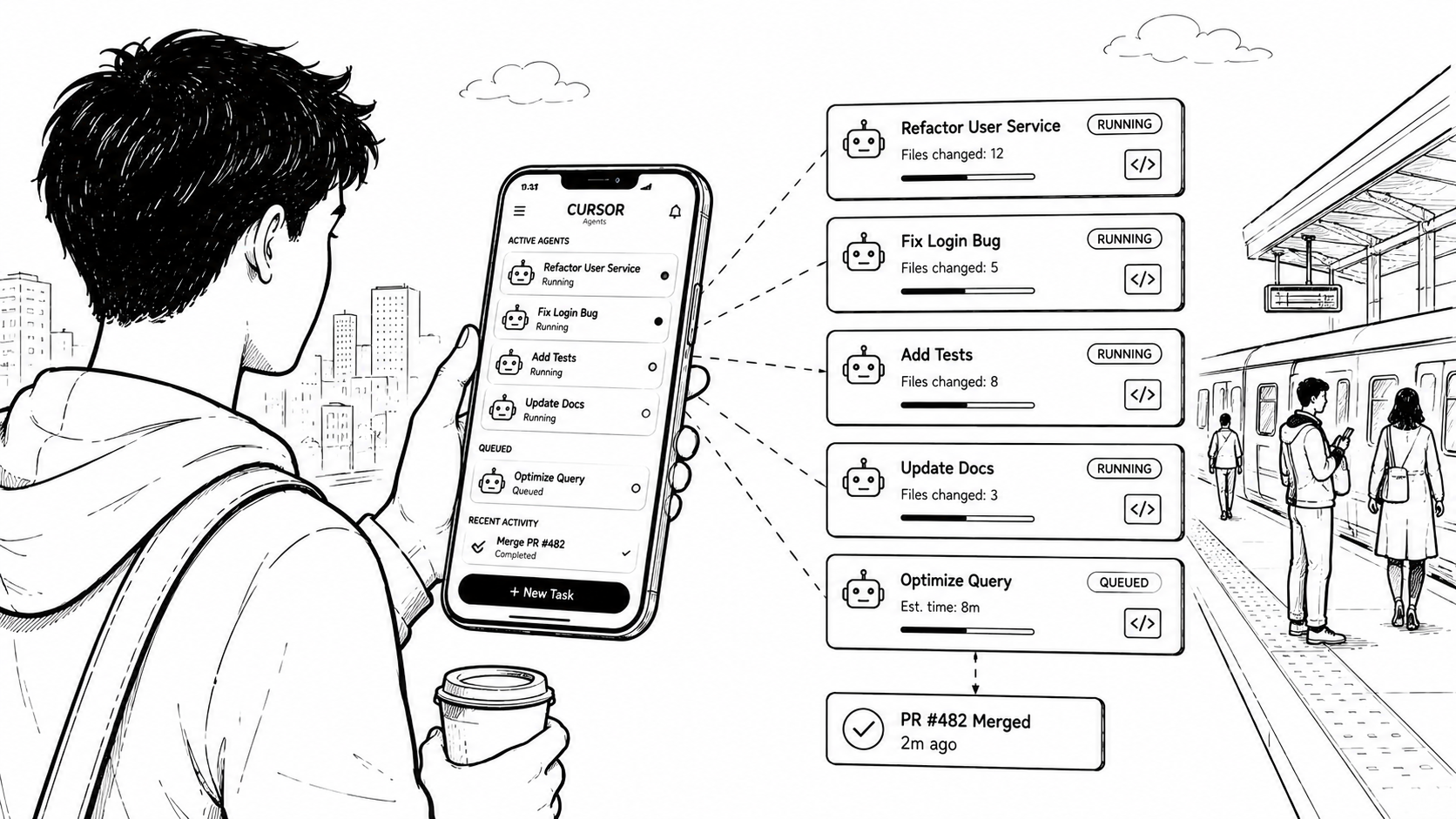
A mobile agent-management product would push that shift into a different labor pattern. Coding has traditionally been tied to the workstation — the editor, the terminal, the local environment, the pull request, the review queue. Agentic coding breaks that rhythm. The developer becomes less a person continuously writing code and more a supervisor assigning, checking, redirecting, and approving work performed by software systems.
The phone matters because it changes when supervision happens. A developer who can monitor coding agents from a mobile device is no longer fully away from the production system. The agent keeps working while the human commutes, sits between meetings, or stays outside the office. That gives companies more throughput. It also stretches the boundary of work into more fragments of the day.
The incentive is clear on both sides. Software companies want faster execution without expanding headcount at the same rate. Developers want agents that can handle routine tickets, refactors, tests, and documentation updates without constant handholding. A mobile control layer turns coding work into a queue of decisions: approve this, rerun that, inspect the diff, send the agent back, merge the safe change.
That creates a new kind of professional skill. The valuable worker is not only the person who writes clean code. It is the person who can judge machine-produced work quickly, know when the agent is drifting, and decide which tasks are safe to delegate. Judgment becomes the scarce labor. Typing becomes less central.
The risk is accountability compression. If code moves faster and review moves onto smaller screens, fewer people may understand the full context of what is being shipped. Teams could gain speed while weakening the slower human processes that catch architectural mistakes, security vulnerabilities, and product decisions disguised as implementation details.
Power moved from the individual developer at the keyboard to the company operating the agent-management layer. Cursor’s advantage is not only code generation. It is workflow control. The next coding-tool fight will be about who owns the place where software work gets assigned, monitored, and approved. Once that layer moves beyond the desktop, software production looks less like a session and more like a managed shift that never fully stops.