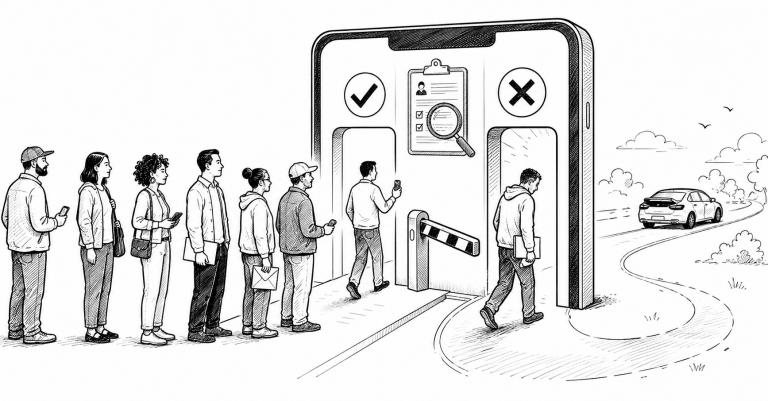

AI Inequality Is Becoming a Sovereignty Problem
Access to AI is not the same as control over it. The gap between those two things is where the next global divide is forming.
High-income countries owned 77% of the world’s colocation data center capacity as of June 2025, according to a recent analysis published by The Economy. Lower-middle-income countries owned 5%. Low-income countries owned less than 0.1%. High-income countries also hold 97% of the capacity inside the world’s top 500 high-performance computing installations. Africa accounts for less than 1% of global data center capacity despite holding 18% of the world’s population, per the Center for Strategic and International Studies. India generates roughly one-fifth of the world’s data but holds only about 3% of global data center capacity.
Those numbers describe more than a technology gap. They describe who gets to own the physical infrastructure that determines whose data gets processed where, under whose laws, and for whose benefit.
The conventional AI-divide story is about access: does a country’s population have phones, internet connections, and apps that put AI tools in their hands. That version of the divide is closing quickly, in part because major AI companies are offering free or subsidized access to premium tools across the Global South, using those markets as testing grounds for products built elsewhere. But access without infrastructure creates a specific kind of dependency. A country whose citizens use AI tools built on foreign compute, foreign data centers, and foreign energy grids does not control what those systems do with the data those citizens generate. The data flows out. The value accrues elsewhere. The country becomes a customer of a system it cannot audit, regulate, or replicate.
That is the sovereignty problem underneath the access problem. Olubayo Adekanmbi, founder and CEO of the AI company EqualyzAI, put it bluntly in an interview with Rest of World about the emerging push toward orbital data centers: “If you don’t have launch equity, you’re just renting intelligence.” His point extends past satellites. A nation can have AI running inside its borders, shaping its economy, education system, and public services, without holding any of the leverage that comes from owning the compute, the energy generation, or the data pipelines that make the system run.
Energy is the constraint that turns this from an abstract governance question into a physical one. Training a frontier-scale AI model can consume thousands of megawatt-hours, a load most fragile power grids cannot support. A country doesn’t need to lack ambition or talent to be locked out of building sovereign AI capacity. It can lack the electricity. That is why the countries moving fastest on sovereign AI, Saudi Arabia’s Public Investment Fund alone has committed more than $40 billion, are pairing compute investment directly with energy and connectivity infrastructure, not treating AI as a software problem layered on top of whatever grid already exists.
Some Global South governments are building a different kind of foundation. India and Brazil have spent years developing digital public infrastructure, national identity systems and real-time payment networks, that now function as the base layer for their own AI sovereignty efforts, giving them public datasets and governance mechanisms that don’t depend on a foreign cloud provider. South Africa’s Centre for High Performance Computing pools regional demand across the Southern African Development Community rather than each country trying to build isolated capacity it can’t individually afford. These are not full solutions to the compute gap, but they represent an attempt to build leverage inside a system that otherwise treats non-owners as pure consumers.
The emerging frontier, orbital data centers, illustrates how quickly the sovereignty question can outrun the infrastructure gap it’s supposed to solve. Space-based compute is being pitched as a leapfrog opportunity for countries that can’t build terrestrial data centers fast enough to meet demand. But moving compute into orbit doesn’t resolve who owns it. If citizen data is processed in a satellite, sovereignty becomes genuinely ambiguous: does it belong to the country the data came from, the country that launched the satellite, or the company operating it? Absent new multilateral frameworks, researchers warn, orbital compute risks becoming an extension of the same terrestrial monopolies, just relocated somewhere even harder to regulate.
The policy conversation happening at forums like the UN’s AI for Good Global Commission, launched July 1 to bring technology executives and Global South leaders into the same governance structure, is an acknowledgment that access alone was never going to close this gap. The real fight is over who owns the physical layer: the chips, the data centers, the power plants, the undersea cables. Countries that win that fight get to set terms. Countries that don’t get to use the tools someone else built, on someone else’s infrastructure, generating value someone else captures. That is not a technology gap closing. It’s a new form of dependency opening, one measured in gigawatts and colocation contracts rather than devices per capita.