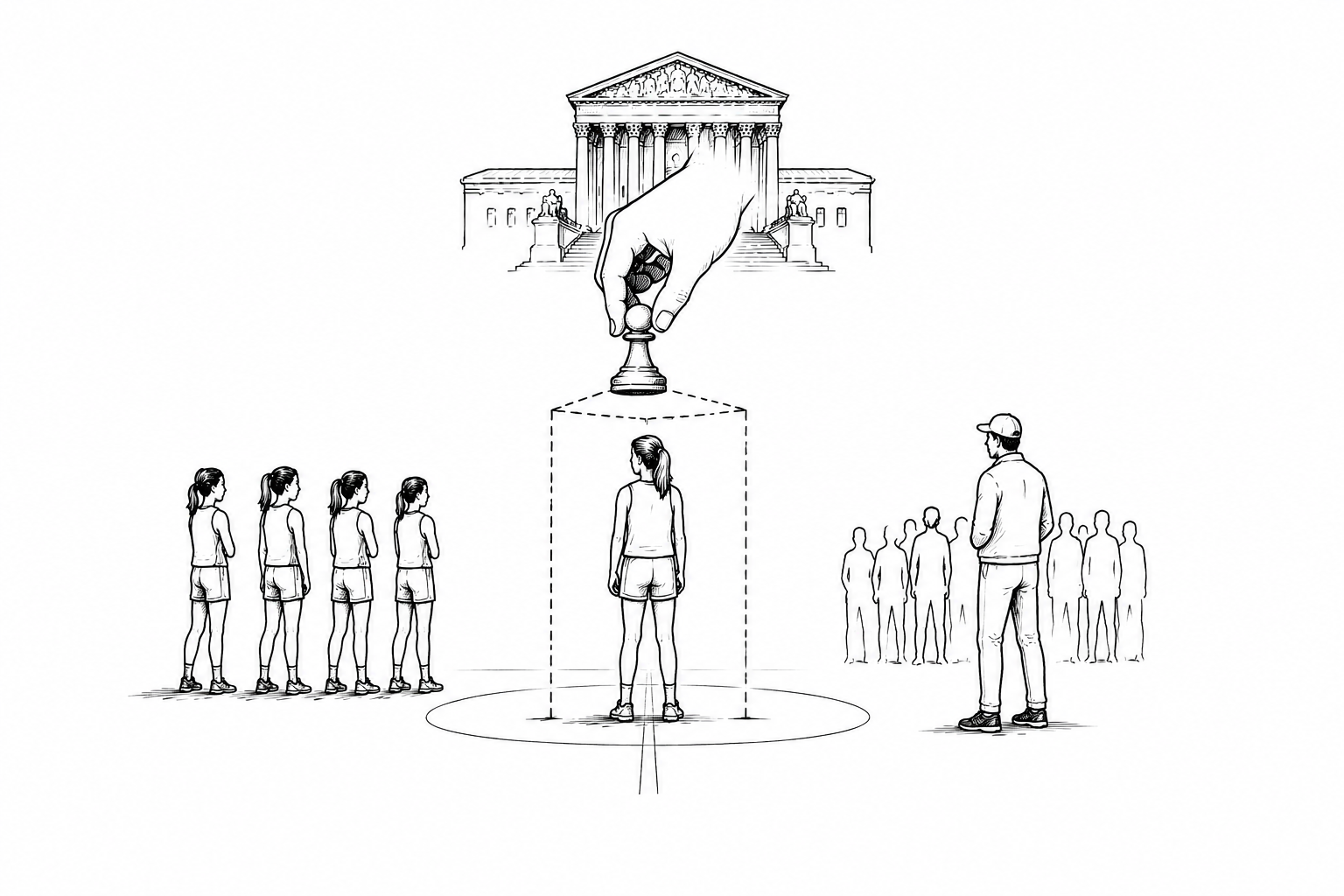
The Supreme Court Turns School Sports Into a Test of Institutional Identity
The ruling gave states more authority over athletic eligibility, but the larger transfer of power is from schools and students to legislatures defining gender through public institutions.
AP reported on June 30 that the Supreme Court upheld state laws in Idaho and West Virginia banning transgender girls and women from participating on female school athletic teams. The 6-3 ruling held that those bans do not violate the Constitution or Title IX, and AP reported that similar laws exist in more than two dozen states.
Public institutions define belonging through rules. A school sports roster looks narrow on paper, but eligibility rules tell students which identities the institution will recognize and which identities it will treat as exceptions. The Court’s decision gives states more room to make that choice through law.
The mechanism is eligibility. Eligibility sounds administrative because it decides who can compete, register, enter, or qualify. But eligibility is also how institutions translate cultural conflict into enforceable categories. Once a legislature defines the category, the school becomes the enforcement site.
That is why school sports became such a powerful political venue. The number of transgender athletes affected is small. The symbolic use of the issue is large. Sports allow lawmakers to frame gender policy through fairness, competition, and safety instead of through the broader question of recognition inside public life.
The ruling moves power from local schools, athletic associations, families, and students to state legislatures. Schools may still run the teams, but the state now has stronger authority to define who counts for participation. Students carry the consequence at the level where law becomes daily experience: tryouts, locker rooms, uniforms, travel, records, and public identification.
That power shift reaches beyond transgender students. Once a state builds systems to police eligibility by sex assigned at birth, institutions need procedures to verify, challenge, and enforce those categories. The burden rarely stays limited to the group named in the law. Girls who do not conform to expected gender presentation can also become subject to suspicion, paperwork, or public questioning.
The Court’s majority framed the issue through state authority and athletic classification. The dissenters treated the ruling as a civil rights problem. That divide matters because it shows two different theories of public education. One sees schools as places where states may preserve sex-separated institutions according to legislative judgment. The other sees schools as places where exclusion requires strong justification because participation is part of equal civic development.
The larger cultural pattern is that material policy moves slowly while identity policy moves quickly. Housing shortages, school funding gaps, youth mental health, and childcare costs can remain unsolved for years. Gender eligibility laws moved through statehouses at speed because they offered a clear political target and a moral frame voters could recognize.
That is not accidental. Symbolic conflicts are easier to package than structural failures. A lawmaker can tell a simple story about protecting women’s sports. It is harder to tell a simple story about why public schools have too few counselors, why families cannot afford care, or why young people are losing trust in institutions.
The ruling does not settle gender in public life. It gives one side more authority to write rules inside institutions. That means the conflict will move to enforcement, exceptions, documentation, private school policies, college athletics, and federal civil rights guidance.
The next stage will be less about whether states can pass bans and more about what institutions must do to enforce them. The politics may stay focused on transgender athletes, but the system being built is broader: a public infrastructure for deciding whose identity the state will recognize before participation begins.