
Arena, the AI leaderboard everyone uses, is now a $100M business
The companies that score models are starting to shape which models get trusted, funded, and bought.
Reuters reported on Jan. 6 that LMArena, the company formerly known as Chatbot Arena, raised $150 million at a $1.7 billion valuation, tripling its valuation in about eight months. The company runs a web-based platform where users compare large language models such as ChatGPT, Claude, and Gemini through anonymous, crowd-sourced evaluations. Reuters also noted that LMArena had previously raised $100 million in a seed round in May 2025.
AI rankings are becoming business infrastructure because buyers need a way to decide what counts as good. The model market moves too quickly for ordinary evaluation systems to keep up. New releases arrive, benchmarks get saturated, companies argue about cherry-picked scores, and enterprise buyers still have to decide which tool is worth integrating into work that carries cost, risk, and reputational exposure.
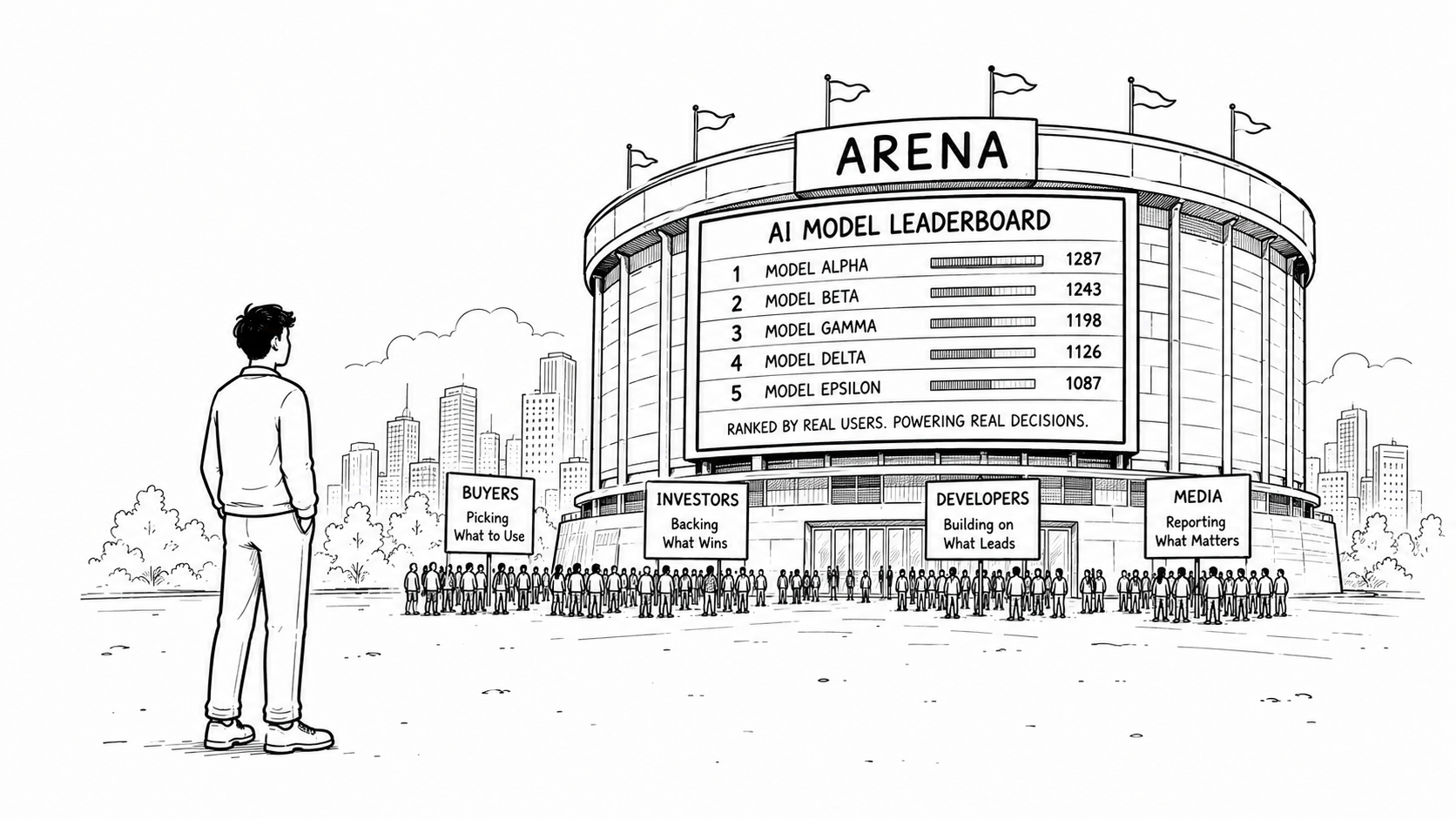
Arena’s value comes from the pressure inside that uncertainty. The platform converts user preference into rankings that the industry treats as evidence. A leaderboard can influence which model gets attention from developers, which company gains investor confidence, and which provider looks safe enough for enterprise procurement. The ranking does not merely describe the market. It helps organize the market.
That creates a power shift inside AI evaluation. Academic benchmarks once carried much of the authority. Company-run demos then became the marketing layer. Arena-style platforms occupy a middle position: public enough to feel independent, user-driven enough to feel practical, and visible enough to affect reputation. Model companies benefit when they climb the board. They absorb reputational cost when they fall.
The incentive problem arrives with that authority. Once rankings affect market value, companies have reasons to optimize for the ranking system itself. Researchers have already warned that arena-style pairwise comparisons can be vulnerable to strategic submissions, including multiple model variants designed to improve ranking outcomes. A leaderboard that starts as a measurement tool can become a target.
That does not make Arena useless. It makes governance central. If evaluation becomes infrastructure, then transparency, auditability, sampling design, model identity rules, and conflict management become part of the product. A ranking system that cannot explain how it protects its own credibility will eventually become another marketing surface.
The business case is powerful because the market lacks a neutral referee. Enterprises do not want to run full internal evaluations for every model release. Developers want shortcuts. Investors want simple signals. Media coverage wants rankings. Arena sits at the junction of all four demands, which is why a leaderboard can become a venture-backed company rather than a research side project.
Power moved from model builders alone to the platforms that evaluate them in public. That shift will matter more as AI purchasing moves from experimentation to procurement. The next AI fight will not only be over who builds the strongest model. It will be over who defines strength in a way the market believes.