Chicago’s School Food Strike Reveals the Hidden Labor Behind Public Services
The dispute shows how public systems depend on outsourced workers whose labor becomes visible only when the delivery chain breaks.
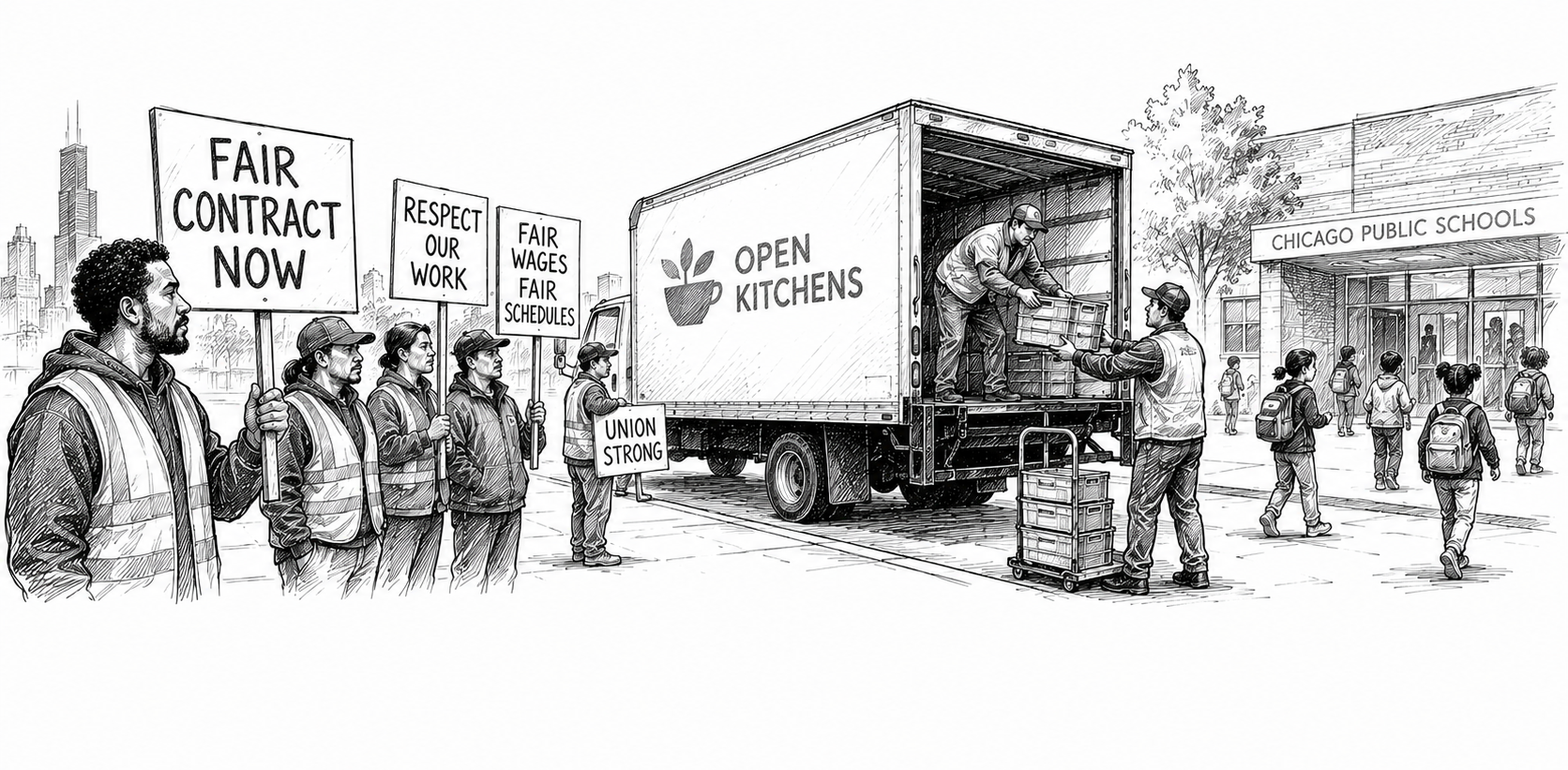
Teamsters Local 703 said in a June 26 statement that drivers and helpers at Open Kitchens, a food-service vendor that delivers meals to Chicago Public Schools and other Chicagoland customers, were forced to strike after the company continued what the union describes as unfair labor practices during first-contract negotiations. The workers voted to unionize last year; Local 703 has since filed multiple unfair-labor-practice charges with the National Labor Relations Board alleging Open Kitchens illegally terminated employees in retaliation for protected union activity. “Management’s reckless and unlawful conduct has left these workers with no choice but to strike,” said Thomas W. Stiede, the local’s secretary-treasurer.
Public services often run on labor that the public does not see. A school meal looks like a district program. A delivery route looks like logistics. A vendor contract looks like procurement. But the system only works because workers move food through the gap between public obligation and private execution.
That is the mechanism underneath this strike. When a district relies on a vendor for food delivery, the public service does not stop being public. The work is simply routed through another employer. Responsibility stays with the school system in the eyes of families, but control over wages, staffing, discipline, scheduling, and working conditions sits somewhere else — in this case, with Open Kitchens, not CPS.
Outsourcing changes where power lives. The district can say it is providing meals. The vendor can say it is fulfilling a contract. Workers are left negotiating inside a structure where their labor supports a public good but their leverage is directed at a private employer. That split is the hidden architecture of many public systems.
Food delivery for schools is especially revealing because it connects labor policy to student welfare. Meal programs are not optional extras for many families. They are part of the social safety net. When delivery workers walk out, the disruption is not only a workplace event. It exposes how much of the safety net depends on low-visibility labor being performed on schedule, at scale, and often under pressure.
That pressure usually stays offstage. Parents see whether food arrives. Students see whether meals are available. Administrators see compliance metrics and vendor performance. Workers see route timing, staffing levels, vehicle conditions, pay, and workload. Each group experiences a different part of the same system.
A strike collapses those separate views into one public fact: the service is only as stable as the labor beneath it. The disruption forces institutions to admit that logistics is not neutral. It is an employment model.
Power moved from public accountability toward contract management when the work was outsourced. That does not mean every vendor arrangement is abusive or every public agency acts in bad faith. It means the public has fewer direct lines of sight into the conditions that make the service possible. Labor risk becomes a vendor issue until the system fails in public.
That is why these disputes deserve more attention than they usually receive. Public-sector debates often focus on teachers, police, firefighters, transit operators, and other visible workers. Contracted food workers, janitors, drivers, aides, and delivery crews are treated as support functions. But support functions are where many systems either hold or break.
The Open Kitchens strike is not the only sign of strain in CPS’s food-service system. Separately, UNITE HERE Local 1, which represents CPS’s own lunchroom cooks, porters, and attendants, has spent months in contract negotiations with the district over pay and staffing levels that the union says have dropped sharply over the past decade, with both sides recently agreeing to bring in a federal mediator. The two disputes involve different employers and different unions, but together they trace the same fault line: the workers who keep meals moving through Chicago’s schools, whether employed directly by the district or by its vendors, are among the lowest-paid people in the system.
As public agencies try to contain costs, outsourcing can make budgets look cleaner while pushing volatility onto workers. The savings are rarely magic. They come from wage structures, staffing flexibility, benefit differences, and distance from direct public scrutiny.
The public still depends on the work, but that distance means workers lose some of the visibility that can produce political protection. A meal program can be praised as public investment while the people moving the meals fight for basic leverage outside the center of public attention.
The next question for Chicago is not only how quickly deliveries resume. It is whether public systems will keep treating contracted labor as a background cost until the workers who hold the system together make themselves impossible to ignore.