Wall Street Is Learning to Like a Weaker Labor Market
A soft jobs report can lift markets when investors believe it keeps the Fed away from another rate hike. That tells us where power sits in this economy.
Reuters reporters Ann Saphir and Lucia Mutikani reported Thursday that traders sharply reduced expectations for a July Federal Reserve rate hike after the Labor Department said the U.S. economy added only 57,000 jobs in June. May’s gain was revised down to 129,000, and futures markets moved to price in less than a 20% chance of a July hike.
That is the contradiction sitting under the market reaction. A weaker labor report should be a warning about hiring, income, and household confidence. For investors, it can also be relief. Slower job growth reduces the pressure on the Fed to raise borrowing costs, and lower rate pressure can support stocks, credit markets, and capital-intensive investment.
Wall Street has always read labor data through two lenses at once. Strong hiring is good if it signals demand. It becomes threatening when it suggests wage pressure, inflation, and tighter monetary policy. Weak hiring is bad if it signals recession. It becomes useful when it buys the Fed time.
That is why bad news can become market-friendly news. Reuters reported that the Dow rose after the soft jobs data, while investors reassessed the likelihood that the Fed would raise rates soon. The employment report did not erase inflation concerns. It changed the timing. It gave markets a reason to believe the central bank could wait.
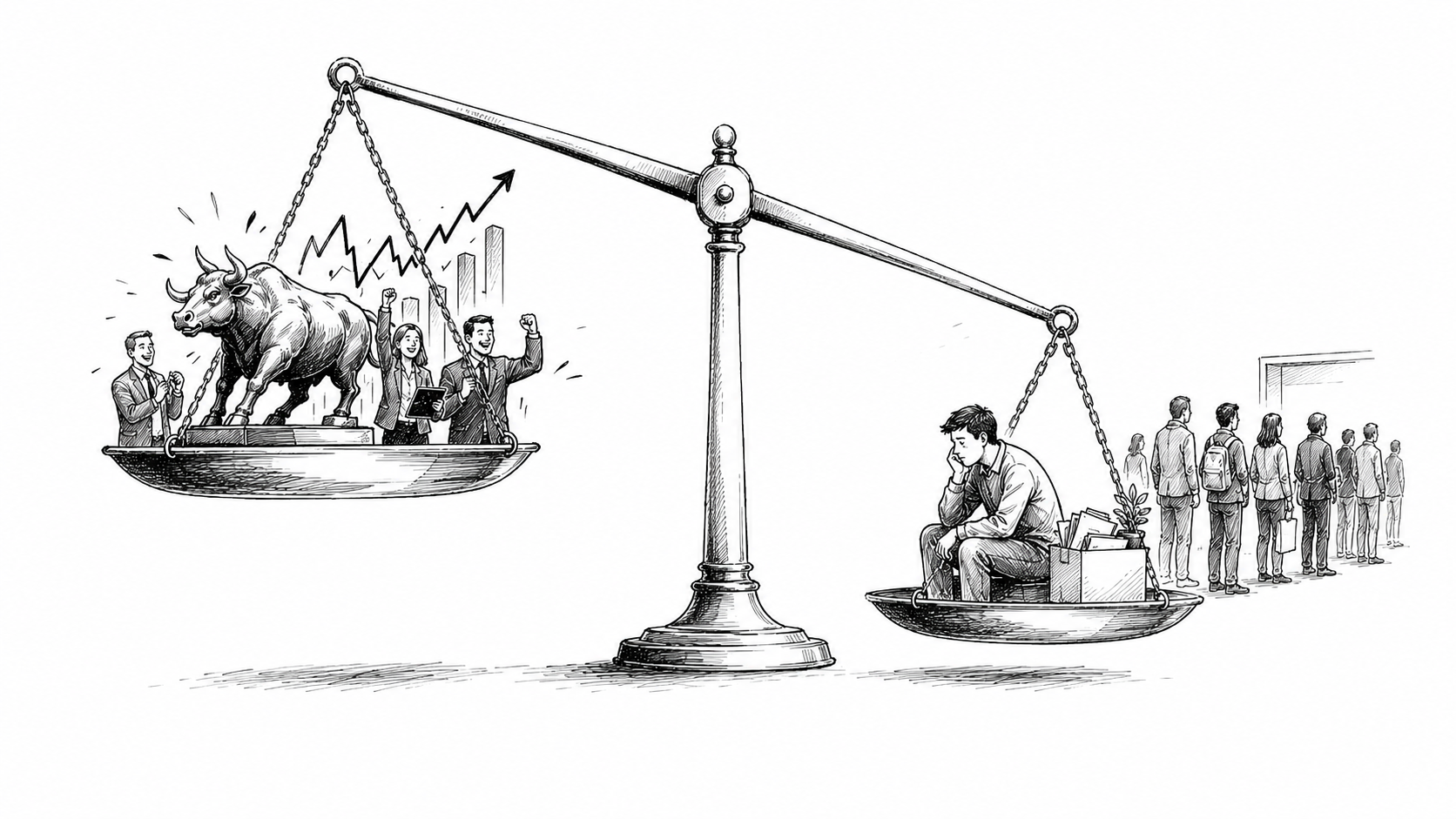
The power imbalance is built into that reaction. Workers experience a hiring slowdown as uncertainty. Investors experience the same slowdown as information about the cost of money. A worker sees fewer openings. A market sees lower bond yields, delayed rate hikes, cheaper financing, and less immediate pressure on corporate margins.
That does not mean investors are rooting for workers to suffer. It means the structure rewards capital for conditions that can make labor weaker. When the central bank is focused on inflation, a softer labor market becomes evidence that policy does not need to tighten as aggressively. The worker’s bargaining position and the investor’s borrowing cost move in opposite directions.
This is especially important in an economy shaped by expensive infrastructure bets. Companies building data centers, energy capacity, cloud systems, factories, and logistics networks are highly sensitive to financing costs. When interest-rate expectations fall, those projects become easier to justify. A cooler labor market can therefore support capital spending even while it makes workers more cautious.
The June report was not catastrophic. The unemployment rate remained low, wages still grew, and some sectors continued adding jobs. But the labor force also shrank, participation fell, and the headline number missed expectations badly. That mix gives markets what they often want: enough weakness to cool the Fed, but not enough weakness to confirm a downturn.
That narrow zone has a name in market language. It is often treated as balance. For workers, it can feel like suspension. The economy is not weak enough to trigger major intervention, but not strong enough to create broad opportunity. People already attached to stable jobs may hold on. People trying to move, enter, or recover from a setback find the door harder to open.
The structural lesson is not that markets are irrational. It is that markets are rational for the people they are built to serve. They translate labor-market softness into rate probabilities, stock valuations, and financing conditions. Workers translate the same data into rent, interviews, savings, and risk.
If hiring keeps slowing while markets keep rallying, the split will become harder to ignore. The economy can look healthy from the trading desk while becoming less accessible from the job search.