New Orleans’ River District shows redevelopment still depends on subsidy sequencing
The River District is being sold as revitalization, but its actual sequence shows how public incentives decide which future arrives first.
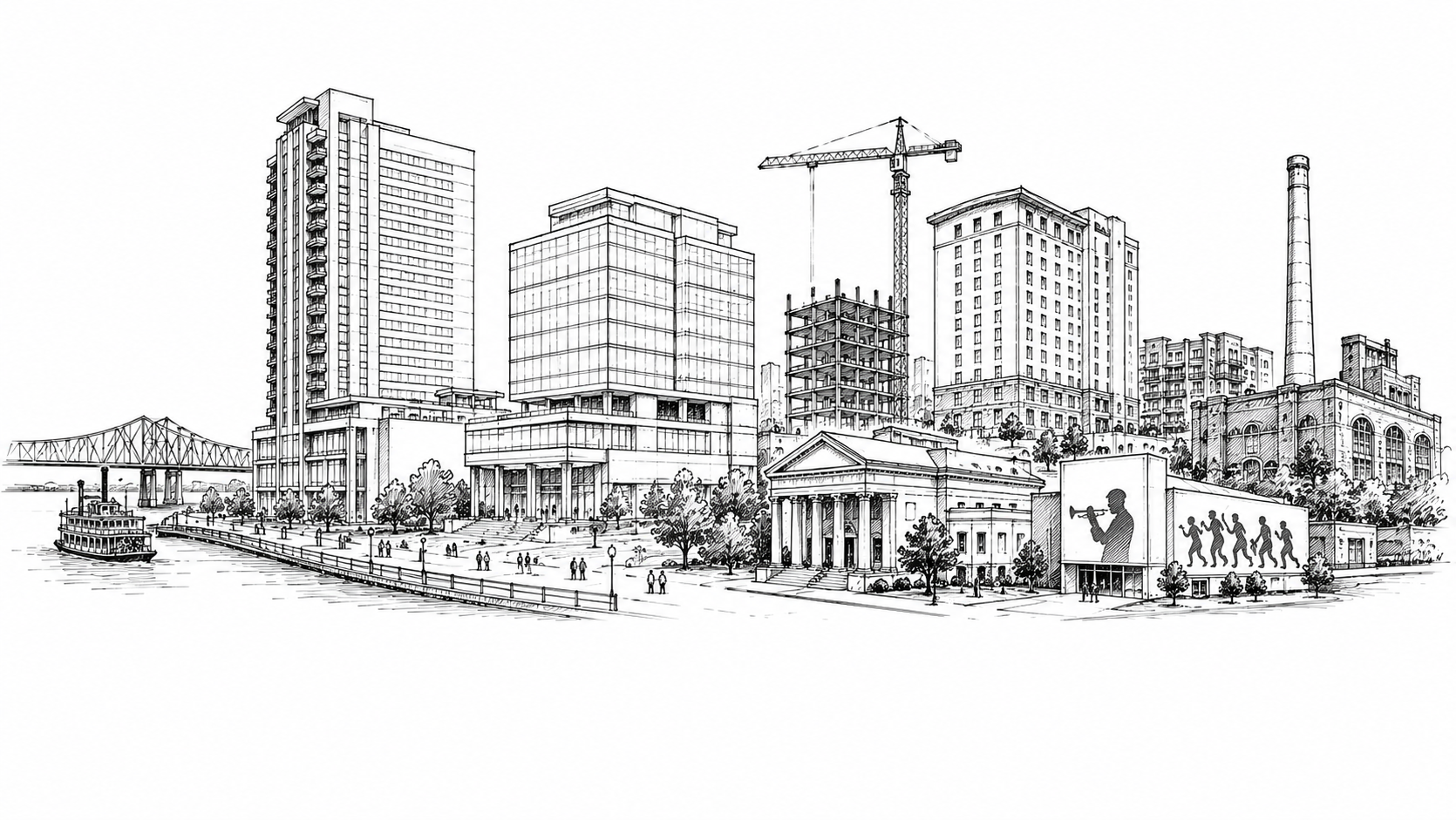
New Orleans’ River District is moving forward through a familiar urban formula: corporate offices, hotels, apartments, entertainment venues, museums, and public incentives arranged into a single promise of revitalization. Axios reported that Shell’s new Gulf headquarters is anchoring the next phase of the project, with construction targeted for completion in April 2027. A 27-story Omni hotel has cleared zoning, a Rivana apartment project is heading toward a tax-incentive vote, and a $170 million Louisiana Music & Heritage Experience has a lease but still needs funding.
That list sounds like momentum. It is also a sequencing map. The projects that move first are not always the projects with the deepest civic meaning. Corporate headquarters, hotel construction, and incentive-backed apartments can advance because they fit the financing logic of redevelopment. They have capital partners, revenue models, and public officials willing to argue that future tax growth justifies present subsidy. Cultural infrastructure and public memory projects often move more slowly because their value is harder to monetize, even when they are central to the story a city tells about itself.
The River District is not just another real-estate story. It sits inside a city where tourism, Black cultural production, climate risk, housing pressure, and public finance already collide. New Orleans does not lack global recognition. It lacks a development model that consistently protects the people and cultural systems that made that recognition valuable. The danger is not that the River District gets built. The danger is that the parts of the district with the most financial power arrive first, while the parts meant to preserve memory, widen access, or stabilize community remain contingent.
That is the politics of subsidy sequencing. Public-private redevelopment is often framed as a package, but every component does not receive the same urgency. A headquarters can become the anchor. A hotel can become the demand generator. Apartments can become the tax-base argument. A music museum can become an aspiration. A civil rights museum can become a future phase. Once that order is set, the public conversation shifts from what the district should become to what can be financed next.
Redevelopment does not simply fill empty space. It reorganizes power around land. It determines who can afford to live nearby, who gets employment, what kinds of businesses benefit, whose history is displayed, and who controls the revenue stream after the ribbon cutting. A project described as mixed-use can still produce a narrow version of public benefit if the public side of the bargain is limited to infrastructure support, tax abatements, and ceremonial cultural inclusion.
New Orleans has seen this pattern before. Cities often use culture to justify development, then struggle to fund the institutions that protect culture from being reduced to branding. The River District’s music and heritage components are not decorative. They are tests of whether the development will preserve civic memory or simply borrow from it. If the museum and public-facing cultural projects lag behind the office towers and hospitality assets, the district will reveal which parts of New Orleans are considered economically essential and which are treated as optional.
The stronger version of the River District would connect growth to public obligation from the start. That means clear housing affordability commitments, transparent subsidy terms, public reporting on jobs and local contracting, durable funding for cultural institutions, and a serious plan for climate resilience in a riverfront city. Without those commitments, revitalization becomes a word that describes capital movement more than public repair.
The River District is still forming, which means the sequence is not destiny. But the order already matters. Shell’s headquarters, Omni’s hotel plans, Rivana’s incentives, the power plant reuse, and the unfinished cultural pieces are not separate developments. They are one operating system. New Orleans can attract investment; it already has. What remains unresolved is whether public investment will make the district more accountable to the city that gave it value, or whether the city will subsidize another version of itself built mainly for those with the capital to arrive first.