Dallas Tech Executives Are Moving Back to San Francisco. That Says Everything About How Companies See Remote Work in 2026.
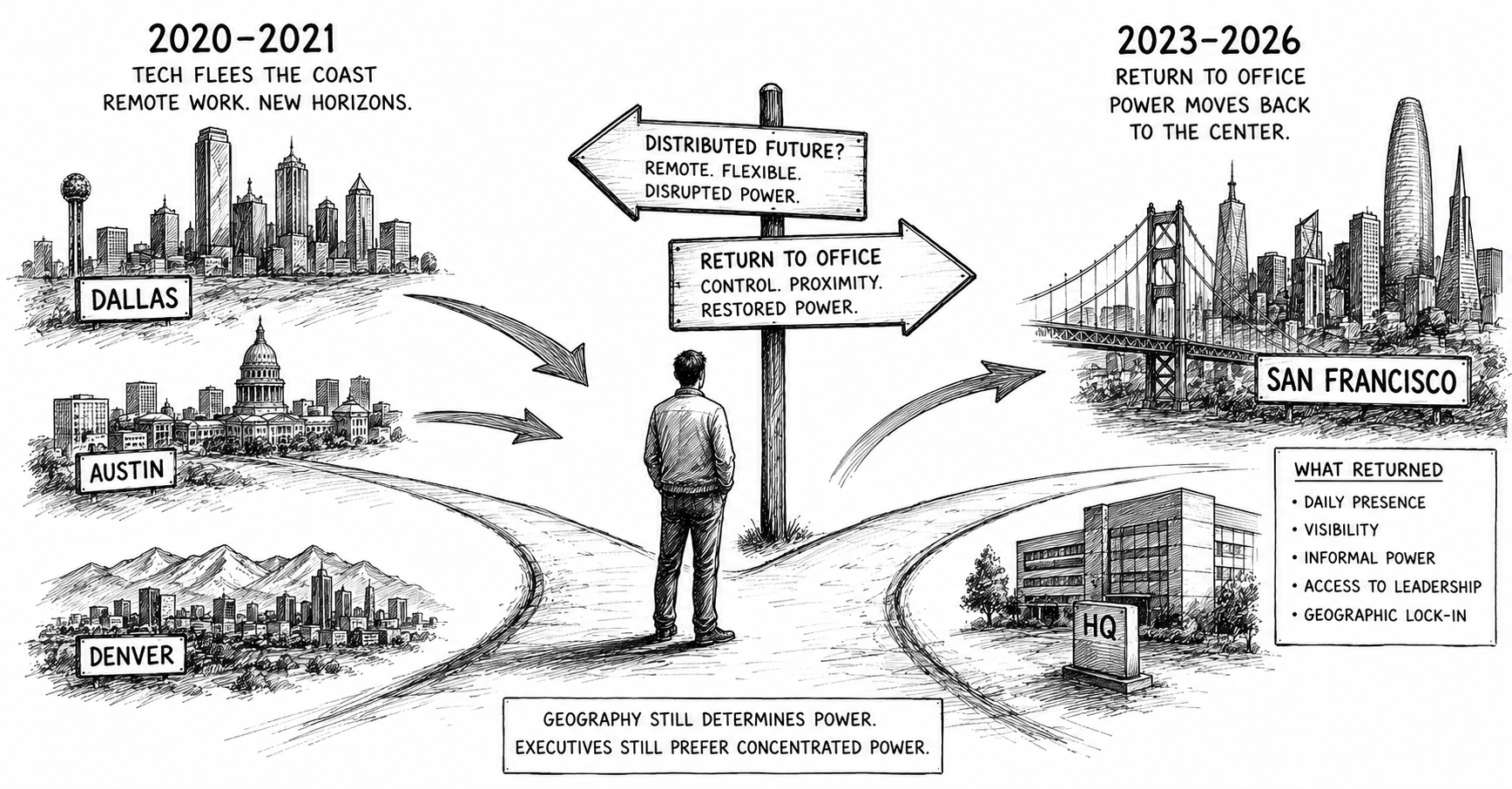
In 2020 and 2021, tech companies fled coastal metros like San Francisco. The reasoning seemed obvious: remote work meant location no longer mattered. Talent was distributed. So companies could attract workers from lower-cost cities without requiring them to live in expensive metros. Dallas became a tech destination. So did Austin. So did Denver. Tech executives moved to these cities, either physically or by expanding offices there. By 2023, it looked like the geography of tech was permanently reshaping.
Then companies started mandating return-to-office. Tesla, Meta, Amazon, Google, and others announced that remote work was ending. Get back to the office or leave. The announcement was framed as productivity necessity. What it actually signaled was a recalibration of where power lives in tech companies. By 2026, that recalibration is complete. Tech executives who moved to Dallas are moving back to San Francisco. Tech employees who were given three-day-a-week remote arrangements are being pushed back to five days in-office. The geographic distribution that looked permanent in 2021 is reversing.
What happened is that companies realized remote work threatened executive power. When everyone is working from home, the office becomes less important. When the office becomes less important, proximity to executives becomes less important. When proximity to executives becomes unimportant, informal power dynamics flatten. Information asymmetry decreases. The hierarchical control that executives exert through presence and visibility diminishes.
Return-to-office mandates are explicitly designed to restore that control. They restore the office as the seat of power. They restore daily presence as a signal of commitment. They restore visibility and informal surveillance as management tools. They restore the ability of executives to control who has access to decision-making through physical presence.
Dallas and other non-coastal cities attracted tech workers because remote work made geography irrelevant. Return-to-office mandates make geography relevant again. Suddenly being in the Bay Area is valuable. Being remote is seen as less committed. Being distributed is no longer an advantage. The entire logic that made Dallas attractive as a tech hub assumed that remote work was permanent. It was not. Companies used remote work during pandemic necessity, then abandoned it when they could control the transition back.
What executives discovered through return-to-office is that they prefer having power concentrated in physical space. That discovery is reshaping the geography of tech again. Dallas will not disappear as a tech hub. But it will shrink relative to San Francisco. Talent that moved there to work remotely will either move back or accept lesser roles at companies that are shedding Dallas offices.
The lesson: the geographic distribution of tech in 2021 was not inevitable. It was temporary. It depended on remote work being permanent. As soon as companies had the choice to return to the office, they exercised it. As soon as they exercised it, the geographic advantage of non-coastal cities evaporated. Geography still matters in tech. It matters because power still concentrates in specific places. Silicon Valley still has the power because executives still want to be there.
Tech workers who moved to Dallas thinking they had escaped the geographic lock-in of the Bay Area learned they had not. The lock-in was always going to reassert once remote work ended. It has. The question now is whether any company will have the courage to build a distributed tech future that is not contingent on remote work remaining permanent. So far, the answer is no. Geography still determines power. Executives still prefer concentrated power. Geography still determines power in tech.