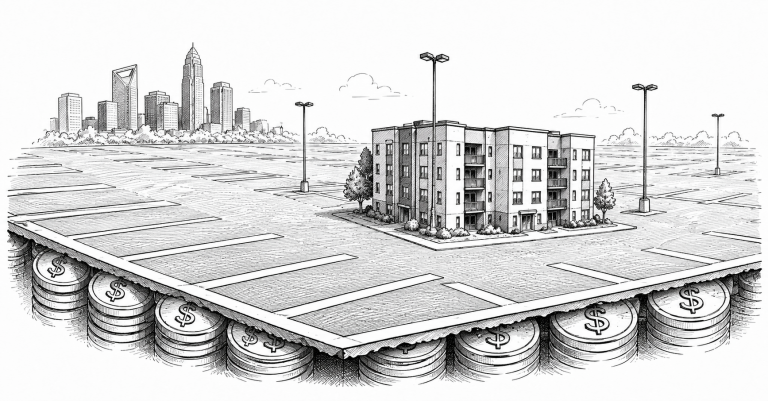

Atlanta’s Racial Wealth Gap Is 46 to 1. The City Has Had the Highest Income Inequality in the Nation for 30 Years.

The median wealth of a white household in Atlanta is $238,355. The median wealth of a Black household is $5,180. That is a 46-to-1 ratio, documented in 2026 research by the Atlanta Civic Circle, Build Black Wealth, and Nonprofit Quarterly. More than one in three Black households in the metro carry zero net worth. The income gap between white and Black households has grown by more than $17,000 over the past decade. Atlanta has held the distinction of highest income inequality in the nation for more than 30 years — a distinction that has persisted through Democratic and Republican administrations, through economic booms and recessions, and through Atlanta’s emergence as a national symbol of Black political and professional achievement.
The coexistence of those two facts — highest income inequality in the nation, sustained reputation as the capital of Black economic aspiration — is not a contradiction. It is the story. Atlanta’s Black middle and upper-middle class is real. The professional networks, the homeownership in Cascade Heights, Lithonia, and Stonecrest, the HBCU corridor, the political infrastructure built over decades of Black mayoralties — these are documented, material, and consequential. They are also concentrated in a stratum of the city that the wealth data sits above. The $5,180 median is the number that includes the households that Atlanta’s economic story does not talk about as often: the families who did not get access to the networks, the homeownership, or the professional infrastructure that the city’s success story is built on.
The mechanism producing the 46-to-1 gap is not primarily discrimination in individual transactions — though that exists. It is the compounding of asset accumulation over generations. Wealth is transmitted through homeownership, inheritance, and access to capital. Black households in Atlanta were systematically excluded from each of these channels during the decades when the wealth that white families now pass down was being built. Redlining determined where Black families could buy homes. Restrictive covenants and discriminatory lending determined at what cost. Federal housing programs designed to build the postwar middle class were administered in ways that produced racially segregated wealth accumulation. The 46-to-1 ratio is not an accident of the market. It is the compound interest on exclusion.
The income gap growth — $17,000 wider over the past decade — is the more current and more actionable number. The existing wealth gap is the legacy of policy decisions made between 1930 and 1980. The widening income gap reflects decisions being made now: which industries the metro is investing in, which neighborhoods are receiving infrastructure, which schools are producing college graduates, which professional networks are producing economic mobility. Atlanta has a reputation for upward mobility for Black professionals with certain credentials and certain networks. It also has an eviction rate, a wage floor in its service economy, and a school funding structure that produce different outcomes for the households below that credential and network threshold.
30 years at the top of the national inequality ranking is not a metric that corrects through economic growth alone. Atlanta’s economy has grown. The gap has widened. Growth that does not change the distribution of assets and income does not close a wealth gap. It finances the infrastructure of the city while leaving the gap in place.