Canada Is Diversifying Away From the United States. The Pivot Is the Most Consequential Economic Decision in Its Modern History — and It Is Being Covered as a Trade Dispute.
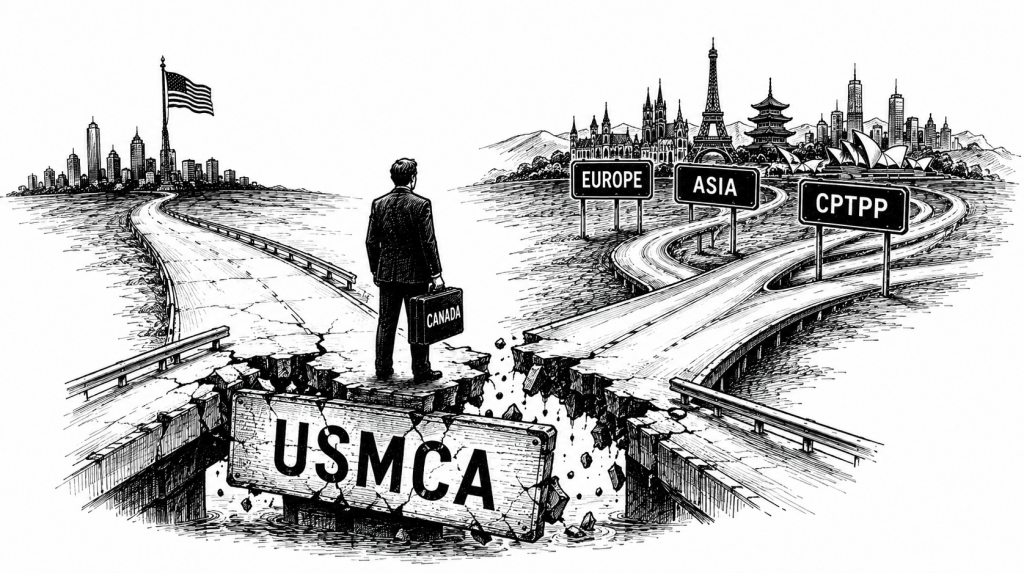
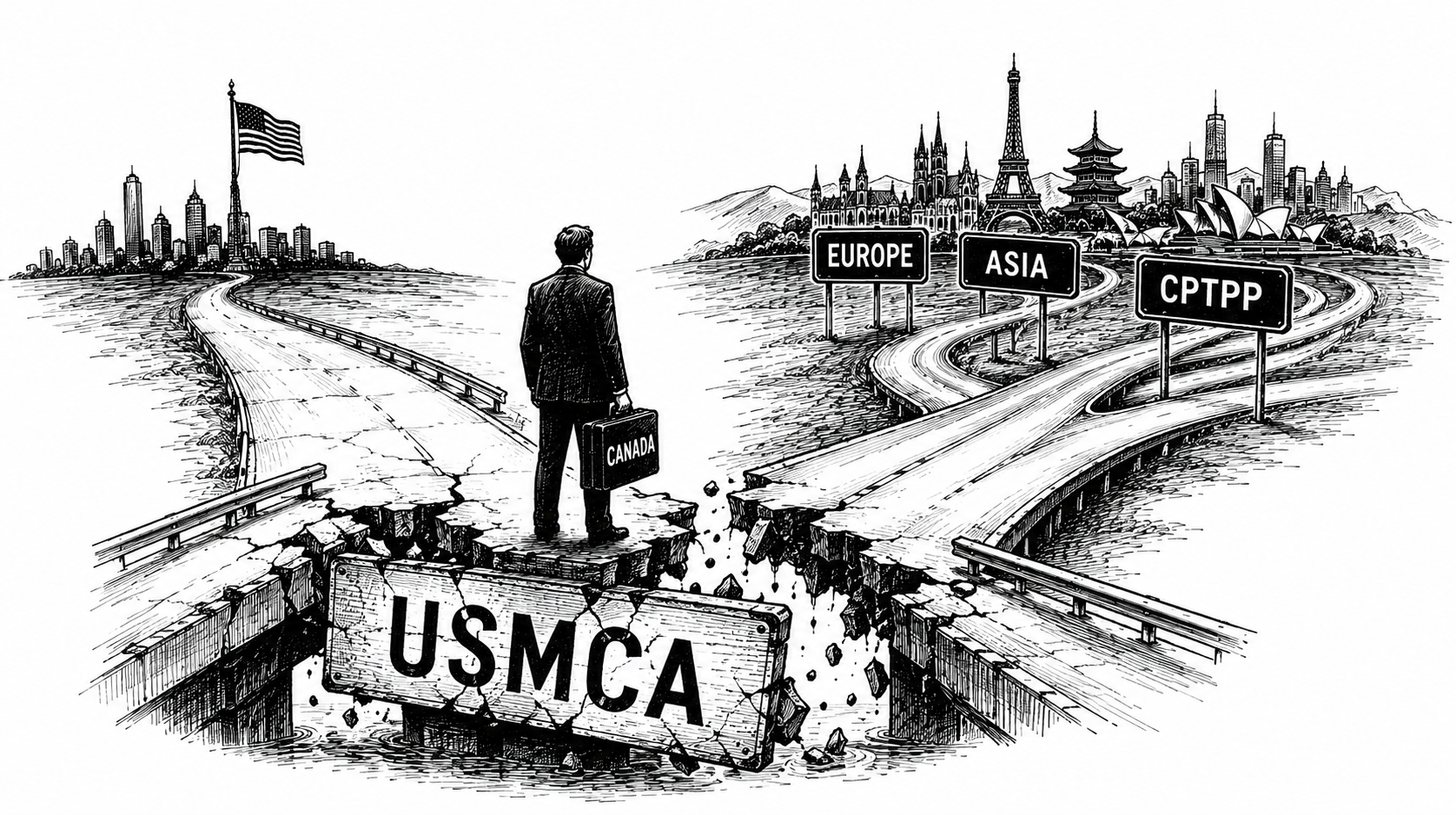
The Bank of Canada is projecting 0.7% GDP growth in 2026 while managing the fallout from the USMCA collapse and accelerating trade diversification through new commercial relationships in Europe, Asia, and the Comprehensive and Progressive Agreement for Trans-Pacific Partnership (CPTPP) — the trade framework the United States exited in 2017. Reporting from Convera and the Steptoe trade practice group, published in July 2026, documents the diversification push as the Canadian government’s primary economic response to the end of its dominant trade relationship. The mainstream frame for this story has been bilateral: Canada versus the Trump administration’s trade policy, tariffs versus retaliation, a dispute that will eventually resolve.
That frame misidentifies the mechanism. Canada is not making a strategic pivot because of a temporary policy disagreement with a specific administration. It is making a strategic pivot because the USMCA collapse revealed that concentrating 75% of national exports in a single bilateral relationship is not a trade policy — it is a vulnerability. The question the Bank of Canada’s economists are now answering is not “how do we get back to the arrangement we had?” It is “how do we build an export architecture that does not expose the Canadian economy to this level of disruption the next time a bilateral relationship changes?”
That question is new in Canadian policy terms. For decades, the bilateral trade relationship with the United States was treated as a fixed feature of the economic environment rather than a strategic exposure to be managed. The geographic, cultural, and linguistic integration of the two economies made deep bilateral dependence feel natural rather than risky. The NAFTA and then USMCA frameworks provided legal infrastructure for that dependence, creating an investment environment in which Canadian manufacturers built supply chains anchored to U.S. market access. The tariff shock and the framework collapse have not just disrupted that trade — they have revalued every investment decision that assumed the relationship was stable.
CPTPP membership gives Canada formal preferential access to Japan, Australia, Vietnam, Mexico, Chile, Singapore, and Brunei — a grouping that collectively represents significant but not yet equivalent demand for the goods Canada exports to the United States. Building commercial relationships at scale within that framework requires time, investment in trade infrastructure, and the kind of sustained diplomatic and commercial engagement that the U.S. relationship made optional for most of Canada’s trading history. Canadian businesses that built their operations around U.S. market access are not positioned to pivot to Asia-Pacific markets quickly, and the transition costs are being paid by the same workforce that absorbed the initial tariff shock.
The most durable consequence of the USMCA collapse may not be the short-term job losses or the 0.7% growth ceiling. It may be the structural rethinking it has forced. Canada is now building trade infrastructure — relationship networks, logistics, commercial legal frameworks — that it should have been building alongside the bilateral relationship for decades. The cost of not having built it is what 100,000 lost jobs and a 1.5 percentage point growth gap measure. The benefit of building it now is a Canadian economy that is less exposed when the next bilateral relationship changes terms.
The dispute frame makes this a story about Donald Trump and Prime Minister Carney. The strategic frame makes it a story about a country discovering, at high cost, that its economic architecture rested on a single assumption it never fully examined. Canada is not diversifying because it wants to. It is diversifying because it has no remaining alternative, and the urgency of the pivot is exactly proportional to how long the alternative was treated as permanent.