Candace Owens Is Testing Whether Controversy Still Has a Shelf Life
Old comments don’t disappear anymore. The bigger question is whether they still cost anything.

Former NBA player Etan Thomas posted a screenshot to X on June 19, pairing Candace Owens’ 2023 comment that Juneteenth is “still ghetto and made up” with his own reply from that year — “You just love to tap dance for them don’t you? Smh” — captioned “While #CandaceOwens is trying to rebrand herself…….” The post crossed several hundred thousand views within a day.
A screenshot is leverage now. Three years ago, Owens’ comment generated a news cycle that ran its course in roughly 48 hours — coverage, backlash, a follow-up tweet doubling down, then nothing. Thomas didn’t need a platform, an editor, or a news peg to revive it. He needed two screenshots stacked on top of each other and a hashtag. That’s the mechanism worth naming: accountability used to require institutional infrastructure — a publication willing to run the story, a producer willing to book the segment. Now it requires one person with a phone and an audience willing to share.
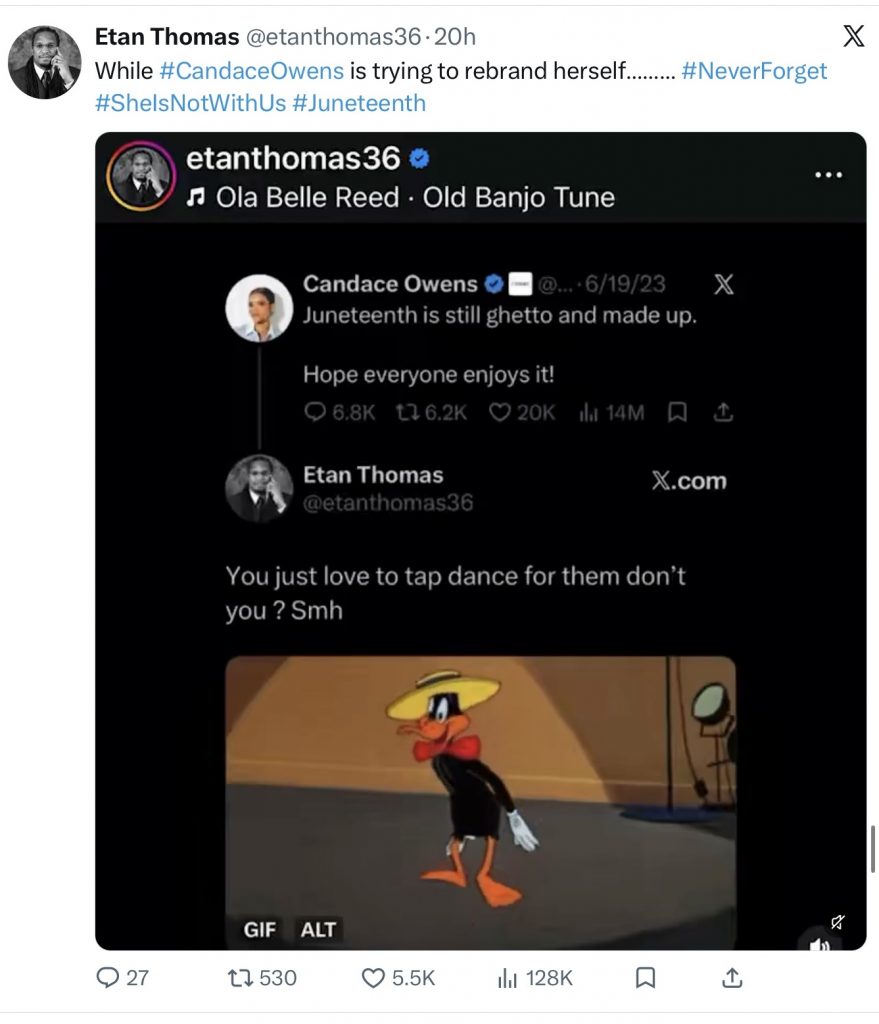
Owens has spent recent months distancing herself from MAGA and recasting her public identity, a shift serious enough that Congress considered a resolution this year condemning her alongside another commentator for antisemitic remarks. Thomas’s framing — “trying to rebrand herself” — names the actual stakes of that repositioning: a rebrand asks the public to evaluate someone going forward. An old screenshot insists the public can’t, because nothing has been retracted, apologized for, or revised. Owens never walked back the 2023 comment. She doubled down on it the next day, telling critics they were “crying racism.” The rebrand and the unretracted statement are sitting in the same public record, and Thomas’s post forces them into the same frame.
That’s a real fight over who controls the timeline of a public reputation. Owens benefits from a media environment where attention is the scarce resource — if a controversy isn’t actively recirculating, it functions as resolved, whether or not anything was actually resolved. Thomas, and the people sharing his post, are exploiting the one thing that media environment can’t fully erase: the original artifact still exists, indexed and searchable, available to anyone willing to spend thirty seconds finding it. Power here moved from institutions that used to control the historical record — networks, publishers, the news cycle’s natural decay — to individuals who can now reassert that record unilaterally, on their own timeline, with no editorial gatekeeper standing between the archive and an audience of hundreds of thousands.
What that transfer doesn’t solve is durability. Thomas’s post will fade the way the original 2023 cycle faded. Nothing about this exchange forces Owens to address the comment directly, change a stated position, or lose access to any platform she currently holds. The power shifted toward the people holding the receipts. It did not shift toward anyone with the authority to make a receipt matter. Until that second transfer happens — until resurfacing carries consequence and not just reach — this cycle will run again next Juneteenth, with a different person holding the screenshot and the same comment doing the same work it did in 2023.
— SSC Culture Desk | Social Storytellers Collective
Free, daily structural analysis like this lands in your inbox every weekday morning. Subscribe: https://246481934.hs-sites-na2.com/newsletter