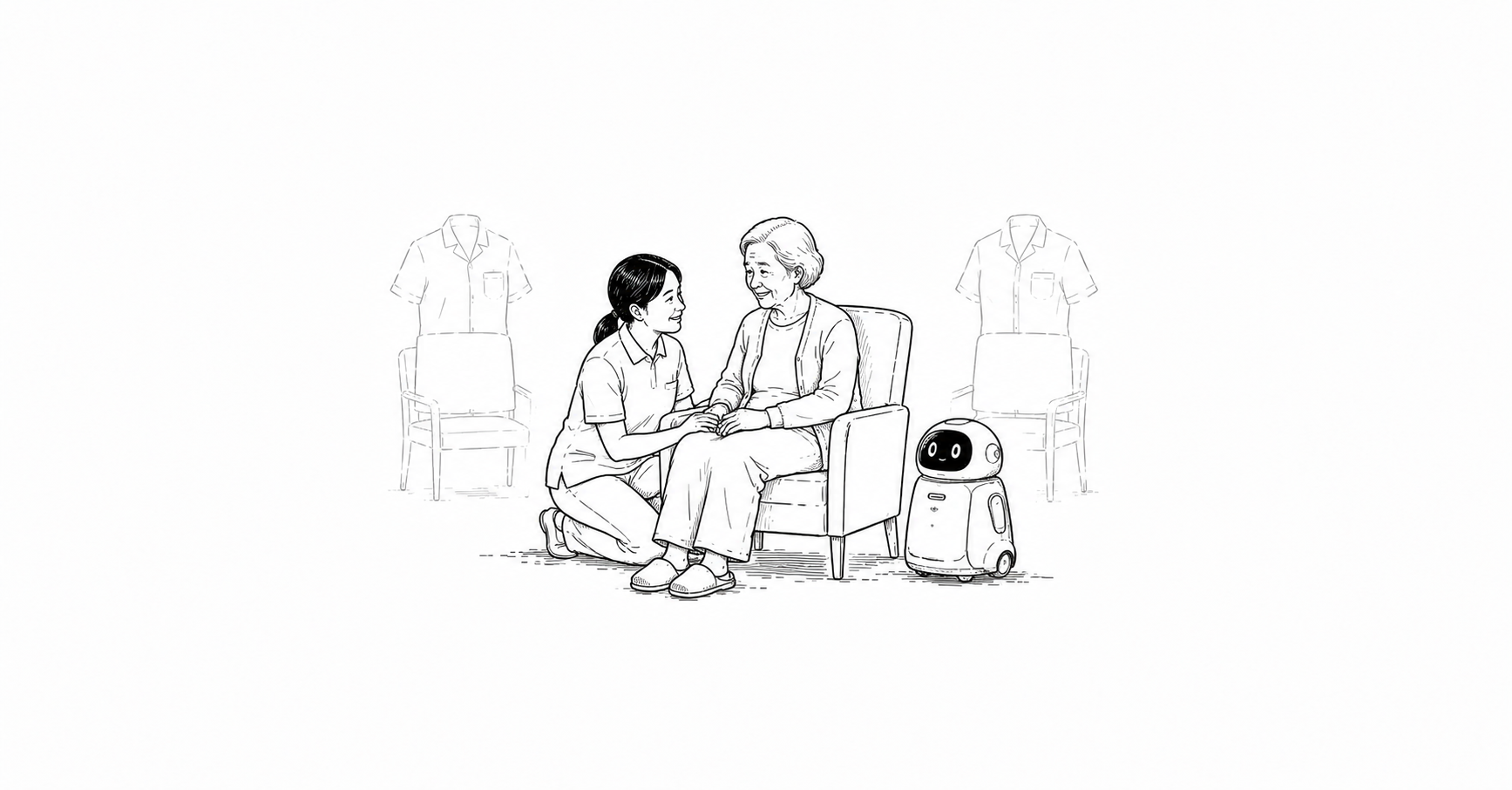
The Country Getting Older Before It Gets Rich
Japan’s caregiver shortage is forcing a test AI hasn’t passed yet: whether the technology can support human care, or whether it becomes an excuse to stop building it.

Catherine Thorbecke, a Bloomberg Opinion columnist covering Asia tech writing in Japan Times commentary, spent several days visiting Tokyo nursing homes this spring and watched plushie robots and conversational dolls being introduced to residents whose families, community networks, and human caregivers can no longer fully meet their needs. More than 29% of Japan’s population is now over 65, according to the Ministry of Internal Affairs and Communications, making it the oldest major society on Earth. The country is expected to face a shortage of 570,000 care workers by 2040.
That shortage is not a forecast Japan is bracing for. It is the operating environment its care system runs on today.
Thorbecke’s reporting complicates the easy version of this story — the one where AI simply arrives to fill the gap. Ethnographic researcher James Wright’s 2023 book, Robots Won’t Save Japan, documented that the country’s earlier, costly push into eldercare automation often created unintended consequences, in some cases adding work for staff rather than removing it. Public appetite hasn’t caught up to the policy push either: in a 21-country Ipsos survey, Japan had the lowest share of respondents who said they were “extremely excited” about AI companions, and the highest share — 46% — who said they hadn’t used any AI tool in the past year.
Facilities are adopting AI-enabled monitoring, predictive fall detection, and conversational tools not because residents or staff are asking for them, but because the alternative is fewer people available to provide care at all.
Care work has resisted automation because much of its value comes from judgment rather than repetition. Recognizing confusion before it becomes an emergency requires familiarity with a specific person. Comforting someone experiencing dementia depends on trust built over time. AI performs differently: it recognizes patterns, predicts risk, documents observations, and reminds patients to take medication. It does not replace the relationship that often determines whether someone accepts care in the first place — which is exactly the distinction Thorbecke’s own grandfather made when he rejected a conversational AI voice mode she showed him last summer.
That distinction is reorganizing what caregivers actually do, rather than replacing them outright. Administrative documentation moves to software. Routine monitoring becomes continuous instead of periodic. Predictive systems flag residents who need immediate attention. Caregivers spend a growing share of their time on the work only a person can do — the emotionally demanding and clinically complex cases — while software takes on the routine load.
That redistribution benefits institutions more visibly than it benefits workers. Facilities manage larger patient populations without expanding staff at the same pace. Governments slow the growth of long-term care costs. Technology companies gain access to one of the world’s fastest-growing healthcare markets. The pressure lands on the workers who remain, whose jobs get harder even as the total headcount shrinks.
Japan’s test previews decisions that South Korea, Italy, Germany, China, and eventually the United States haven’t yet had to make, even as their demographic trajectories point the same direction. The question they’ll all face is the one Thorbecke poses about Japan’s own experiment: whether companion bots and monitoring systems end up as one tool in a kit aimed at preserving dignity in old age, or as a policy-convenient substitute for the harder, more expensive work of training and paying enough humans to do the job.
Japan hasn’t answered that question yet. Its 46% non-adoption rate on AI tools, next to a 570,000-worker shortfall projected for 2040, suggests it’s currently choosing to defer the answer rather than commit to either path — a position that gets more expensive to hold the longer the shortage compounds.