You Need to Earn $109,152 to Afford the Median Home. The Median Household Earns $88,000. That Gap Has a Name.
To qualify for a mortgage on a median-priced single-family home in the United States, a household must earn $109,152 a year, according to the National Association of Realtors’ June housing affordability data. That figure is based on a median home price of $446,400, a 30-year fixed mortgage rate of 6.57 percent, and a 20 percent down payment. June marked the fifth consecutive month of declining affordability. Homebuyer purchasing power has been shrinking since February.
NAR chief economist Lawrence Yun noted that affordability actually improved on an annual basis, since income growth outpaced home price appreciation and mortgage rates were modestly lower than a year ago. That’s technically true. It’s also exactly the kind of thing you say when you represent sellers.
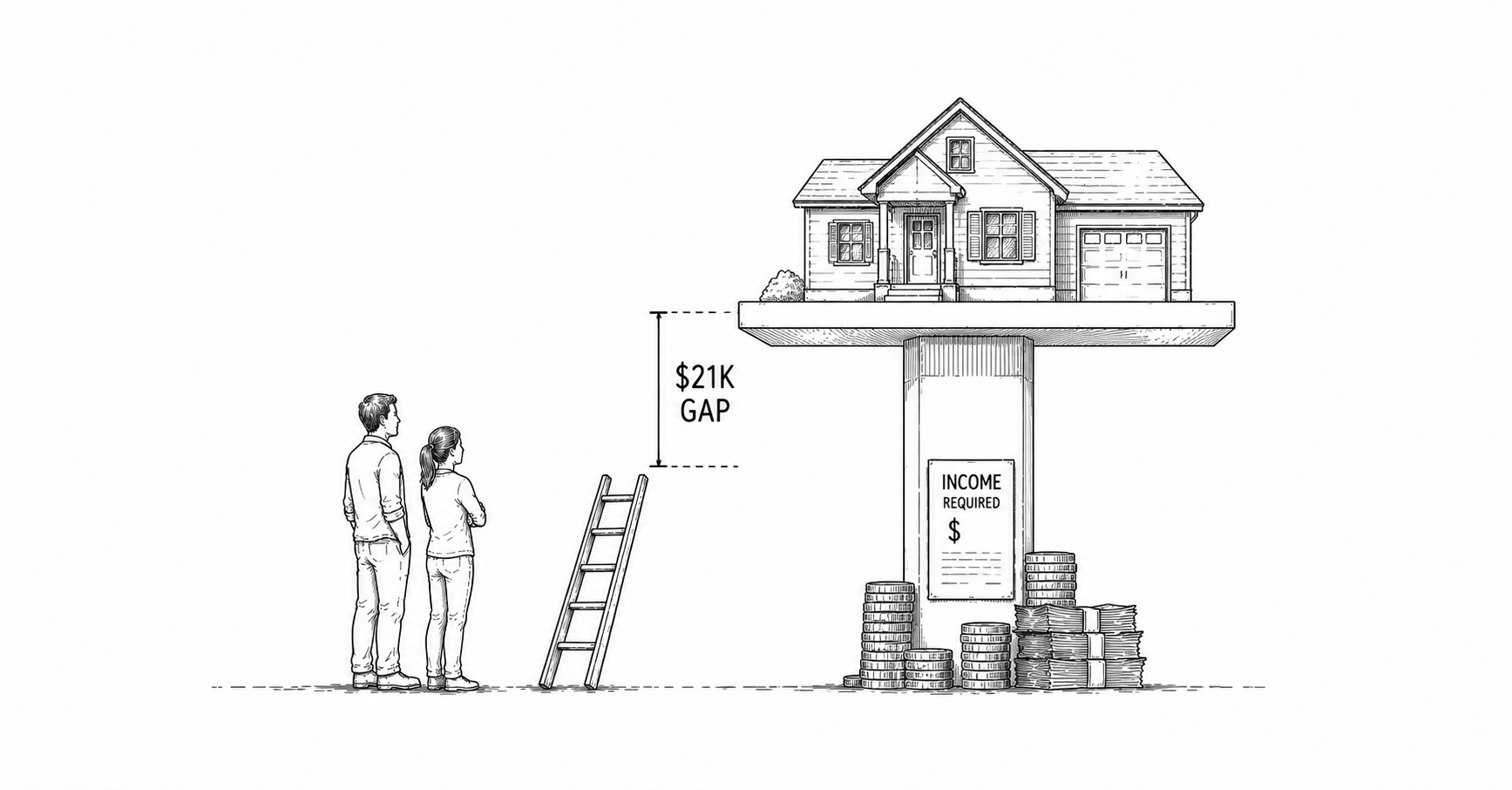
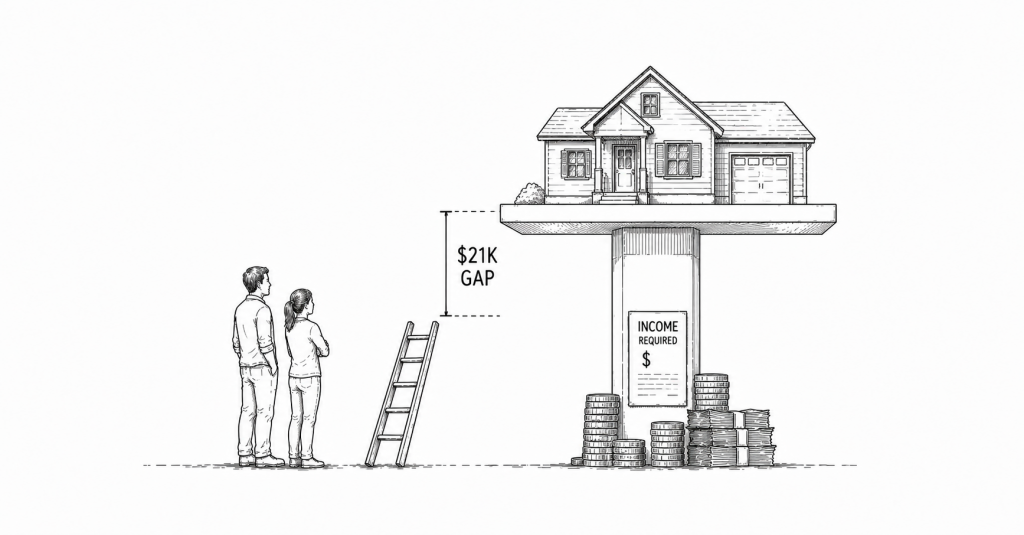
Here’s what the data actually shows. Median household income in the United States in 2026 is estimated at roughly $88,000. The income required to qualify for the median home is $109,152. The gap between those two numbers, roughly $21,000, is not a rounding error or a temporary market condition. It’s the distance between where the American middle class sits and where the housing market requires them to be in order to enter it, and that distance has been widening for years.
Yun’s annual comparison is misleading in a specific way. Saying affordability improved relative to last year means the situation got slightly less bad from a baseline that was already inaccessible to most American households. Improving from unaffordable to slightly less unaffordable isn’t a recovery. It’s a slower rate of exclusion.
The 20 percent down payment assumption embedded in NAR’s math deserves its own scrutiny, because it’s doing significant hidden work. Twenty percent of $446,400 is $89,280 — the upfront cash a buyer needs before paying a single dollar in mortgage, closing costs, homeowner’s insurance, or property tax. Most Americans don’t have $89,280 in liquid savings. Federal Reserve survey data has consistently shown that the majority of American households can’t cover a $400 emergency without borrowing. The distance between that reality and the down payment required to enter the median home market isn’t a personal finance problem. It’s a systemic one.
The median down payment among actual homebuyers is closer to 9 percent, less than half of what NAR’s affordability formula assumes. Buyers who put down less than 20 percent typically pay private mortgage insurance, which increases monthly costs and raises the effective income threshold even above the $109,152 figure NAR publishes. NAR is measuring affordability against a scenario most first-time buyers can’t access, and even that scenario shows affordability declining for five straight months.
Who can actually buy a home in this market? Primarily people who already own one. Repeat buyers can tap existing home equity, the accumulated wealth of prior ownership, to make a large down payment on a new property. That’s why the median down payment for repeat buyers is 23 percent while first-time buyers average 9 percent. The housing market has built a system where the primary qualification for buying your next home is that you already own one. For everyone outside that cycle — renters, younger workers, families without inherited wealth, people who moved for work and never bought in a cheaper market — the entry point has been priced above what their incomes can reach.
The median existing home sale price hit $440,600 in June, a national record, up 1.8 percent year over year. Record prices are good news if you own property. They are the precise mechanism of exclusion if you don’t. Every percentage point of appreciation on the median home increases the income required to afford it, increases the down payment required to enter it, and extends the timeline for anyone trying to save their way in.
The policy conversation not happening at sufficient scale is the one about supply. The gap between what American households earn and what American homes cost isn’t primarily a mortgage rate problem. Rates fell from their 2023 highs and affordability kept declining anyway, because the underlying asset kept appreciating faster than incomes could follow. The supply of homes for sale in the United States remains insufficient relative to demand, a problem built over decades of zoning restrictions, construction cost increases, and local political resistance to density. Bringing rates down further doesn’t solve a supply problem. It increases purchasing power in a market without enough inventory to absorb it, which puts upward pressure on prices and partially offsets the rate relief.
The number worth sitting with isn’t $109,152. It’s the $21,000 gap between that threshold and what the median American household actually earns. That gap means the median household, the exact middle of the American income distribution, can’t qualify for the mortgage on the median home in the country they live in. That’s not a market in the process of correcting. That’s a market that has already made its decision about who it serves.
Yun is right that things improved slightly from last year. The question is what “improvement” means when you start from a position where the typical American family is priced out of the typical American home. Getting closer to something you can’t reach isn’t the same as reaching it.