Saudi Arabia Is Building an AI Supercomputer Network. Its Plan Exposes a Deeper Bet.
Saudi Arabia announced in May 2026 that it had launched Humain, a new artificial intelligence initiative under the Public Investment Fund. The project aims to develop 1.8 gigawatts of data center capacity by 2030 and 100 gigawatts of AI compute capacity by 2026. Total AI-related investment commitments from Saudi public and private entities exceed 20 billion dollars. Microsoft confirmed that customers will be able to run cloud workloads from its Saudi Arabia East datacentre region from Q4 2026. Google has committed infrastructure deals. The Saudi Arabia Data Center Market is projected to grow from 1.33 billion dollars in 2024 to 3.9 billion dollars by 2030.
On the surface, this looks like a standard tech infrastructure bet. A wealthy country diversifying away from oil, investing in digital capacity, positioning itself as a regional tech hub. Vision 2030 has always included digital transformation. The data center expansion is consistent with that framing. But the scale and the speed suggest something deeper is happening. Saudi Arabia is not building data centers to compete with AWS or Azure in the global market. It is building compute capacity to run artificial intelligence models that will serve the Middle East and North Africa. It is building an alternative to Western AI infrastructure.
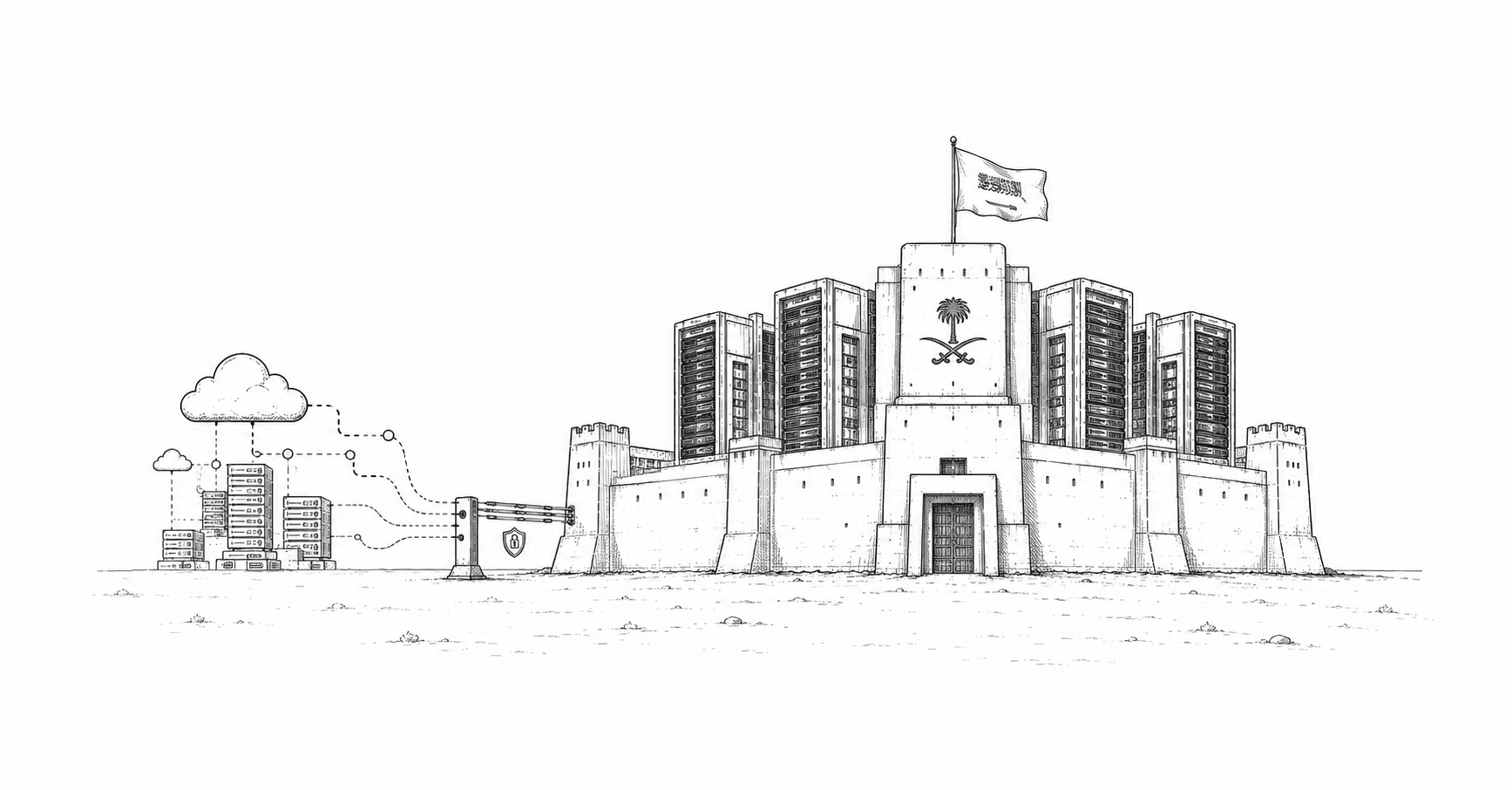
This matters because AI compute capacity determines which models run in which regions, which companies can deploy which services, and whose data gets processed through which systems. When Microsoft and Google operate datacentres in Saudi Arabia, they are operating on Saudi Arabia’s terms. The country can demand data localization. It can require compliance with Saudi regulatory standards. It can restrict which models run and which do not. It can exclude foreign companies that do not meet its terms. The data center infrastructure is not just about serving customers. It is about controlling which artificial intelligence systems operate within Saudi borders and what they are allowed to do.
The Humain initiative frames this as building an AI ecosystem. But the ecosystem is defined by Saudi Arabia’s strategic interests, not by open market competition. The country is following the China model: build domestic compute capacity, attract foreign companies to operate within your regulatory framework, develop domestic talent and companies that can leverage the infrastructure, gradually reduce dependence on foreign AI providers. The timeline is compressed compared to China’s approach, but the direction is identical.
What this exposes is that the global AI infrastructure is not actually global. It is regional. Microsoft’s datacentres operate under U.S. law. Google’s comply with U.S. regulations. For countries that want to use AI systems but do not want to do so under U.S. regulatory authority, that is a problem. Saudi Arabia is solving it by building infrastructure that operates under Saudi authority. The U.S. government has expressed concern about this because it reduces U.S. leverage over which AI systems run globally.
But from Saudi Arabia’s perspective, the U.S. concern is exactly the point. The country does not want American tech companies deciding what AI services can operate in the region. It wants to make that decision itself. The infrastructure investment is not primarily about economic growth, though that is part of it. It is about strategic autonomy from the U.S.-led AI ecosystem.
This is a pattern playing out across multiple countries. The EU is building its own AI governance framework. China is restricting foreign AI access and building domestic alternatives. India is negotiating with the UAE to build shared compute capacity rather than relying on U.S. cloud providers. Brazil is discussing sovereign AI infrastructure. The global AI market is regionalizing. U.S. tech companies will still operate globally, but they will do so under different regulatory regimes in different regions. Saudi Arabia is accelerating that fragmentation by offering alternative infrastructure with alternative governance.
The risk for the U.S. is not that Saudi Arabia builds data centers. It is that if Saudi Arabia succeeds in creating a viable alternative to U.S.-based AI infrastructure, other countries follow. Then the U.S. has less leverage over the global AI market. Then geopolitically, the U.S. loses one of its key advantages in the AI era: the ability to control which AI systems operate where and under what rules.
Saudi Arabia is framing this as Vision 2030 diversification. It is actually a geopolitical play dressed in economic development language. The data centers are the infrastructure. The real strategy is autonomy from U.S. tech dependency. That strategy is working because the U.S. tech companies want to operate in Saudi Arabia more than the Saudi government needs to use their infrastructure exclusively. That imbalance is where the leverage shifts.