Woonsocket Has One Supermarket for 45,000 People. Property Contracts Help Explain Why.

Rhode Island has banned a practice that let large grocers leave a neighborhood and keep another supermarket from replacing them.
Access Shift
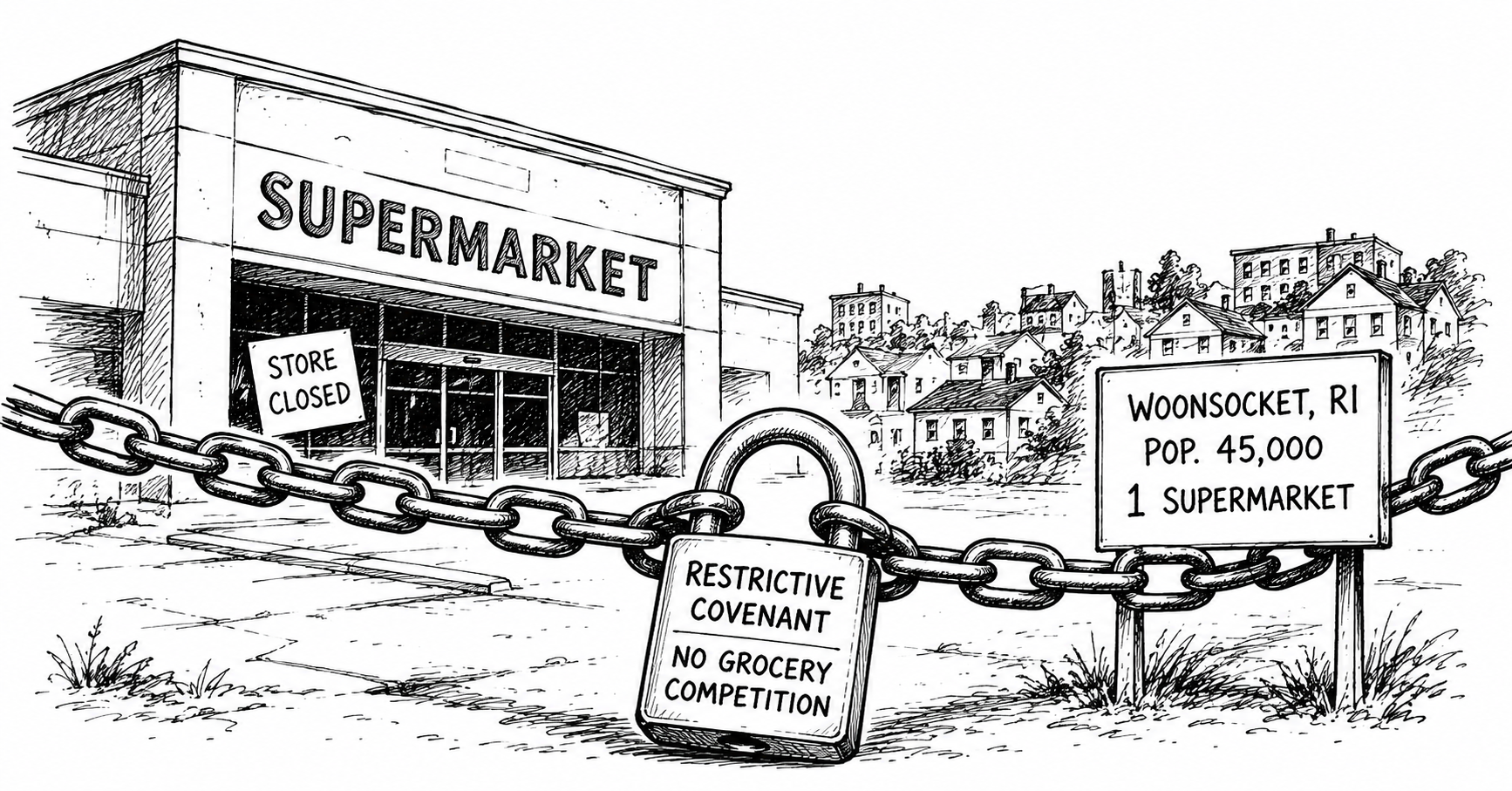
Woonsocket, Rhode Island, has roughly 45,000 residents and one full-service supermarket. Thirty-seven percent of residents are food insecure and 18 percent have no access to a vehicle. It reads as a familiar American food-desert story until the property records enter the picture. At least three Woonsocket properties carry restrictive covenants limiting grocery competition, including sites that major chains abandoned years ago.
That reframes the whole question. A food desert sounds like an absence, something that happened because no one came. A covenant is a decision, made by a company on its way out, that outlasts the company itself.
A Store Can Leave and Still Control the Market
Restrictive covenants are clauses attached to deeds or leases that limit how a property may later be used. Grocery chains have written them when relocating or closing stores, barring a competitor from taking over the site. Some remain enforceable for decades after the original store is gone.
In Woonsocket, a Stop & Shop that closed in 2004 left a restriction behind. Walmart departed in 2011 with a covenant barring both grocery stores and pharmacies from its former space. Statewide, officials have identified seven grocery-related covenants, one originally written for a 75-year term.
The physical economics are what make this bite. A full-size supermarket may need at least 30,000 square feet plus substantial plumbing, electrical, loading and parking infrastructure. An empty former grocery store is ordinarily the easiest possible entry point for a new grocer, already built to purpose. A covenant converts that asset into a site a competitor cannot consider at all. The community is not short on demand or on suitable buildings. It is short on buildings it is permitted to use.
The Ban Stops the Practice, Not Its Inventory
The state responded this year. Legislation signed by Gov. Dan McKee prohibits restrictive covenants intended to keep grocery stores out of qualifying retail properties. Lawmakers described the clauses as an anti-competitive practice capable of running 30 years or longer. Rhode Island became the second state to adopt such a ban.
The limitation is that the law does not void covenants already in force. Existing agreements run until their terms expire. One restricted Woonsocket property will not come available until 2034. The state has stopped the system from reproducing itself without dismantling what it already built.
Other barriers survive regardless. A local operator planning a supermarket in a former Sears building estimated the project at $3 million to $4 million; the cost has since grown to more than double that. Capital, construction and thin grocery margins remain serious obstacles even where no covenant applies. The law addresses one mechanism, not every reason supermarkets avoid lower-income communities.
Still, the mechanism matters because of what it makes visible. Food access is usually treated as a problem of geography, poverty or consumer demand. Rhode Island’s experience adds a category: ownership power written into property law. Once that is on the table, the policy question shifts. It is no longer only how to persuade grocers to enter underserved communities. It is why departing competitors were ever allowed to keep the door locked behind them.