
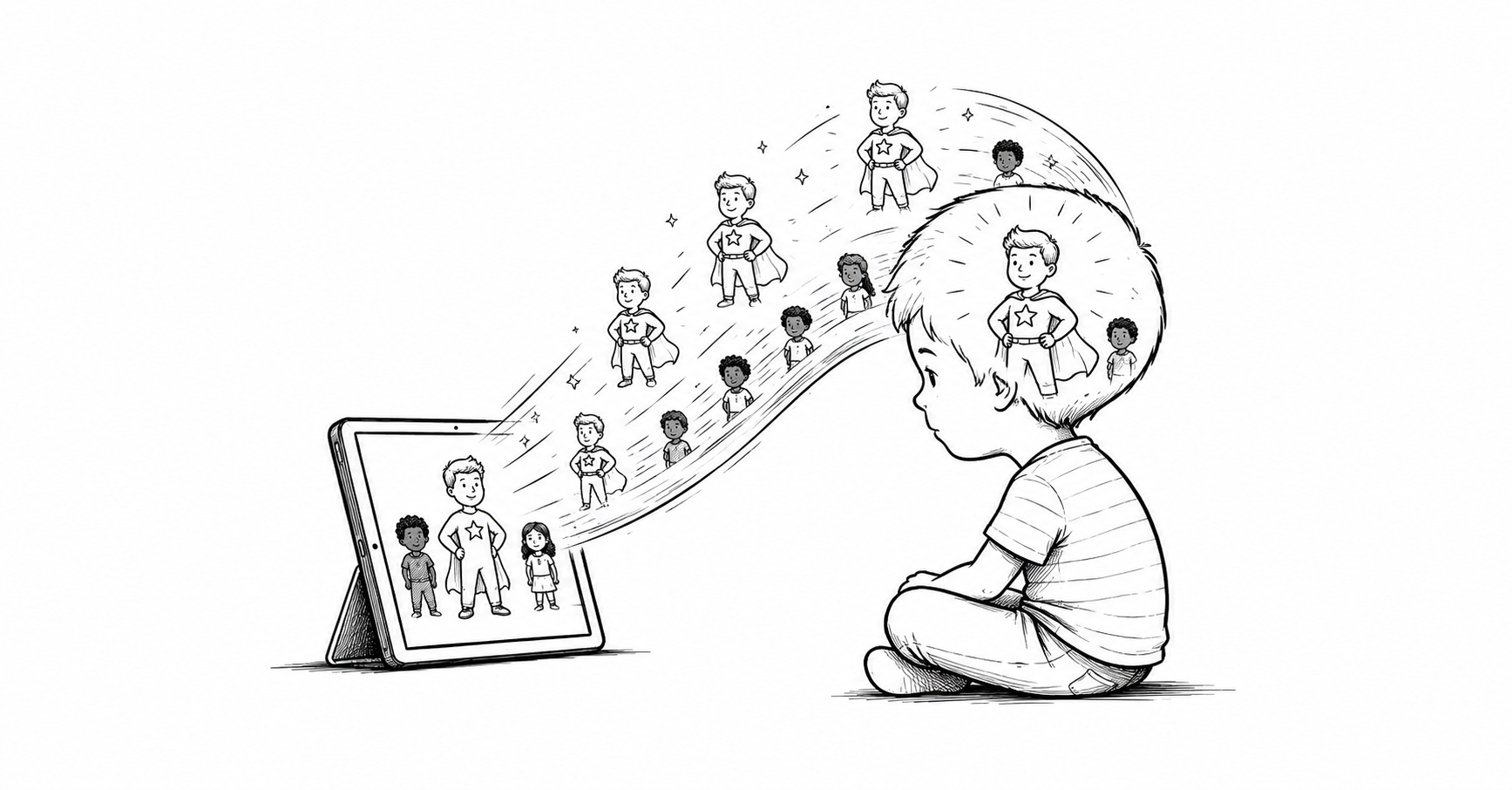
A New Study Found That Television and Movies Are Teaching White Children Racial Bias. The Researchers Say the Content Doing It Is Still Dominant in Popular Culture.
Research published this month in American Psychologist by Michael T. Rizzo and colleagues at New York University has established a direct link between the media young white children consume and the racial biases they develop. The study, titled “The role of children’s media in White, U.S. children’s developing racial biases,” was covered by Phys.org on July 14, 2026, and represents one of the most specific findings to date on how popular entertainment shapes the racial attitudes of children before those attitudes are ever consciously formed.
The finding is not that television and movies contain racial bias — that has been documented extensively. The finding is that exposure to that content measurably shapes the bias of the children watching it during developmental windows when those biases are still being formed. Rizzo, a postdoctoral researcher at NYU at the time of the study, stated the conclusion directly: “Our findings highlight the role media play in the development of racial biases during childhood and underscore the importance of monitoring the messages young children receive when consuming media.”
The paper was produced with co-authors including Megan Moran, Chrystelle Leveille, Alex Boyd, Cassandra Chum, and Jonathan Liles at NYU, along with Sydney Klein of the University of Connecticut and Tobias Britton of UC Santa Cruz. Its senior author, Marjorie Rhodes, a professor in NYU’s Department of Psychology, noted that “These findings offer pathways for addressing racial biases before they become deeply entrenched.”
That last line is important. The study is not documenting something irreversible. It is documenting something preventable — and the preventability is the structural argument that requires most of the work to hold.
The popular cultural ecosystem that children consume most heavily — animated films, streaming children’s content, broadcast television — is produced by a small number of major media companies. Those companies operate under market conditions that have historically rewarded particular representational patterns: white protagonists who save, lead, and are heroic; characters of color who are secondary, comedic, villainous, or absent. Those patterns are not accidents of individual creative choice. They are products of an industry structure where the people making decisions about what gets produced, greenlit, and distributed have been predominantly white, predominantly male, and are working within a commercial framework that treats the status quo as the default. The default carries a racial logic.
What Rizzo and colleagues have documented is the downstream effect of that default logic on child development. Children do not arrive at racial bias through a single documentary or news event. They absorb it through cumulative exposure — thousands of hours of media in which who gets to be the hero, who gets to be the person in distress, who gets to speak first and last and most, encodes a social hierarchy into the developing mind before the child has the cognitive framework to question it.
The study’s significance is not just as a research finding. It is as a corporate accountability argument. If exposure to dominant media patterns produces measurable racial bias in children, then the companies producing that media are producing a downstream social harm, not just content. The question of what they are responsible for — legally, ethically, commercially — follows directly from what the research establishes.
The media industry has made visible commitments to representation since 2020, and some of that movement has produced genuine change. But Rhodes’s statement that these findings offer “pathways for addressing racial biases before they become deeply entrenched” implies a faster timeline than corporate diversity initiatives typically operate on. Children’s biases are being formed now, by content being produced and distributed now, within an industry that is still predominantly controlled by the same demographic groups that have always controlled it.
The research does not identify the specific titles or companies responsible for the most damaging patterns. That would require a different study design, and it is also the kind of specificity that draws legal and commercial risk. But the structural argument the research supports does not need individual titles to be valid. The aggregate pattern of representation across popular children’s media — the one that exists when you look at the industry as a whole — is the producing condition. Addressing it requires industry-level accountability, not title-by-title content audits.
Rhodes is right that the findings offer pathways. The more important question is who is positioned to walk them. Regulatory frameworks for children’s media have existed since broadcast television, but streaming has largely escaped those frameworks. The platforms distributing the content most likely to shape children’s racial attitudes operate under significantly fewer content obligations than traditional broadcasters. That regulatory gap is not accidental. It was created through lobbying, through the speed of technological change, and through a policy environment that treats content as speech rather than as a social infrastructure with measurable developmental consequences.
The research establishes the mechanism. The policy question is who owns the responsibility to interrupt it.