California Is Considering Paying Newsrooms According to How Many Journalists They Employ
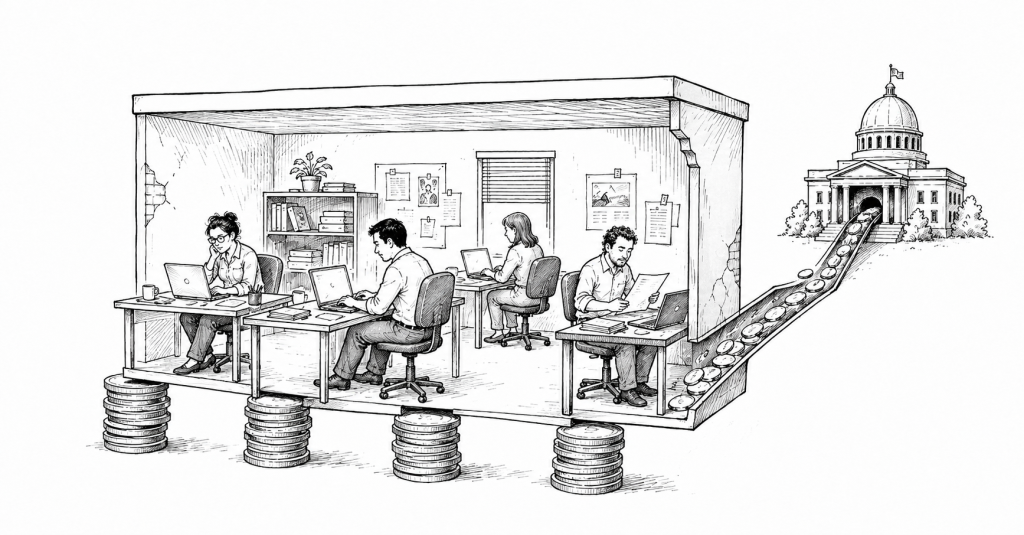
AB 2222 would use refundable tax credits to preserve reporting jobs, turning newsroom payroll into a public-policy target.
Structural Reality / Policy
California lawmakers are weighing an unusual answer to the collapse of local journalism: pay news organizations by the head. Assembly Bill 2222 would provide a refundable state tax credit of $20,000 for each of a newsroom’s first five full-time qualifying journalists, $15,000 for each additional journalist and another $15,000 for each new full-time position. Part-time journalists would generate $7,500.
The Franchise Tax Board estimates the program could make more than $40 million available annually. The Assembly has approved the measure; as of Aug. 28 the amended bill had been read a second time in the Senate and ordered to a third reading, near the end of the legislative process but not yet law.
The dollar figures are not the interesting part. What California is proposing is a shift in what the state thinks it is buying. Not content, not access, not a settlement with the platforms — the continued existence of people employed to report.
From Platform Payments to Payroll
California spent years debating whether technology companies should compensate publishers whose journalism circulates through search engines and social platforms. That framing treats journalism as content with a price that someone is failing to pay. AB 2222 abandons it. Rather than calculating what Google or Meta owes a publisher, the state would subsidize the labor that produces the journalism in the first place.
The financing is equally indirect. The bill would align parts of California’s tax code with a federal change limiting deductions for certain executive compensation above $1 million, generating additional state revenue, then route money to newsrooms through refundable credits. Because the credits are refundable, an eligible newsroom could collect the amount exceeding its state tax liability rather than merely zeroing out a tax bill — which matters, since many struggling outlets owe little tax to offset.
The design also tries to wall off editorial judgment. Money would not follow whether officials approve of a newsroom’s coverage. The metric is employment: keep journalists, receive a credit; add journalists, receive more. Eligible organizations would still have to meet statutory requirements establishing that they are legitimate local news operations.
Journalism as Infrastructure
The premise is that journalism now generates more social value than the market will finance. A report cited by the Los Angeles Times estimates the number of local journalists per 100,000 U.S. residents has fallen 75 percent since 2002. Advertising migrated to digital platforms, newspapers closed, staffs contracted, and many surviving outlets cut the expensive work — school boards, courts, agencies, neighborhoods — first.
Opponents dispute the remedy without necessarily disputing the diagnosis. The California Taxpayers Association and business groups argue that taxing one set of employers to fund credits for an unrelated industry is poor fiscal policy. Republican Assemblymember Carl DeMaio has objected to public support flowing to outlets that make political endorsements, which raises the harder question underneath the bill.
Fire departments, libraries and transit systems are subsidized because their public value cannot be fully captured transaction by transaction. American journalism has resisted that category, on the reasoning that financial independence from government underwrites editorial independence from it. AB 2222 attempts a narrower version: fund the existence of reporting jobs without funding any particular reporting. Whether that line holds is the experiment.
If the bill passes, the consequential change will not be the $20,000. It will be the assumption beneath it — that working journalists are a measurable civic resource worth preserving on purpose. That moves the local-news debate past the search for a new business model and toward a harder question: what does a democracy do when it decides an institution is necessary after the market has stopped producing enough of it?