The U.S. Economy Is Still Holding. Consumers Are Less Convinced It Will.

Spending, employment and business investment have stayed resilient. Inflation, borrowing costs and expectations are moving the other way.
Society & Economy
The latest U.S. economic numbers refuse to tell one story. Inflation ran at 3.7 percent in July. Consumer confidence fell to 89.4, its lowest in seven months. The average 30-year mortgage reached 6.66 percent. Yet unemployment claims remain historically low, consumer spending grew strongly through the second quarter and businesses kept investing.
The contradiction is not really a contradiction. It is a gap between how the economy is performing and how secure people feel inside it. The aggregate figures describe production. The sentiment figures describe whether households believe that production will protect them from whatever comes next. Those two things have come apart, and the second is deteriorating first.
Growth Held. Household Momentum Did Not.
Real GDP expanded at an annualized 1.5 percent in the second quarter, down from 2.1 percent in the first. The headline understates the underlying strength. Consumer spending grew at a 3.4 percent annual rate, business investment outside housing rose 8.5 percent on the strength of the AI infrastructure boom, and imports, which subtract from the GDP calculation, accounted for much of the slowdown.
July looked different at the household level. Personal income rose 0.4 percent and disposable income 0.5 percent, but nominal spending increased only 0.2 percent. Adjusted for inflation, real spending was essentially flat. The personal saving rate stood at 3 percent, leaving little cushion if prices keep climbing.
Inflation is what closes that gap between income and spending. The Federal Reserve’s preferred PCE index was 3.7 percent higher than a year earlier in July, unchanged from June and well above the 2 percent target. Core PCE, excluding food and energy, stood at 3.3 percent. Inflation-adjusted incomes were only 0.2 percent higher than a year earlier, according to the Associated Press’s analysis of the government data. Households are earning more and buying almost exactly as much as before.
Confidence Is a Forecast, Not a Report
The Conference Board’s August survey separates the two cleanly. Its Present Situation Index, measuring how consumers see current business and labor conditions, rose 6.8 points to 121.2. Its Expectations Index, covering the outlook for income, jobs and business conditions, fell 5.8 points to 68.2. Overall confidence slipped to 89.4. Americans grew more positive about what they could see and more pessimistic about what they anticipated.
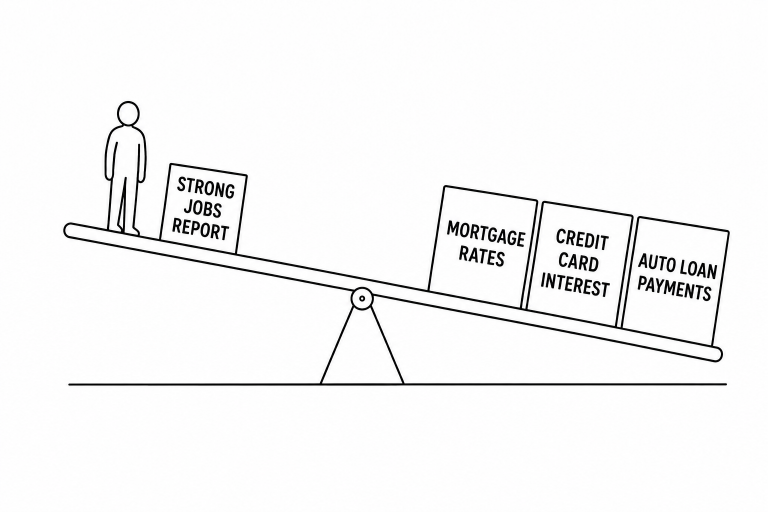
Borrowing costs sharpen that anxiety. The 30-year mortgage near 6.66 percent sits close to its 2026 high, and persistent inflation has kept pressure on longer-term rates. The consequences are concrete rather than statistical: expensive housing finance, elevated credit costs, and prices still rising from a level already reset substantially higher during the post-pandemic cycle.
Which is why sentiment cannot be waved off simply because aggregate spending is intact. People do not experience GDP. They experience whether raises outrun prices, whether a house is reachable, how much interest they carry and how hard replacing a job would be. Each of those can deteriorate well before the aggregate economy visibly contracts.
The United States can keep producing, investing and hiring while households grow less confident that any of it will hold. If that gap widens, the indicator worth watching is not whether Americans are still spending. It is how long they believe they can keep it up.