Women Are Moving Into Jobs That Automate Slowly. Men Are Concentrated in Jobs That Disappear Fast.
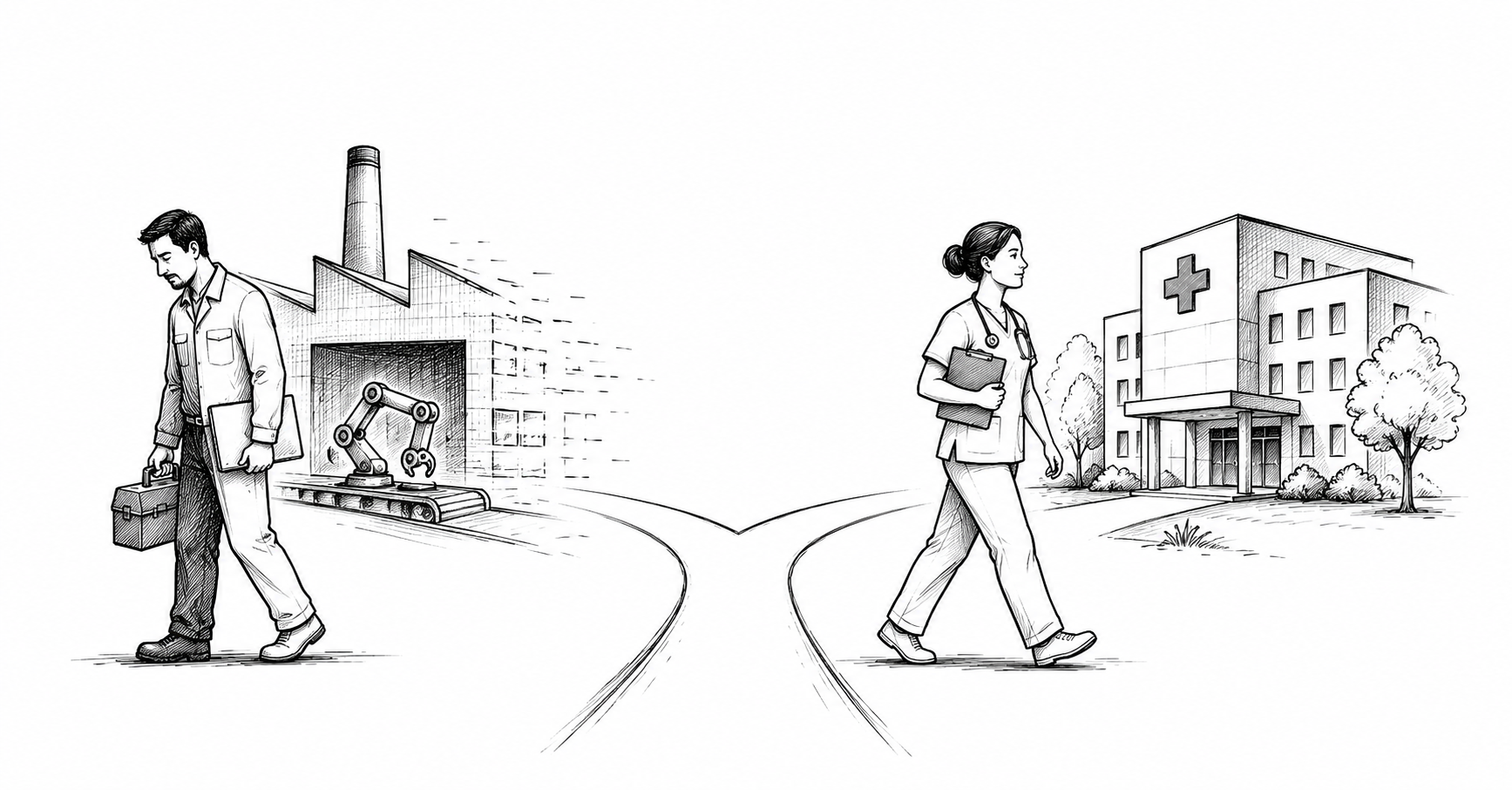
According to McKinsey analysis and recent employment data, sectoral automation sorts the labor force by gender. Healthcare and education add jobs annually—sectors where women concentrate. Technology and manufacturing lose jobs—sectors where men concentrate. Manufacturing lost over 90,000 jobs in 2025, the third straight year of decline, according to CBS News and Marketplace reporting. U.S. employment growth is driven by healthcare jobs, with demographic changes including aging baby boomers driving demand for medical services. This divergence is not accidental. It reflects the sectoral concentration of the labor force by gender that has developed over decades.
As automation reshapes the economy, it eliminates jobs where men are concentrated while growing jobs where women are concentrated. The outcome is a reshaping of the labor force along gender and sectoral lines. Women are gaining employment in growing sectors. Men are losing employment in shrinking sectors. The overall unemployment rate stays stable because the gains offset the losses. But that aggregate obscures massive reallocation by gender and sector.
For individual men, the displacement is devastating. A 50-year-old man losing a $90,000 manufacturing job cannot easily find new employment paying similar wages. The jobs available in his region are healthcare (nursing starting at $58,000, healthcare admin at $45,000) and retail (starting at $30,000). His displacement is real even if aggregate unemployment suggests the economy is functioning normally.
Healthcare added 200,000 jobs in 2026. Nursing, the largest healthcare occupation, hired predominantly women. Manufacturing lost 150,000 jobs as automation accelerated. These were predominantly held by men. The gender divergence in job creation and job loss is not policy-driven. It emerges from the sectoral concentration of the labor force and which sectors automation targets.
A manufacturing facility that employed 200 workers in 2020 employed 40 workers in 2026. The 160 job losses were predominantly men. The facility was not closing—it was automating. Robotic welding, automated assembly, computer-controlled machinery. The workers who remained were programmers and technicians maintaining equipment. The workers displaced were production line workers who earned $50,000-75,000. They couldn’t find replacement work at similar wages.
Meanwhile, a hospital in the same region hired 40 nurses. They were predominantly women. The wages were $58,000 starting. But those jobs required credentials and training. A laid-off manufacturing worker with a high school diploma couldn’t transition into nursing without two years of additional education. The jobs that were being created required different qualifications than the jobs that were disappearing.
According to WHO, there is an 11 million health-worker shortfall projected by 2030. Each healthcare job supports 3.4 additional jobs. The pipeline for healthcare employment is expanding while manufacturing automation eliminates pathways.
What happens when the labor market reorganizes along sector and gender lines? The next recession targets different demographics differently based on sectoral concentration. The labor market has sorted people. The next shock will reveal what sorting produces. Men in shrinking sectors face vulnerability. Women in growing sectors have some protection. The divergence will compound.