The UAE Set a Minimum Wage for Its Own Citizens. The Migrant Workers Who Outnumber Them 9-to-1 Are Still Outside It.
On January 1, 2026, the UAE implemented a minimum wage of AED 6,000 (approximately $1,634) per month for Emirati nationals employed in the private sector. Employers were given until June 30 to amend existing contracts. Middle East Briefing and Morgan Lewis both covered the policy as a milestone for private-sector labor standards in one of the Gulf’s wealthiest economies.
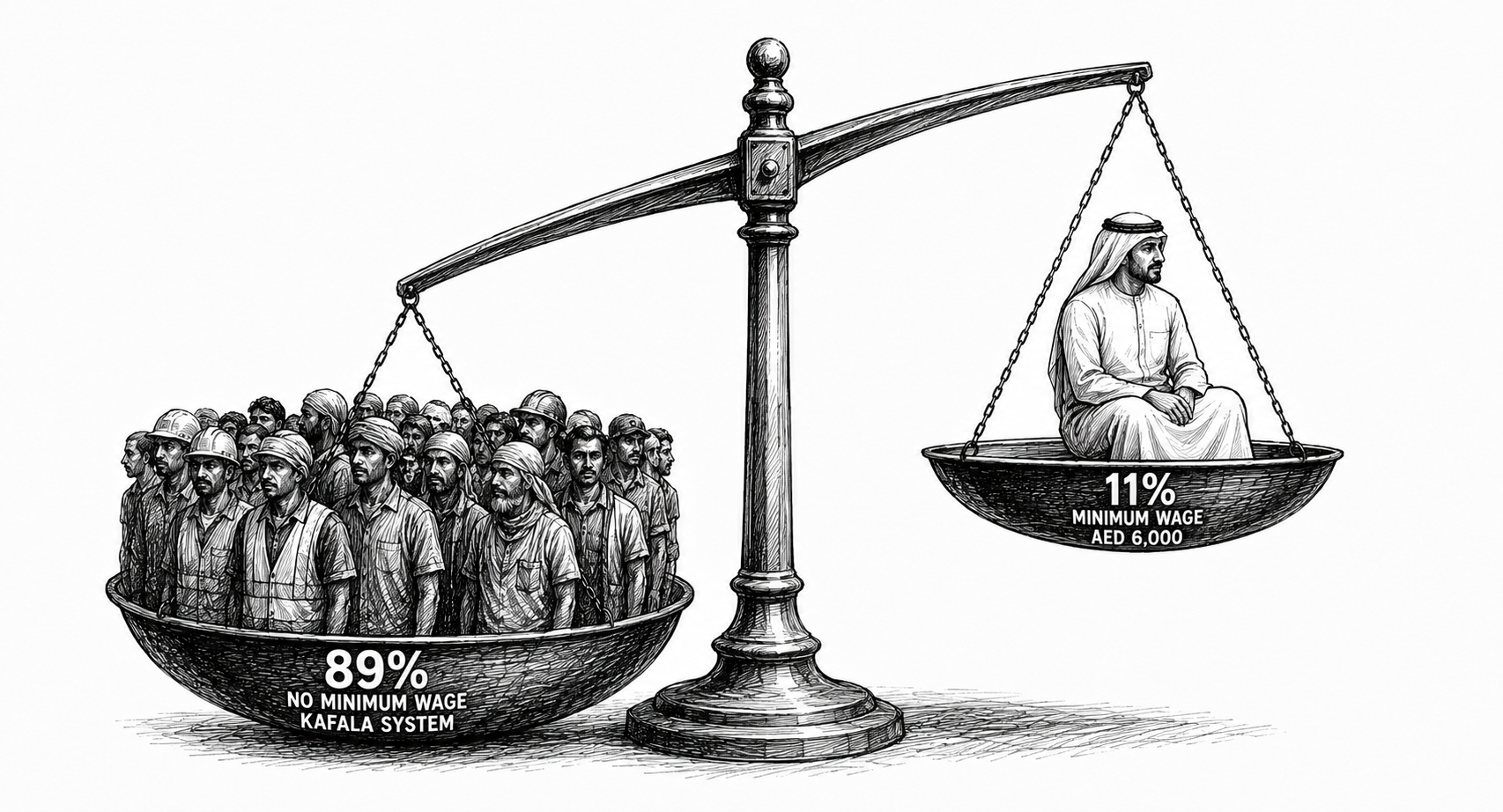
What the coverage largely omitted: Emirati nationals represent approximately 11% of the UAE’s total population. The remaining 89% — roughly 9 million migrant workers from India, Pakistan, Bangladesh, the Philippines, Nepal, Egypt, and dozens of other countries — are not covered by the minimum wage. They are covered by the Wage Protection System, which monitors payment timing and non-payment violations, and by individual contracts enforced through the Ministry of Human Resources and Emiratisation. They are not covered by a wage floor.
The legal architecture separating those two groups is the Kafala sponsorship system. Under Kafala, most migrant workers’ legal residency in the UAE is tied to their employer. They cannot change jobs without employer approval in most circumstances. They cannot remain in the country after a contract ends without employer sponsorship for a new role. The employer holds, functionally, exit-gate authority over the worker’s ability to stay, work, or seek recourse. Within that framework, a minimum wage for Emirati citizens does not alter the negotiating conditions for the 9 million workers whose position in the labor market is already defined by structural dependency.
The UAE has modified Kafala incrementally in recent years — introducing a Domestic Worker Law in 2017, enabling some job mobility for workers on expired contracts after 2021, and expanding the WPS monitoring system. Those reforms have not dissolved the foundational power asymmetry the sponsorship structure creates. An employer who controls a worker’s visa status retains leverage that no contract provision fully counteracts.
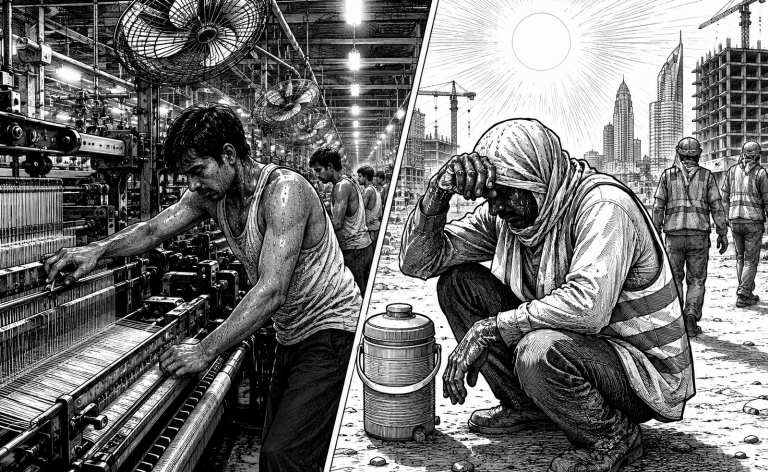
The economy rests on migrant labor in a way that is structural, not incidental. Migrant workers build the country’s infrastructure, staff its hospitality sector, drive its logistics network, maintain its residential towers, and perform the domestic labor that makes the standard of living of its citizen population possible. They do this work inside a legal framework that makes it difficult to leave a bad employer, effectively impossible to organize collectively, and structurally costly to report wage theft or safety violations.
Setting a wage floor for Emirati nationals in the private sector addresses a real disparity — Emirati workers have historically been underrepresented in private-sector employment partly because public-sector compensation was higher, and the AED 6,000 floor is designed to close that gap and encourage Emiratisation of private-sector roles. That is a legitimate policy objective. It does not become a labor market reform for the broader workforce simply because it was announced alongside language about worker dignity.
A wage floor covering 11% of the workforce, inside a two-tier legal system in which the other 89% have structurally constrained bargaining power, is a compensation policy for one category of worker in an economy built on the legal vulnerability of another. The labor rights framework migrant workers in the Gulf have been requesting — bilateral labor agreements with meaningful enforcement, standardized base wages, and Kafala restructuring — remains unmade.
Whether the coverage calls this a labor rights milestone or a selective policy depends on which workers it considers the relevant population. In the UAE, the relevant population is the one that makes the economy run. 89% of them are outside the wage floor announced in January.