Texas Cities Are Legally Forbidden From Raising Their Own Minimum Wage. The Cities Where Living Costs Rose Fastest Are the Ones Most Locked Out.
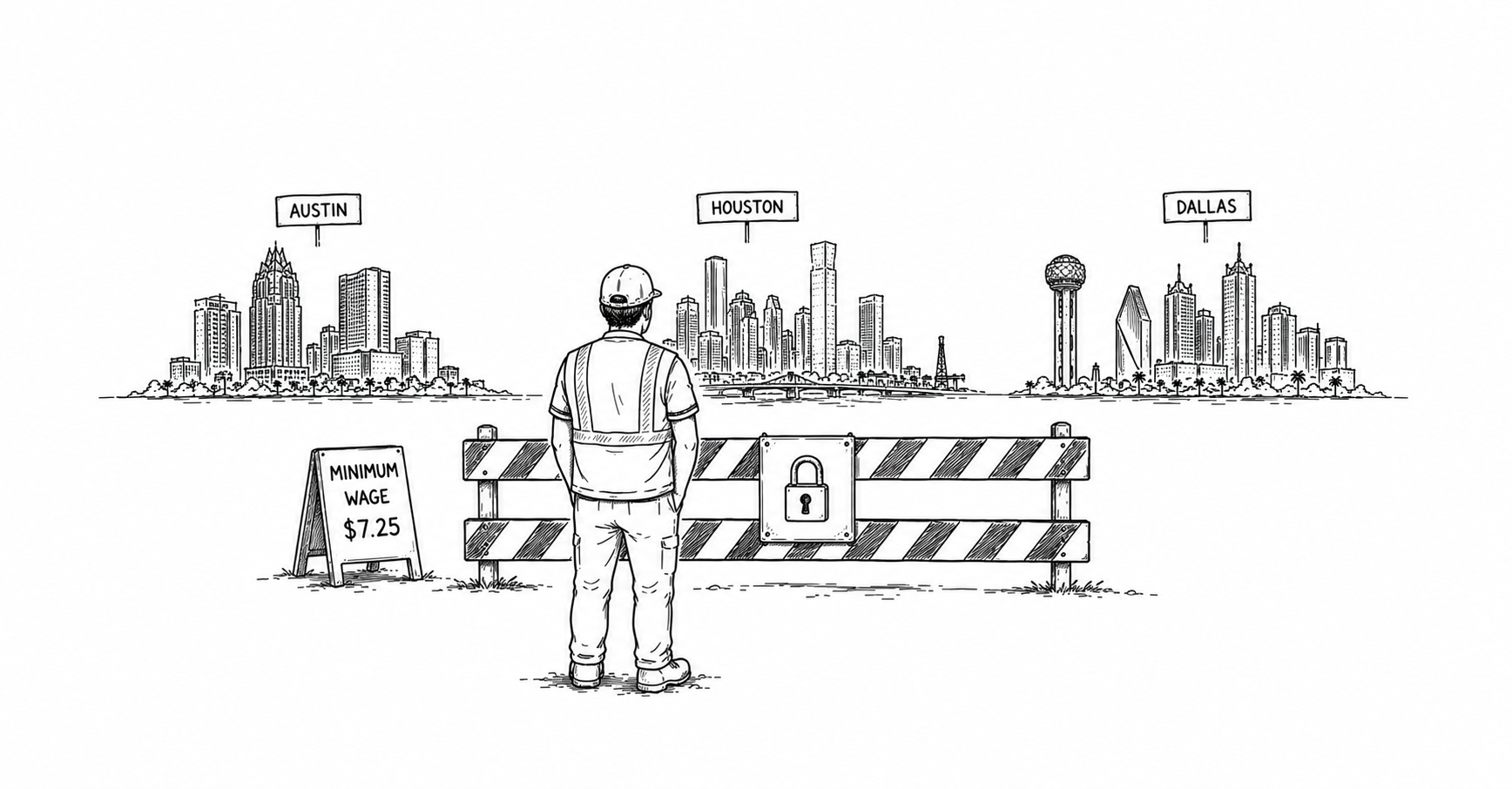
Texas has preempted local minimum wage ordinances since 2003. As living costs in Austin, Houston, and Dallas compounded over two decades, the floor stayed fixed at $7.25. The state sets the rule. The cities absorb the consequences.
Texas has not raised its minimum wage since 2009, when it matched the federal floor at $7.25 per hour. Seventeen years later, the floor has not moved. Section 62.0515 of the Texas Labor Code explicitly prohibits any city, county, or political subdivision from requiring employers to pay above the state or federal minimum.
The preemption exists because Texas municipalities tried to act. Austin and San Antonio both attempted local minimum wage ordinances. Both were blocked. In 2023, the Texas Regulatory Consistency Act — known informally as the Death Star law — extended state preemption across labor, environmental, and other regulatory domains, removing any remaining ambiguity about whether cities retain authority to govern wages within their limits.
The result is a structural mismatch that compounds with time.
Austin’s median rent now exceeds $1,296 per month. Houston’s cost of living has risen consistently across rent, groceries, and transportation. Dallas has experienced significant housing cost increases despite construction activity. In all three cities, a worker earning $7.25 per hour generates approximately $15,000 per year at full-time hours — enough to cover roughly one month of rent at current median prices.
States use preemption to enforce policy uniformity and prevent what they describe as a patchwork of inconsistent regulations. That argument has genuine merit in some regulatory domains. Applied to wage floors, it enforces consistency downward: the state sets a minimum that no local government can exceed, regardless of what it costs to live in that jurisdiction.
The cities most exposed to a $7.25 floor are not rural communities with low housing costs. They are Texas’s major metros — where technology employment, population growth, and construction demand have driven living costs far beyond what the federal minimum can reach.
Workers in Austin earning $7.25 cannot afford Austin. The city cannot change that. The state has specifically reserved the authority to prevent it from trying.
Power in Texas wage policy sits entirely at the state level, held by a legislature that is not elected by — and does not reflect the economic conditions of — the urban workers most exposed to the floor it enforces. The cities experience the cost of living. The state controls the floor. Those are not the same governing body, and they do not share the same accountability to the workers living between them.
—
Sources: Texas Labor Code Section 62.0515; Littler analysis of Texas Regulatory Consistency Act, 2023; Texas Payroll Guide minimum wage reporting, 2026; Bloomberg Government preemption analysis.