Nigeria’s Doctor Shortage Is What Underfunding Produces
When a country trains medical talent but cannot retain it, healthcare access becomes a class system.

Chioma Obinna reported for Vanguard on June 18 that Nigerian doctors are warning of a dangerous manpower crisis, with only about 55,000 doctors actively practicing inside the country. The president of the Nigerian Medical Association, Prof. Omoti Ernest, told Vanguard that the Medical and Dental Council of Nigeria had registered more than 130,000 doctors, but only about 55,000 were working in Nigeria. He put the practical ratio at roughly one doctor for every 3,600 to 4,000 people.
A country with 55,000 doctors for more than 220 million people has a capacity problem only on the surface. The operating mechanism is retention. Nigeria has doctors in the record books, doctors in training pipelines and doctors practicing abroad. What it does not have is a public health system strong enough to hold enough of that talent in place.
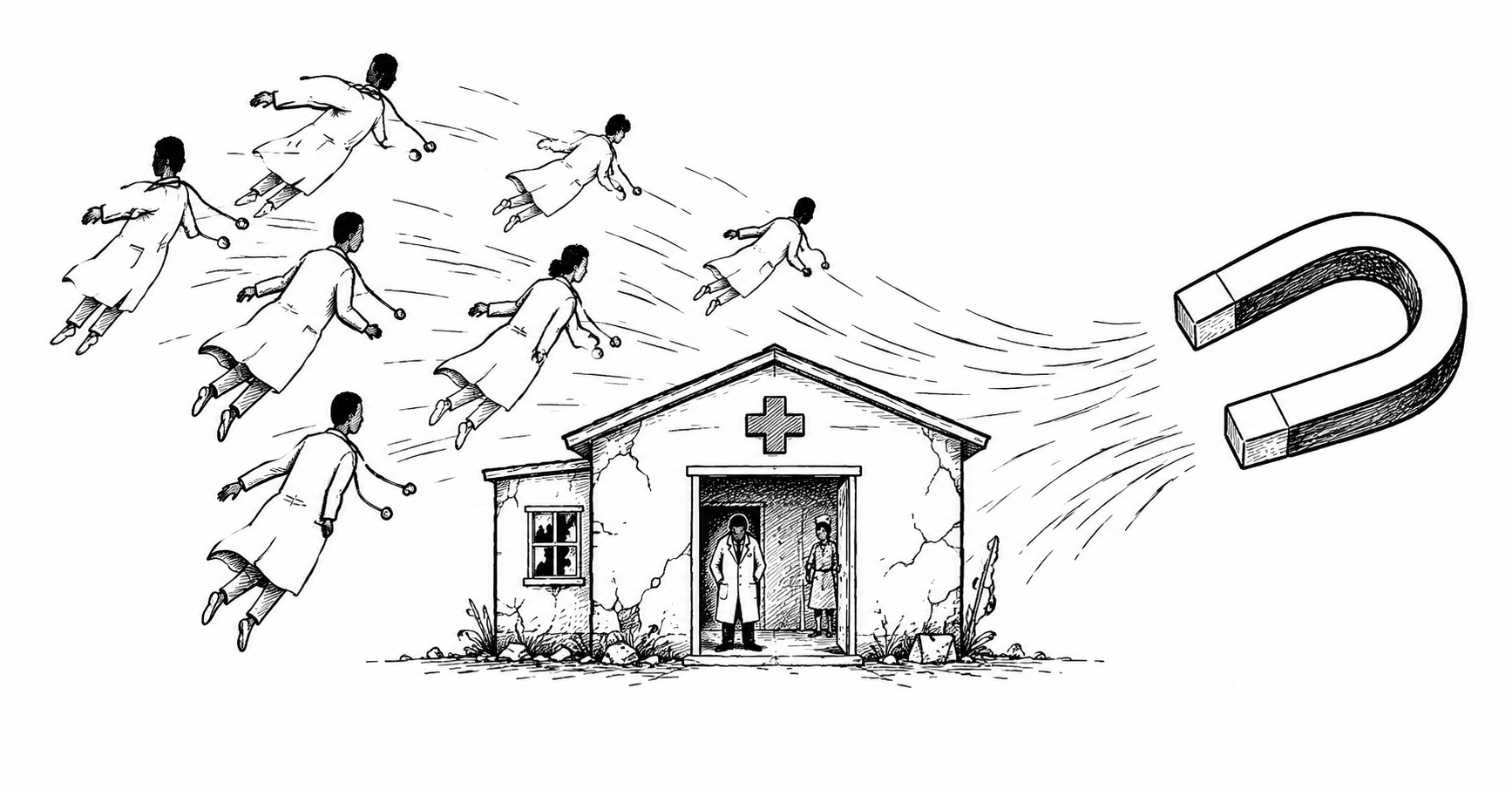
The gap is not mysterious. Nigerian-trained doctors are leaving because the global labor market is telling them, plainly, that their skills are worth more somewhere else. Obinna reported that at least 16,000 Nigerian doctors have emigrated in the last five years, with doctors citing poor pay, delayed salaries, unsafe working conditions, weak infrastructure, heavy patient loads and limited career advancement. None of that sounds like a lack of patriotism. It sounds like math.
The country did the hard part. It trained the doctors. Then it built working conditions that make departure rational. Talent moves toward stability, pay, equipment, safety and professional growth. When those things are supplied by the United Kingdom, Canada and the United States, doctors follow the system that can actually support their labor.
That movement creates a quiet transfer of public investment. Nigeria absorbs the cost of producing medical talent, then higher-wage countries receive the benefit of that training. The receiving countries get staffed hospitals without carrying the full social cost of educating those workers. Nigeria gets the empty chair, the longer queue, the exhausted resident doctor and the patient who arrives late because the nearest specialist is too far away or too expensive.
Underfunding turns that transfer into a domestic access crisis. In March, Eromo Egbejule reported for The Guardian that Nigeria’s health sector received roughly 5.2% of the country’s 2025 federal budget, far below the 15% Abuja Declaration target agreed to by African Union member nations. That budget number matters because staffing is never only staffing. It is salary reliability. It is equipment. It is hospital power supply. It is medicine availability. It is whether a young doctor can imagine a future inside the public system without sacrificing basic professional dignity.
The result is a healthcare structure split by class and geography. Wealthier Nigerians can seek private hospitals, travel for care or pay their way around delay. Poor and rural Nigerians absorb the shortage directly: longer waits, fewer specialists, out-of-pocket costs, missed diagnoses and heavier dependence on whatever care is reachable. Mental health shows the fracture sharply. Vanguard reported that specialists warned the shortage is worsening psychiatric access, with many Nigerians living with mental health conditions unable to obtain formal care.
Training more doctors may still be necessary, but training alone cannot repair a system that exports its own workforce. More medical school seats will produce more graduates, but graduates will keep leaving if the public system cannot compete on pay, safety, equipment and career path. A retention strategy has to treat doctors as public infrastructure, rather than as professionals expected to carry institutional failure because patients need them.
Nigeria’s doctor shortage is what happens when healthcare is treated as a budget line instead of a public good. The next phase will be harsher if the incentives do not change: public hospitals will carry the sickest patients with the thinnest staffing, private care will become the practical safety net for those who can pay, and medical migration will keep functioning as a release valve for doctors rather than a repair plan for patients.