Wholesale Inflation Went Flat in July. The Measure That Strips Out the Noise Rose Four Times Faster Than June.
Gasoline did the work. Construction, portfolio management and services went the other way.
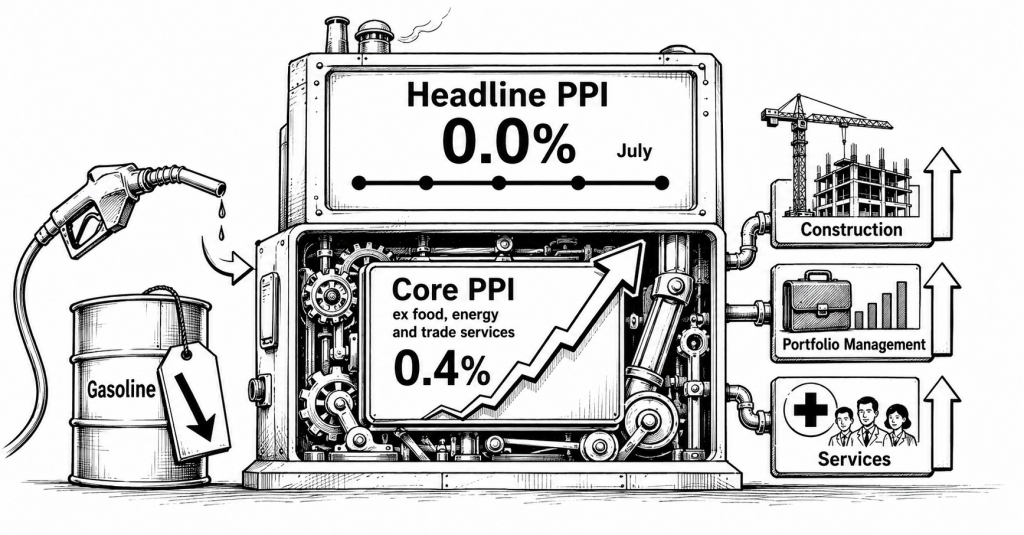
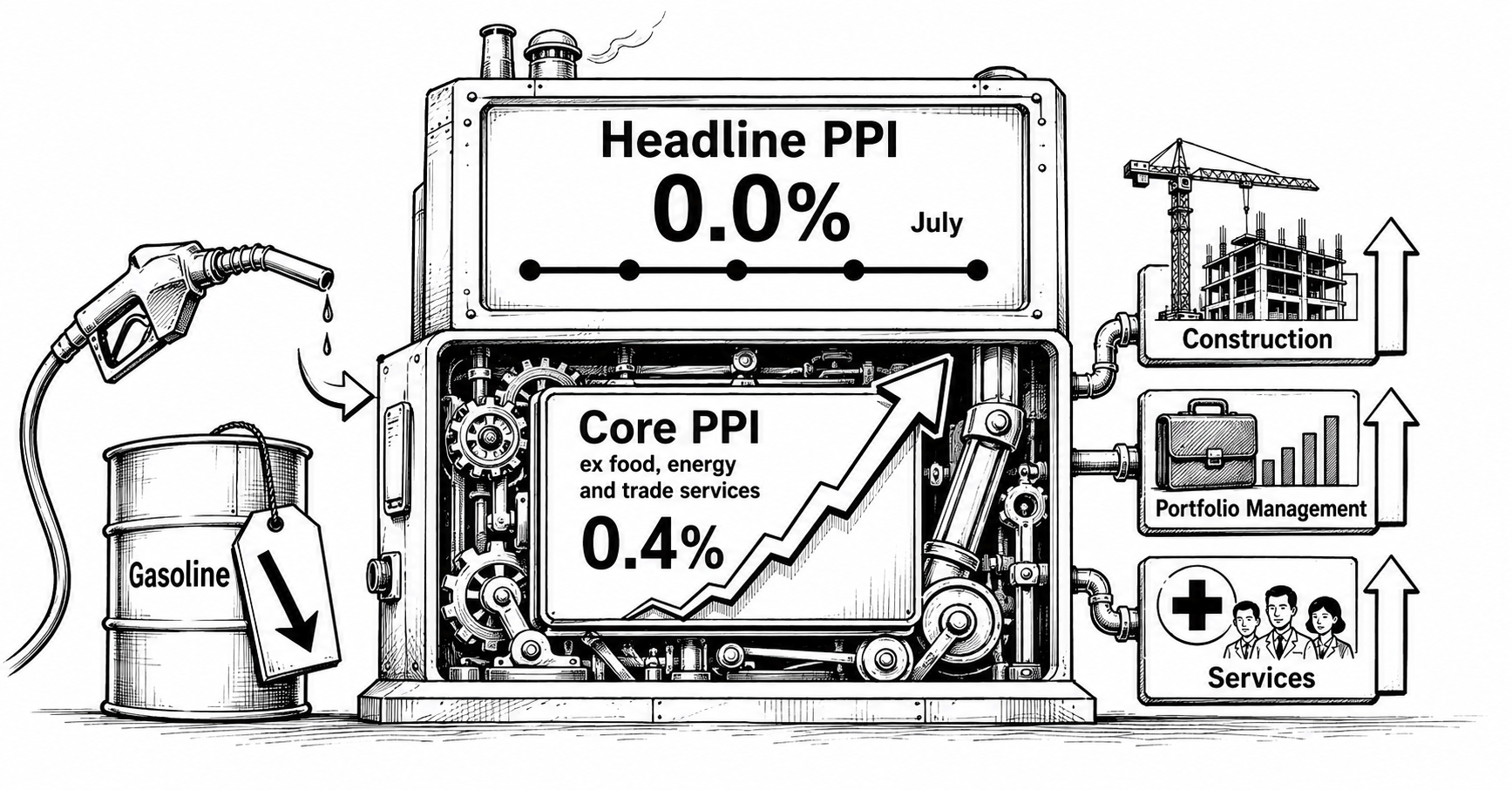
The Bureau of Labor Statistics reported Thursday that the Producer Price Index for final demand was unchanged in July, below the 0.2 percent consensus, with the annual rate slowing to 4.7 percent from 5.5 percent in June. Coverage moved immediately to the easing narrative, and the headline supports it. The composition does not. Core PPI excluding food, energy and trade services — the measure built specifically to filter out what jumps around — rose 0.4 percent for the month, up from 0.1 percent in June, and its twelve-month rate sits at 4.7 percent, identical to the headline it is supposed to clarify.
The Flat Number Has Two Halves
Goods prices fell 0.7 percent, driven by a 3.1 percent drop in energy that included a 5.7 percent slide in gasoline. Food fell 0.9 percent. Those declines are the entire flat reading.
Services moved the other direction at 0.2 percent, led by a 6.5 percent surge in the portfolio management index. Construction prices advanced 2.2 percent, the largest single move in the report and one that flows toward shelter costs on a lag measured in quarters rather than months. A reading that nets a gasoline collapse against a construction spike produces zero, and zero is not the same as stability.
What Fell Was the Thing That Had Already Spiked
Energy prices are lower now because they were extraordinarily high earlier this year, having climbed sharply following the Iran war. July’s decline is a partial unwind of that spike rather than evidence of disinflation working through the pipeline. The unwind has a floor and a finish date. Once gasoline stops falling, the arithmetic that produced a flat headline stops working, and what remains is the 0.4 percent monthly reading in the categories that never fell.
The distribution of that relief also runs opposite to the distribution of the pressure. Cheaper gasoline reaches every household that drives, arrives immediately, and can be deferred by anyone who drives less. Construction costs reach households through rent and home prices, arrive slowly, and cannot be deferred by anyone who needs somewhere to live. Portfolio management fees rise as a percentage of asset values, which means the 6.5 percent jump is charged against balances that grew — a cost concentrated among people whose position improved rather than among people whose position did not.
What the Fed Sees
Several PPI categories feed directly into the Personal Consumption Expenditures index, which is the measure the Federal Reserve actually targets. Wednesday’s CPI came in at 3.4 percent annually, down a tenth, with a 0.1 percent monthly gain — subdued enough that investors began reconsidering whether the September meeting brings a rate increase. Two soft headline prints in two days will shape that expectation more than the internals will.
That gap between what the headline says and what the components say is where the risk sits. A central bank reading a flat producer print alongside a subdued consumer print sees an inflation problem resolving. A central bank reading the ex-trade-services measure sees the underlying rate accelerating from 0.1 to 0.4 percent in a single month while sitting at 4.7 percent on the year — more than double the 2 percent target the Fed has not reached in years.
Watch the August and September releases for the moment energy stops contributing. The base effect from the summer spike exhausts itself within roughly two prints, and the headline will converge toward the core rather than the reverse, because the core is composed of things that are not going down: construction, financial services, medical care. When that convergence arrives it will be reported as inflation reaccelerating, and it will be more accurate to say the arithmetic that concealed it ran out.