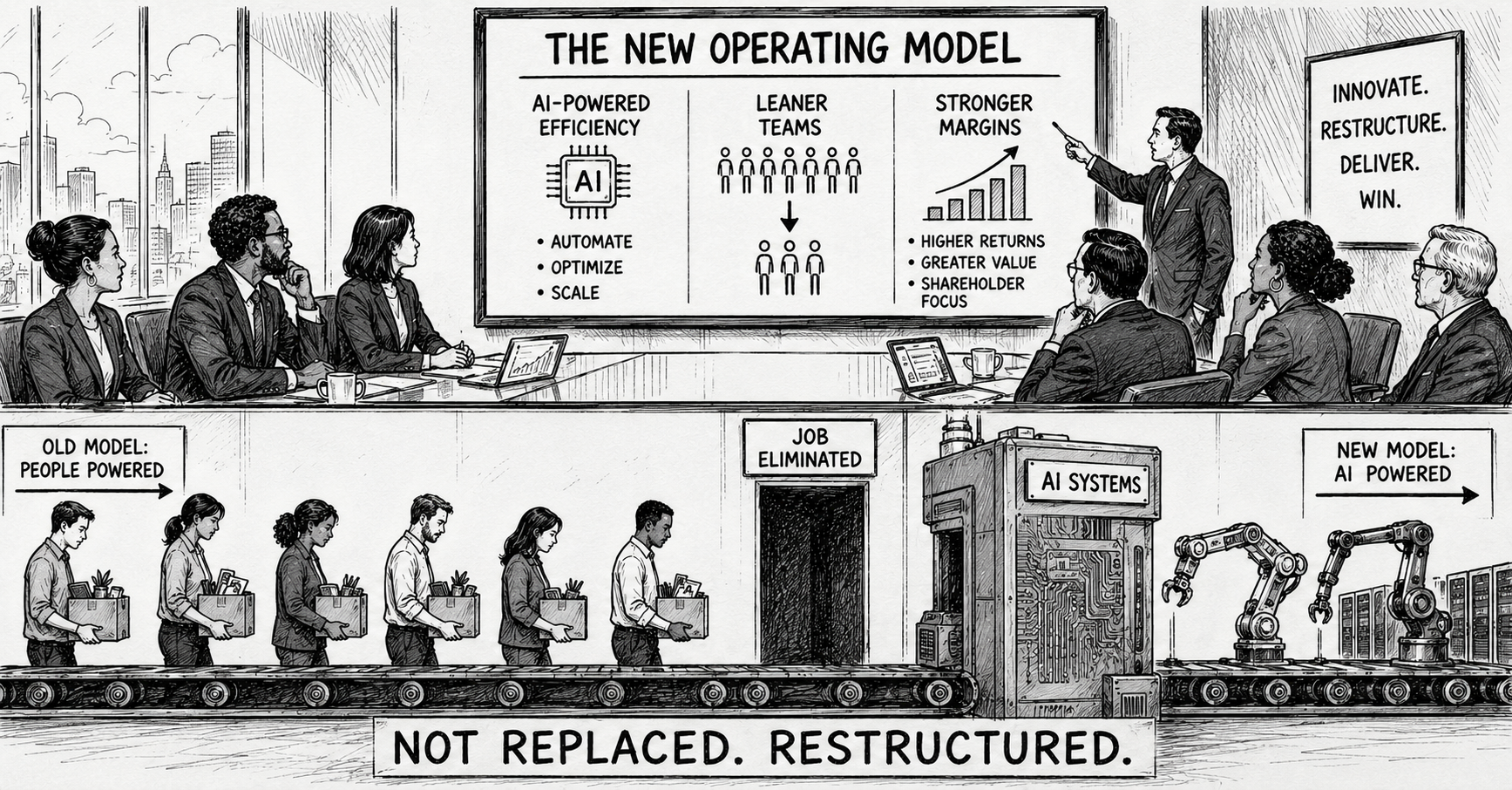
AI Didn’t Replace Those Workers. It Just Made Eliminating Them Sound Like a Strategy.
The public argument has fixed itself on replacement. Replacement is a standard almost no company will ever meet — and that’s exactly the point.
Part of Society, Economy & Wellness — examining how economic pressure reshapes labor, access, and everyday life.
NEWS DESK | SOCIAL STORYTELLERS COLLECTIVE
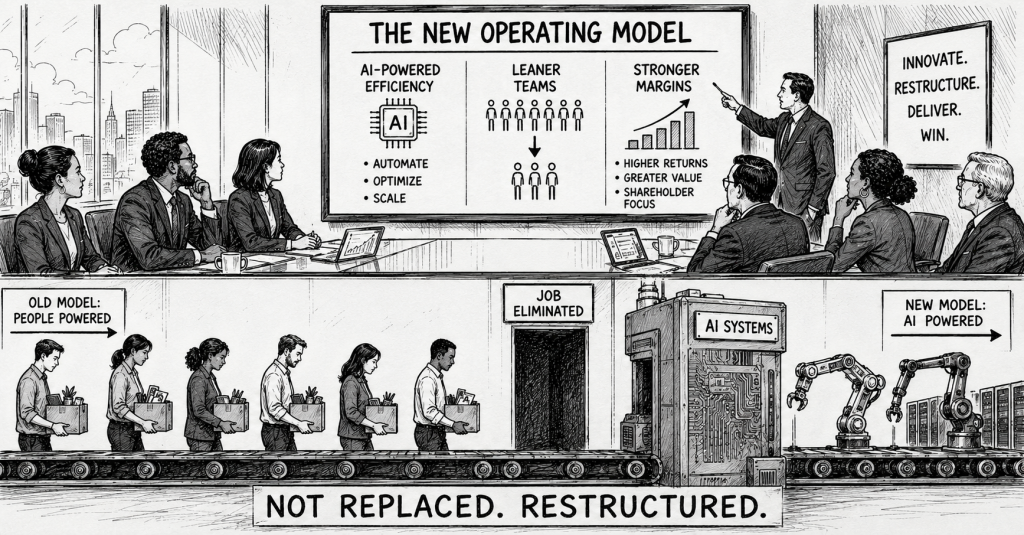
Microsoft chief people officer Amy Coleman told employees that the roles eliminated in the company’s latest cut of 4,800 jobs were not being replaced by artificial intelligence — a statement InformationWeek logged in its 2026 tech layoff tracker alongside her acknowledgment that AI is changing how the company operates. Both halves of that are true. The distance between them is the whole story, because the public argument has fixed itself on replacement, and replacement is a standard almost no company will ever meet.
Here is the actual mechanism. A firm does not fire a support representative and seat a chatbot at her desk. It redesigns the support function so a smaller team handles escalations while automated systems take first contact, then declares the previous team configuration obsolete. Nobody was replaced. The role was eliminated. That distinction is legally sound, publicly defensible, and completely without consequence for the person who no longer has income. Coleman’s statement is probably accurate on its own terms. But a company can be truthful sentence by sentence and still describe a process that leaves the listener with the wrong picture — and the wrong picture here has a direction. It suggests that job loss and AI adoption are running on separate tracks that occasionally cross, when the more defensible reading is that AI adoption supplies the justification, the timing, and the investor tolerance for cuts that reshape who gets paid.
The scale is now large enough to see the pattern instead of inferring it. Skillsyncer’s layoff tracker counted 322 layoff events in 2026 through July 24, affecting 205,832 workers — an average of roughly 1,004 jobs lost per day. Its analysis found that 54% of those events explicitly named AI, automation, or machine learning as a driver, covering 170,945 workers across 173 companies. LayoffAlert.org, which counts only WARN Act filings and therefore sees a fraction of the total, logged 2,954 notices across 44 states through July, affecting 270,641 employees. Challenger, Gray and Christmas reported 108,000 announced cuts in January alone — a 118% increase over the same month a year earlier. Those figures do not prove AI eliminated 170,945 jobs. They prove something more useful and more specific: AI has become the explanation companies reach for when they cut. That is a separate fact with its own consequences, and it is worth separating from the technical question, because the two have different beneficiaries.
An AI-attributed layoff reads differently to investors than a demand-attributed one. Cutting because sales fell is a confession. Cutting because your operations have gotten smarter is a strategy. The first depresses the stock. The second can lift it. Coinbase said the quiet version out loud when it cut roughly 700 jobs — about 14% of its global workforce — and Brian Armstrong tied the move both to a down crypto market and to AI tools letting smaller, flatter teams operate. One of those explanations is a problem. The other is a plan. Companies have learned which one to lead with. As SSC documented in Visa Cut 2,600 Jobs on the Same Day It Reported 14% Revenue Growth, this is the pattern across the 2026 layoff cycle: profitable companies cutting from strength, using efficiency language to describe what the underlying economics were already demanding, and letting the AI attribution carry the investor story.
Follow where the money goes and the redistribution becomes visible. Meta, Amazon, Microsoft, and Alphabet have collectively committed hundreds of billions to AI infrastructure while reducing headcount, and the two motions are connected. Payroll and capital expenditure are not equivalent forms of spending. A payroll dollar disperses across a metropolitan area into rent, groceries, childcare, and local tax receipts. A data center dollar concentrates into chips, land, power contracts, and a construction crew that leaves when the build finishes. Converting the first kind of spending into the second is not cost-cutting in any neutral sense. It is a transfer of economic activity out of household budgets and into balance sheets.
The cut categories tell the rest. Skillsyncer identified reductions concentrated in customer support, content moderation, data entry, QA testing, and traditional software engineering. Those are the jobs that have functioned as entry points for two decades — the roles a person without a network or a credentialed background could enter and use as a first rung. Removing them does not just eliminate current employment. It removes the mechanism by which people who start outside professional work get inside it. The senior engineer keeps her job this year. The person who would have become that engineer in six years has nowhere to begin. As SSC covered in The Job Market Isn’t Crashing. It’s Closing., the 35% decline in entry-level positions over five years is not a byproduct of market conditions. It is the structure of what is being built — and the communities most concentrated in those entry-level categories are the ones absorbing the cost of that structure first.
The pattern has also stopped being a tech story. Skillsyncer’s tracking places AI-attributed cuts in finance, logistics, consulting, media, retail, and manufacturing. Verizon announced plans to cut more than 13,000 workers, primarily in management. Amazon said in January it would eliminate around 16,000 corporate roles globally, its second major round since October. Citi confirmed its reductions would extend into this year as part of a plan to cut about 20,000 employees — roughly 10% of its workforce. The geographic dimension compounds the demographic one. As SSC documented in The Black Recession Is Already Here, the sectors absorbing the most concentrated AI-attributed cuts are the same sectors where Black workers are most heavily represented — customer support, logistics, data processing, administrative services. The restructuring is not hitting everyone equally. It is hitting along the fault lines that were already there.
The next phase will not announce itself through a single dramatic quarter. It will show up in the entry-level hiring numbers first, in the gap between how many people companies employ and how many they train, and in which regions see payroll converted into construction. The AI attribution will fade from layoff announcements once it stops flattering the stock. The reorganizations it justified will stay exactly where they are.
Why This Matters
The replacement debate is a distraction — and a useful one. As long as the argument is about whether AI literally replaced a specific worker, no company will ever lose that argument, because no company has to run the operation that way. The mechanism is subtler and more durable: AI supplies the justification, the timing, and the investor tolerance for cuts that were already economically available. What gets restructured away are the entry points — the roles that didn’t require a credential or a connection, the first rung of the ladder. What gets built in their place is infrastructure that concentrates the gains of that efficiency into fewer hands, in fewer places, on fewer balance sheets. That is not a technology story. It is a distribution story. The technology just made it easier to tell.