The Permanent Job Is Becoming the Exception. Here’s How Employers Rewired Labor Markets to Make It Happen.
Nearly half the American workforce will be freelance by the end of 2026. By 2027, the number hits 50 percent—a milestone that would have seemed impossible a decade ago, when the gig economy was still understood as a supplement to primary employment. It is not a supplement anymore. It is the primary labor system.
The shift was not accidental. It was not driven by worker preference for flexibility or by technology making remote work inevitable. It was driven by a deliberate, coordinated choice by employers to restructure labor markets in ways that transfer risk downward, eliminate benefit obligations, and make the workforce instantly scalable. The permanent job—with its stability, its benefits, its mutual obligation between employer and employee—did not disappear because it became obsolete. It disappeared because it became expensive, and because the infrastructure to make that expense optional was finally in place.
The gig economy crossed from being a niche labor model to being the dominant one not because workers voted for it, but because employers calculated that the cost savings were worth the tradeoffs. What we are watching is not the future of work. It is the present of work, already constructed, already operating at scale. The only question now is whether anyone notices the architecture before it becomes too expensive to rebuild.
The Mechanism: How Permanent Became Optional
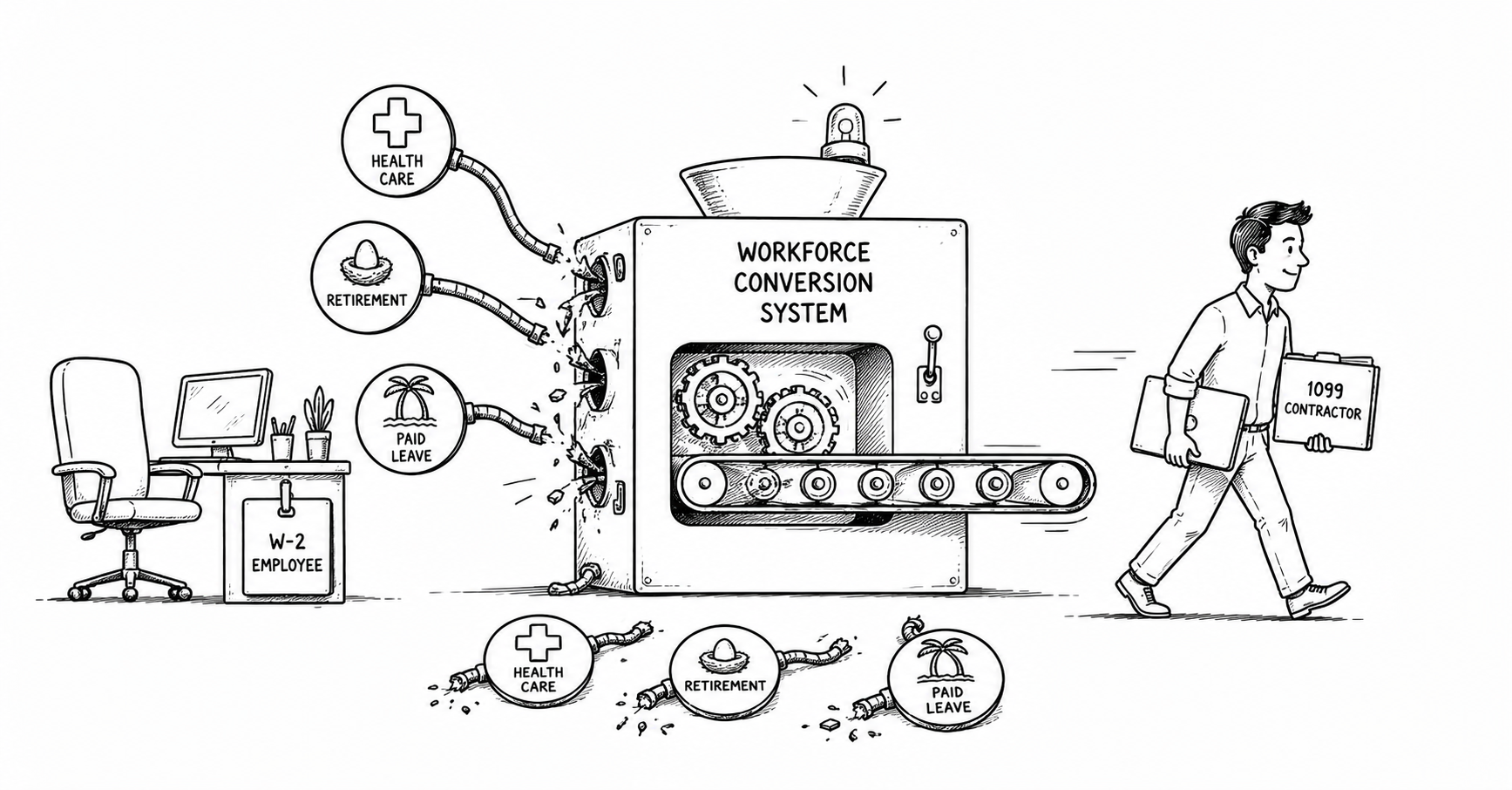
The transition began quietly. Employers did not announce they were moving away from permanent hiring. They simply stopped doing it. Instead, they built hybrid workforce models that operate W-2 employees and 1099 contractors in the same system, performing overlapping functions, with the contractor population absorbing the volatility while the permanent staff provides continuity.
The logic is transparent and it is relentless. A permanent employee costs money whether revenue exists or not. Health insurance, employer-side payroll taxes, unemployment insurance contributions, and severance obligations are all fixed costs that survive revenue downturns. A contractor stops costing money the moment the contract ends. There is no severance calculation, no benefits continuation, no unemployment insurance liability. The employer’s obligation terminates when the project does.
Staffing firms and workforce management platforms have built the infrastructure that makes this feasible. Oysterlink, Zeal, and similar platforms now operate as hybrid labor systems, allowing a company to staff with W-2 workers for core functions and 1099 contractors for variable demand. The platforms handle contractor onboarding, payroll, and compliance classification. The employer handles headcount strategy: hire permanent for what is essential, contract for everything else.
The numbers make the strategy obvious. According to Dayforce, average freelancer income in 2026 is $108,028 annually. That is a robust number until it is contextualized. The same worker, if employed as a W-2 employee, would typically receive employer-contributed health insurance (average family coverage premium $24,500 annually), employer retirement matching (average 4-6 percent of salary), and paid time off (average 3-4 weeks). That bundle adds $45,000 to $60,000 in annual cost for the employer—or roughly 40-55 percent of the base salary.
A contractor earning $108,028 in reported income carries none of that cost. The company pays exactly what they agree to. Everything else—health insurance, retirement, paid leave, disability coverage—becomes the contractor’s responsibility and expense.
The math compounds over time. A permanent employee earning $100,000 with full benefits costs the employer roughly $155,000-$160,000 in total compensation. A contractor earning $108,000 costs $108,000. The difference is not marginal. Over a year, it is $47,000 to $52,000 per worker. Over five years, across a workforce of 500, it is $117 million to $130 million in avoided costs.
This is not an accident of labor markets. This is an engineered outcome.
The Policy Infrastructure: What Made This Possible
The architecture enabling contractor dominance was not built overnight. It required legal permission, tax incentives, and regulatory decisions that accumulated over decades, then converged.
The foundational shift was the evolution of independent contractor classification. The IRS and Department of Labor have long maintained guidelines for what distinguishes an employee from a contractor—control over work, provision of tools, permanence of relationship. But enforcement of these guidelines has been inconsistent, and the tax incentives for misclassification are substantial.
An employer that reclassifies an employee as a contractor avoids not just benefits costs but also employer-side payroll taxes (15.3 percent combined Social Security and Medicare), workers compensation insurance, and unemployment insurance premiums. The IRS has attempted enforcement action, but the penalties for misclassification are often less than the lifetime savings from contractor status, which means the economics favor non-compliance.
State-level regulation created additional permission structures. Some states enacted gig-economy carve-outs that exempted certain classes of work from employee classification requirements. California’s Proposition 22 in 2020 exempted ride-sharing and delivery platforms from classifying drivers as employees. Other states followed with similar carve-outs for tech-enabled services. These were marketed as worker protections—drivers get to choose their hours—but they functioned as employer permission structures that made contractor status legally defensible.
Federal policy reinforced the incentive. The Trump administration’s 2017 tax cuts reduced the corporate tax rate from 35 percent to 21 percent, but left the tax incentive for contractor use intact. Contractor costs are deductible as business expenses. Employee costs include fixed benefit obligations that reduce net profit less efficiently. For a company operating at 10 percent net margins, reducing employee headcount and replacing it with contractor capacity is a direct path to margin expansion that survives tax changes.
What emerged is a three-layer permission structure. Tax incentives made contractor use profitable. State regulation made contractor classification legally defensible in certain sectors. And federal policy left the incentive structure in place even as evidence accumulated that misclassification was widespread.
The result: by 2026, the infrastructure exists for a company to build a workforce that is 60-70 percent contractor and 30-40 percent permanent without legal or tax consequences. The infrastructure exists because policy chose to make it exist.
The Worker Reality: The Mythology Versus the Mechanism
The narrative around gig work emphasizes flexibility. Workers choose their hours. They work from wherever they want. They are their own boss. The appeal is real for a minority of workers—people with other income sources who want supplemental earnings, or people with constraints (caregiving, disability, geographic isolation) that make traditional employment impossible.
But the numbers tell a different story about how many workers are choosing this or having it chosen for them.
Approximately 48.5 percent of the US workforce is freelance by late 2026, according to Oysterlink data. That is not a niche. That is nearly half of all workers. The proportion who report freelancing by choice versus by necessity is not equally split. Survey data from Pew Research on the gig economy consistently finds that 60-65 percent of gig workers took that work because they could not find traditional employment, not because they preferred it. The flexibility narrative fits the 35-40 percent who chose it. It obscures the 60-65 percent for whom it was the available option.
The income picture compounds the issue. Average freelancer income is $108,028. Median freelancer income is substantially lower—approximately $68,000 to $72,000 according to Upwork and Fiverr surveys. The difference between average and median reveals that the income distribution is skewed: some high-earning specialized contractors pull the average up, while the majority earn substantially less.
That median income comes without health insurance. According to the National Association for the Self-Employed, approximately 45 percent of freelancers report difficulty obtaining or affording health coverage. For families, the average cost of individual market health insurance is $500-$600 per month. Over a year, that is $6,000-$7,200. The median freelancer earning $72,000 annually is dedicating 8-10 percent of gross income to coverage that a W-2 employee’s company would provide.
Retirement savings follow a similar pattern. An employer-matched 401k typically contributes 4-6 percent of salary. A self-employed worker paying into a Solo 401k or SEP IRA receives no match and must fund it entirely from after-tax income. A median freelancer earning $72,000 who wants to match what an employer would contribute ($2,880-$4,320 annually) is dedicating another 4-6 percent of gross income to retirement savings that a permanent employee receives as a benefit.
Add health insurance and retirement together and the median freelancer is allocating 12-16 percent of gross income to benefits that a W-2 employee’s employer provides. That is $8,640 to $11,520 annually. The actual gap between freelancer and employee compensation is not $0. It is $8,640 to $11,520 per year, plus the loss of paid time off, disability insurance, and job security.
The flexibility narrative is real but it is partial. Yes, a freelancer can set their own hours. They can also lose their income when a contract ends, with no severance, no transition period, and no unemployment insurance in many cases. They can work flexible hours, but they cannot access flexible benefits or flexible security.
For the 60-65 percent who did not choose this, the flexibility is theoretical. What is real is the instability.
The Economic Driver: Why Now, Why This, Why At Scale
The transition from permanent to contractor labor accelerated during a very specific economic window: 2020-2026, when capital markets were rewarding margin expansion above growth.
During the 2010s, the narrative in tech and venture-backed companies was growth at all costs. Uber, Lyft, WeWork, and other venture-backed companies operated at massive losses in pursuit of market dominance. Investors accepted negative margins because they believed scale would eventually produce profitability.
That model broke during the 2020-2022 period when the Federal Reserve raised interest rates and venture capital dried up. Companies that had been burning cash to achieve growth suddenly needed to be profitable. The fastest path to profitability was not revenue growth—that takes time. The fastest path was cost reduction.
The primary cost in most businesses is labor. A company with 1,000 permanent employees and a 5 percent net margin is more vulnerable to economic pressure than one with 300 permanent employees and 700 contractors. The permanent staff is a fixed cost that survives revenue fluctuations. The contractors are a variable cost that can be shed instantly if revenue falls.
This is where the contractor shift becomes visible at scale. Companies did not gradually migrate to contractor labor. They did it during restructuring periods when they were cutting costs anyway. Stripe, Amazon, Google, Meta, and hundreds of smaller companies all announced layoffs in the 2022-2026 period. The layoffs typically affected permanent staff while contractor headcount remained flat or grew.
The mechanism works like this: a company in restructuring mode eliminates permanent positions, then rebuilds capacity using contractors and temporary workers. The permanent headcount falls. The contractor headcount rises. The total work output remains similar or improves, because contractors work with higher utilization (less overhead, fewer meetings, more billable hours). The per-unit cost falls. The margin improves. The share price responds.
This is not unique to tech. JPMorgan Chase, Verizon, United Airlines, and manufacturing companies have all moved toward contractor-heavy workforces during restructuring cycles. The pattern is universal because the economic logic is universal: margin pressure drives cost reduction, and labor is the largest cost line.
The question is whether this was structural or temporary. Evidence suggests it is structural. Companies that built contractor-heavy workforces during 2022-2024 restructuring have not rehired permanent staff as revenue recovered. Instead, they are maintaining the lean permanent base and scaling with contractors as demand fluctuates. This is not a temporary measure. This is the new operating model.
The gig economy reached 48.5 percent of the workforce not because workers suddenly wanted flexibility. It reached that level because employer margins are under pressure and contractor labor is the most efficient way to manage that pressure while maintaining profitability.
The Implications: What Happens When Half the Workforce Has No Leverage
The shift from permanent to contractor labor fundamentally changes labor power dynamics.
A permanent employee has leverage. If dissatisfied with compensation, they can find another permanent job, potentially with better pay and benefits. The employer has invested in training, onboarding, and relationship capital. Losing a permanent employee is costly. The employer has incentive to retain them through wage growth, promotion, and benefit improvements.
A contractor has leverage only in specific circumstances. If they have rare, in-demand skills and can afford to turn down work, they have leverage. If they are one of thousands of people offering the same service, they have none. Upwork and Fiverr operate as contractor marketplaces where supply is elastic. If one contractor declines a project, 50 others will accept. The platform, not the contractor, has the leverage.
The dynamic inverts compensation pressure. In a permanent employment market with labor scarcity, wages rise. In a contractor market with supply elasticity, wages flatten or fall. A company using contractors can simply move to the next platform or region if local rates rise. A contractor cannot do the same.
Wage stagnation is a natural outcome of contractor dominance. If half the workforce has no leverage and the other half is competing against contractor rates, wage growth compresses across the entire market. Permanent employees cannot demand raises when they know the company can contract out the function. Contractors cannot demand raises when supply is elastic.
This compounds across generations. A worker entering the labor market in 2026 has different expectations and different options than a worker who entered in 2006. The 2006 worker expected to find permanent employment, build skills within a company, accumulate benefits and security, and retire with a pension or matched 401k. The 2026 worker expects to piece together income across multiple platforms, manage their own benefits, and accept that job security is not available.
That is not just a change in work. It is a change in how wealth accumulates. Permanent employment with benefits and matching retirement contributions builds wealth. Contractor income without benefits or matching does not. The wealth gap will widen because one segment of the workforce builds capital and the other does not.
The second implication is organizational fragility. Companies with 70 percent contractor workforces are structurally unstable. They cannot retain institutional knowledge because contractors leave when projects end. They cannot execute long-term strategy because the workforce is volatile. They compensate by hiring permanent staff for institutional memory and strategy while contracting out execution. The result is a bifurcated labor structure where permanent staff are expensive and rare, and contractor staff are cheap and interchangeable.
This works until it does not. When economic conditions shift and a company needs to move quickly, a 70-30 contractor-permanent split is less agile than a 50-50 split. When institutional knowledge matters—in complex product development, client relationship management, or regulatory compliance—a contractor-heavy workforce is a liability. Companies will eventually discover that contractor dominance solves the margin problem while creating an instability problem.
The third implication is democratic. A labor force with no security, no benefits, and no leverage is a politically fragmented labor force. Permanent employees formed unions. Contractors cannot, because they are not employees. Contractors have no legal right to collective bargaining, no protection from at-will termination, and no recourse for non-payment beyond small claims court. A contractor-majority workforce is a workforce that cannot organize.
This is not accidental either. The expansion of contractor labor coincided with the decline of union membership and the rise of right-to-work legislation. The two movements are not unrelated. A workforce that is 90 percent contractor and 10 percent permanent cannot unionize. A workforce that is 90 percent permanent can. The shift to contractor labor is structurally anti-union.
What Comes Next: The Durability Question
The permanent job did not disappear because it became obsolete. It disappeared because the economic incentives, policy structure, and technology infrastructure aligned to make contractor labor more profitable. Those conditions are durable. No single company has incentive to unilaterally move back to permanent employment when contractors are cheaper. No policy maker has moved to close the tax or regulatory loopholes that enable contractor dominance.
What could change the trajectory? Labor scarcity in specific sectors could increase contractor bargaining power enough to reduce the wage gap. A major recession could cause companies to discover that contractor-heavy workforces are less resilient than they believed. A policy change—federal reclassification of contractors, elimination of tax incentives for contractor use, or state-level regulation—could make permanent employment more economically rational.
None of these are happening. Labor remains abundant in most sectors. The economy has not experienced a major downturn since 2022. And policy is moving in the opposite direction—toward more contractor flexibility, not less.
The 48.5 percent figure will likely reach 50-55 percent within two to three years. By then, the permanent job will be the exception rather than the norm. Companies will have fully rebuilt their operating models around contractor staffing. Workers will have adjusted their expectations accordingly. The permanent job will still exist—for executives, specialists, and institutional memory keepers—but it will be understood as a privilege rather than a standard.
That transition is complete and it is not reversible without a deliberate policy choice. The architecture is built. The incentives are aligned. The workforce has adapted. The permanent job did not fail. It was engineered into obsolescence, one policy decision and one contractor platform at a time.
The honest assessment is that we are not discussing whether this happens. We are discussing how far it goes before anyone decides to stop it. And the evidence to date suggests the answer is: all the way.