UAE Begins Enforcing Emiratization Wage Floor, Suspending Non-Compliant Employers
As of July 1, UAE companies with 50 or more employees face work-permit suspensions if they have not raised Emirati employees’ pay to a new minimum of AED 6,000 a month, about $1,634. The rule, part of the country’s multi-year Emiratization program, is the first hard enforcement deadline attached to a policy that has spent several years building toward this point through steadily rising quotas.
The mechanics of the program are straightforward. Companies with 50 or more employees have been required to increase Emirati representation in their workforce by 2% annually since 2022, with a target of 10% Emirati staffing by the end of 2026. Firms with 20 to 50 employees in 14 designated sectors had to hire one Emirati employee in 2024 and a second in 2025. The new wage floor, which took effect for new or renewed work permits on January 1 and became mandatory for existing Emirati employees on June 30, is the enforcement teeth behind those quotas: a company can technically meet its Emiratization hiring target and still face penalties if it isn’t paying those Emirati hires enough.
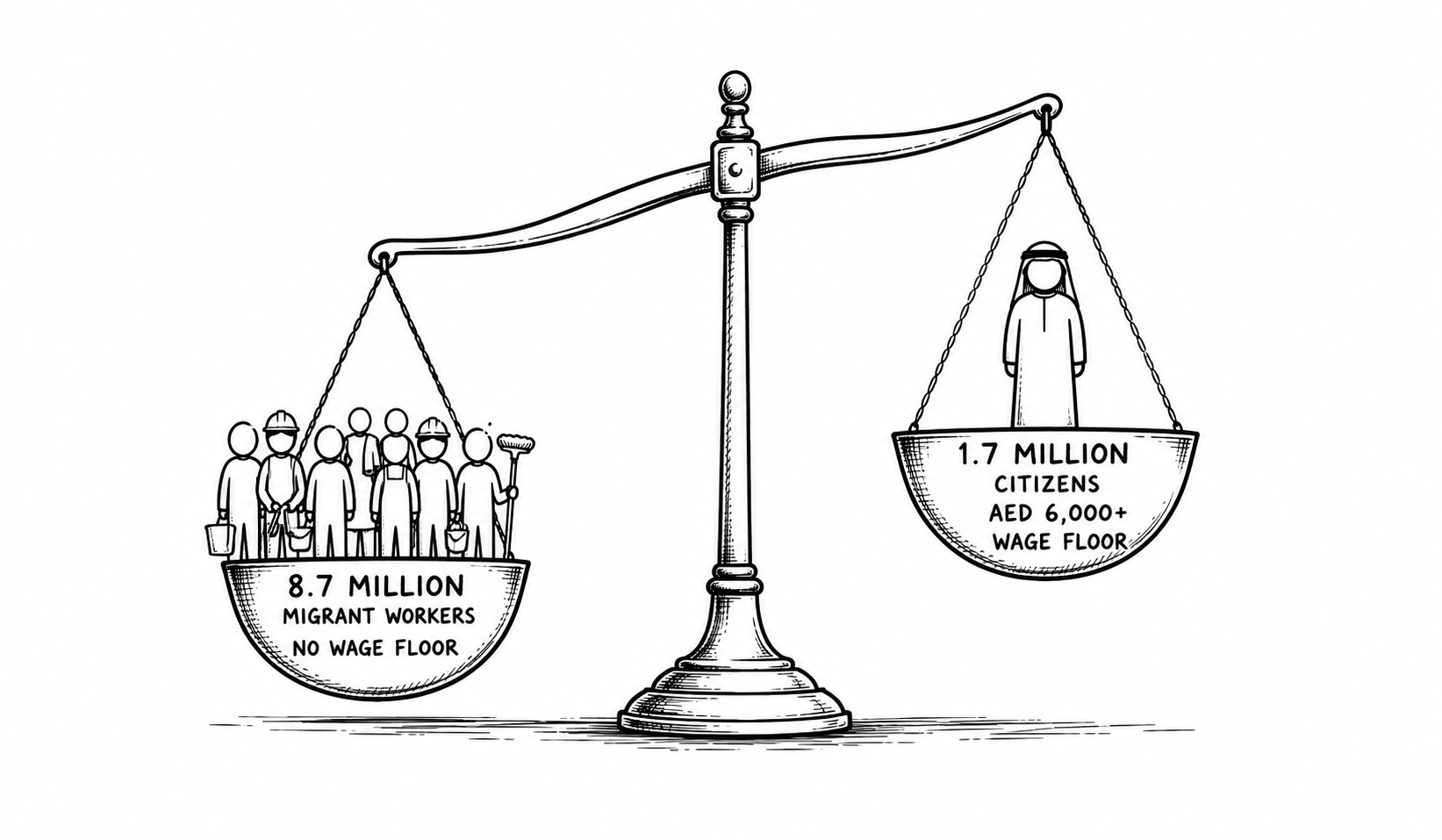
What the policy does not do is establish anything comparable for the rest of the workforce. The UAE has no general minimum wage. Migrant workers, who make up roughly 80% of the country’s population, about 8.7 million people, are covered instead by the kafala sponsorship system, under which an employer holds substantial control over a worker’s visa status, ability to change jobs, and legal standing in the country. Wages for that population are set entirely by individual contract and employer discretion, with no floor comparable to the AED 6,000 threshold just enforced for citizens.
That structure means the UAE’s labor market runs on two entirely separate logics simultaneously. For the roughly one-fifth of the population holding citizenship, the state is actively intervening to guarantee rising, enforced compensation, complete with a penalty mechanism, work permit suspension, serious enough to threaten a company’s ability to operate. For the migrant majority who build, staff, and largely run the country’s hospitality, construction, and domestic-work sectors, no equivalent floor exists at all. A construction worker from Bangladesh or a domestic worker from the Philippines has no minimum wage protection to invoke regardless of how long they’ve lived and worked in the country. What determines a worker’s wage guarantee in the UAE is not the job they do, the hours they work, or the value they generate. It is a passport.
This is not a hidden or contested policy design. It is the explicit, publicly stated purpose of Emiratization: to increase the economic participation and standard of living of citizens specifically, in a country where citizens are a demographic minority inside their own labor market. That’s a coherent policy goal on its own terms, and the UAE is not alone among Gulf states in pursuing citizen-employment quotas as a strategy. But the enforcement date arriving now puts a sharp point on what the policy leaves untouched: research from organizations including the Building and Wood Workers’ International has documented that a majority of migrant workers in the wider Gulf region cannot freely terminate their employment, and that wage theft and delayed payment remain persistent, common complaints with limited recourse.
The work-permit suspension mechanism gives the Emirati wage floor real enforcement power, which is more than most minimum wage laws anywhere in the world can claim. The question the July 1 deadline doesn’t answer, and isn’t designed to answer, is what recourse exists for the much larger population of workers the floor was never built to cover.