Visa Cut 2,600 Jobs on the Same Day It Reported 14% Revenue Growth
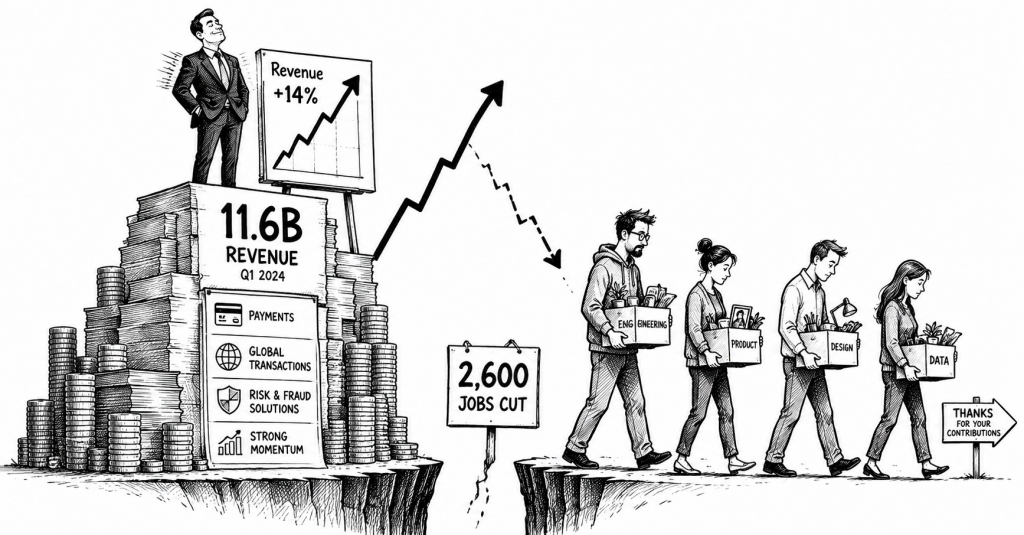
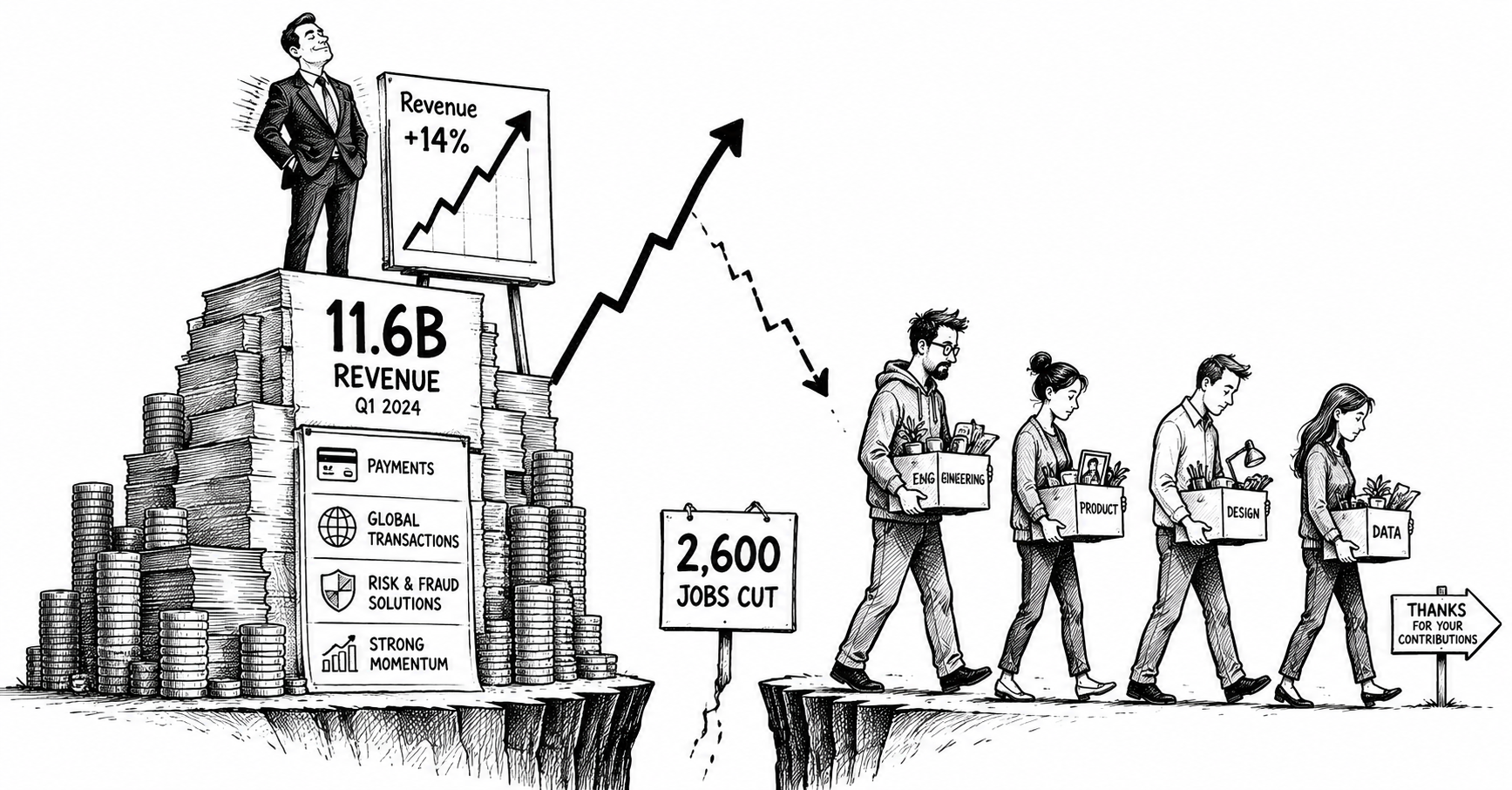
Bloomberg reported Tuesday, citing a staff memo from CEO Ryan McInerney, that Visa will eliminate roughly 2,600 positions — about 7% of its workforce — with technology and product teams taking most of the reductions. The company announced the cuts hours before releasing fiscal third-quarter results showing net revenue of $11.6 billion, up 14% year over year. The simultaneity is the whole story. Visa did not cut because the business weakened; it cut on a day it had strong numbers to report, which is what a company does when profitability is funding the restructuring rather than preventing it.
Strong performance stopped functioning as job protection
Visa’s quarter offered no evidence of conventional distress. Payments volume and processed transactions each grew 10%, net income reached $5.6 billion, and adjusted earnings per share of $3.32 beat the $3.23 analysts expected. McInerney told employees the company needed to drive efficiency in order to reinvest in its highest-potential opportunities — consumer payments, commercial and money-movement products, value-added services, and emerging infrastructure including stablecoins.
Large workforce reductions have historically followed declining revenue, excessive debt, failed expansion, or a downturn. Visa’s decision sits in a different category: preemptive restructuring by a profitable company that believes technology lets it hold or increase output with fewer people. The goal is not to stabilize the business but to raise how much revenue and product development each remaining worker generates.
AI moved from tool to headcount assumption
Executives once described artificial intelligence as something that would assist employees. It is now being written directly into staffing models, with anticipated productivity gains priced in before they are demonstrated. Visa has been more careful about this than its peers, presenting AI as one factor among several rather than the driver, but the company has acknowledged that AI-related efficiency shaped the decision.
Where the cuts land is the more telling detail. Technology and product functions are the departments companies spent a decade expanding to support digital transformation, software development, and new-product launches, and they were widely assumed to be insulated from automation because they built the automation. Visa’s reorganization suggests the first wave of enterprise AI may not stop at routine administrative work. It may reduce how many developers, product managers, and technical specialists a company needs to build and maintain its own systems.
The payments sector is reorganizing around smaller teams
Mastercard announced cuts of roughly 4% of its global workforce about six months ago, citing a need to refocus investments. Block said in February it would shed close to 4,000 positions, with CEO Jack Dorsey attributing the reductions directly to AI productivity and arguing that smaller teams now outperform larger ones. PayPal has announced reductions of its own. Visa’s public framing has been the most restrained of the group, emphasizing operational efficiency over automation — a difference in messaging rather than in outcome.
Efficiency has become an operating model rather than a cost-control cycle. These companies are cutting established teams while investing in stablecoins, automated commerce, fraud detection, money movement, and AI-enabled services. The savings are not leaving the business. They are being routed toward categories executives believe can grow without restoring headcount.
Growth and employment have separated
Visa employed roughly 34,100 people at the end of its last fiscal year, an 8% increase over the prior year. The 2,600 positions being eliminated roughly reverse that single year of expansion, which means the company grew into a headcount it has now decided it does not need — while revenue, transaction volume, and cross-border activity all kept climbing. Stronger cash flow may now accelerate the pressure to cut, because it gives management room to redesign operations before conditions force the question.
For workers, the implication is that individual performance has stopped being the relevant measure. Employees are being evaluated against what executives believe a smaller AI-assisted team could produce, a comparison no one can outwork.
Expect the announcements to get quieter from here. Pairing a 7% reduction with a 14% revenue quarter invites precisely the scrutiny Visa is now receiving, and the sector has already demonstrated it can reduce headcount without a memo — through attrition left unbacked, roles reclassified rather than eliminated, and hiring freezes that are never formally lifted. The next round of cuts at companies like this one will show up as a line in an annual report showing headcount down year over year, with no announcement attached to explain it. What Visa did on Tuesday was make the trade visible. The rest of the industry watched how that landed.