
The Job Isn’t Enough Anymore. Neither Is the Paycheck.
Eight in ten employees worldwide are not engaged at work. The question isn’t whether that number is alarming. It’s why the old solutions stopped working.
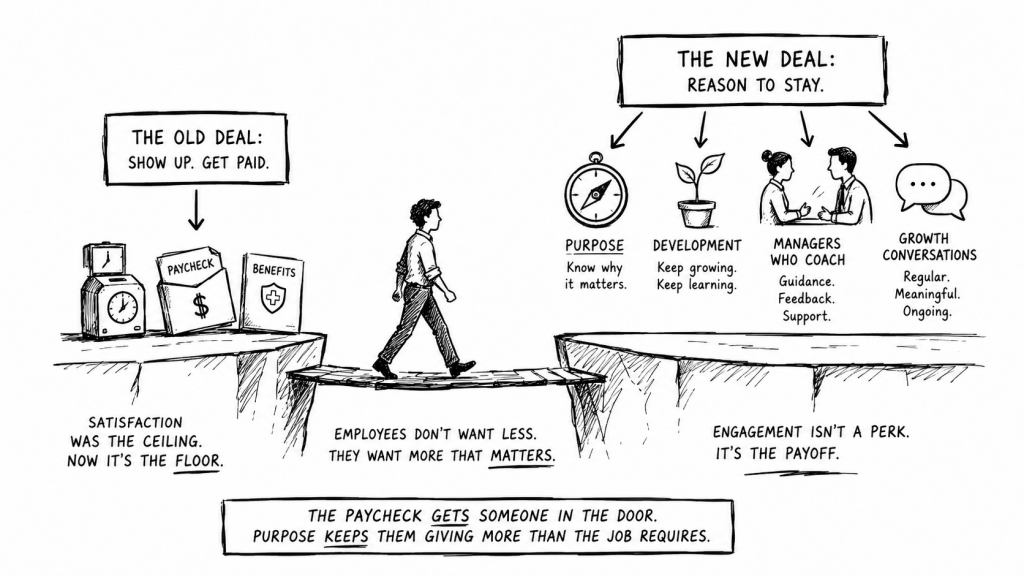
For decades, the employer’s side of the deal was relatively simple to define. Show up. Pay fairly. Offer benefits. Keep the lights on. If workers were satisfied — not miserable, not underpaid, not actively looking — the arrangement was considered successful.
That arrangement is no longer working.
Gallup’s latest global research finds that 8 in 10 employees worldwide are either not engaged or actively disengaged at work. That number has proven stubbornly resistant to the tools organizations have traditionally reached for. Compensation increases move it. Benefits expansions move it. Neither moves it enough, or for long enough, to change what that number is describing.
What the number is describing is a gap — between what work was designed to provide and what the people doing it now need from it.
Satisfaction Was the Ceiling. Now It’s the Floor.
The language organizations used for years was the language of satisfaction. Are employees satisfied with their pay? Satisfied with their benefits? Satisfied with their manager? Satisfaction surveys measured the absence of problems. They were not built to measure the presence of something worth staying for.
Gallup’s research makes the distinction plainly: compensation, benefits, and job satisfaction still matter. They are necessary. They are no longer sufficient to earn what researchers call sustained discretionary effort — the work people choose to do beyond the minimum the job requires.
What earns that effort is a different set of conditions. Employees increasingly expect work to provide purpose — a clear line between what they do and why it matters. They expect development — not annual reviews, but ongoing investment in who they’re becoming professionally. They expect managers who coach rather than simply supervise, and regular conversations that treat growth as an active project rather than a once-a-year formality.
These are not perks. They are the new floor.
The Manager Is the Variable
If there is a single finding in the engagement research that organizations keep missing, it is the role of the immediate manager.
Broad culture initiatives, company-wide values statements, and firm-level benefits packages all matter at the edges. What determines whether an individual employee experiences any of those things as real is almost entirely a function of who manages them day to day.
A manager who coaches — who asks where an employee wants to go, who connects daily work to larger purpose, who has conversations about growth rather than only conversations about performance problems — produces a fundamentally different experience than a manager who does not. Engagement lives or dies at the team level, and the team level is the manager.
The implication for organizations is uncomfortable: you cannot fix an engagement problem with a program. You can only fix it by changing what managers actually do in the moments that matter — the one-on-ones, the feedback conversations, the decisions about who gets development opportunities and who gets managed out.
What the Disengagement Number Is Really Counting
Eight in ten is not a number about unhappy people. Most disengaged employees are not miserable. They are present. They complete their work. They do not cause problems. They have simply stopped investing more than the role requires, because nothing in the environment has given them a reason to.
That quiet withdrawal is expensive in ways that don’t always show up on a balance sheet. It shows up in the quality of work that could have been better. In the innovation that didn’t happen because no one felt safe enough or invested enough to suggest it. In the institutional knowledge that walks out the door when someone who was never really retained finally leaves.
The Gallup research points to what organizations that close this gap actually do differently: they build workplaces where purpose is legible, development is ongoing, managers function as coaches, and conversations about growth are a regular feature of the work rather than an annual event.
That is a different kind of investment than compensation. It is also, the evidence suggests, a more durable one.
The paycheck gets someone in the door. What keeps them — what earns the effort that the job description doesn’t require — is something the paycheck alone has never been able to buy.
Social Storytellers Collective covers the gap between the data and the life inside it.