A Single Adult Needs $97,000 a Year to Be “Financially Stable” in Dallas. The Median Wage There Is Not That.
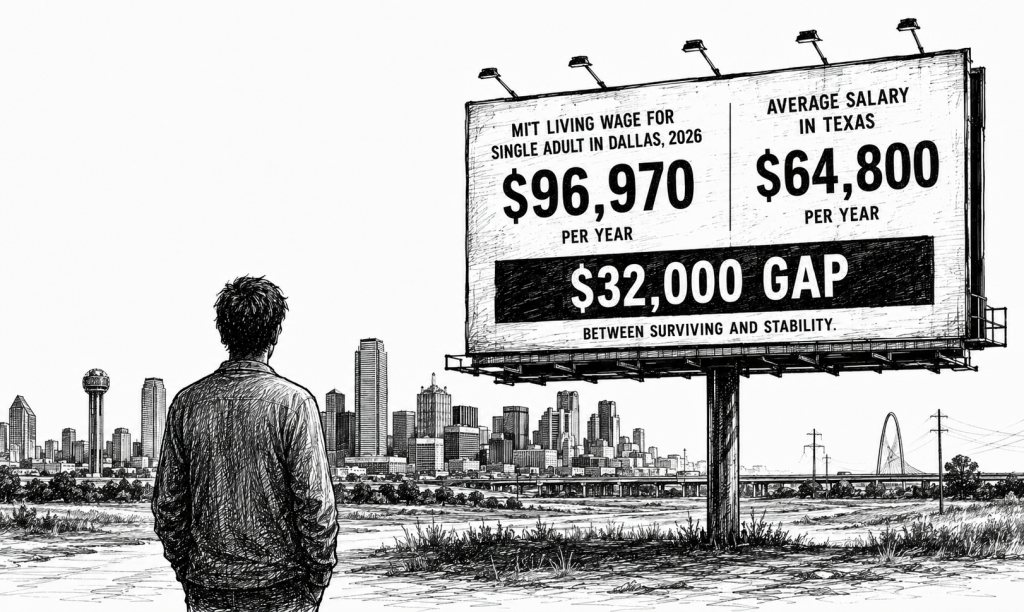
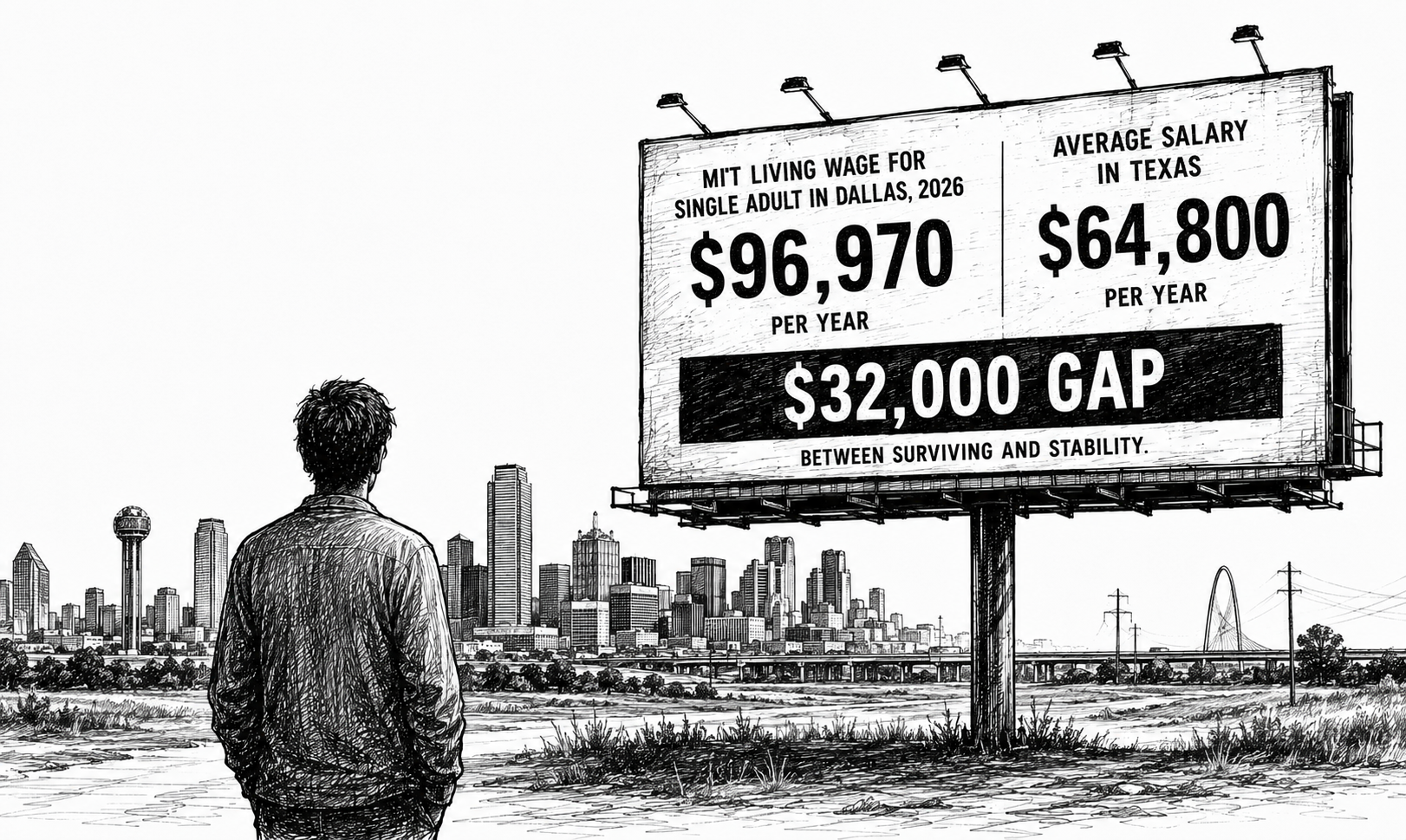
The affordability case for Dallas has always been comparative — cheaper than New York, cheaper than Los Angeles, cheaper than San Francisco. The MIT Living Wage Calculator makes a different calculation. It measures what it actually costs a single adult to cover basic needs, transportation, healthcare, housing, food, and modest savings in a specific geography. For Dallas in 2026, that figure is $96,970 per year, according to data reported by CultureMap Dallas in June 2026.
The statewide average salary in Texas is approximately $64,800. The gap between what a single adult needs to achieve financial stability in Dallas and what the average worker in Texas earns is roughly $32,000 — per year, per worker, compounding annually. That gap is not a coastal comparison. It is the distance between the city’s affordability reputation and the numbers underneath it.
“Financial stability” in the MIT framework is not a measure of luxury. It is not the income required to save for a house, take a vacation, or build a retirement fund at a meaningful pace. It is the threshold at which a person can cover their costs without material financial stress — the point at which a medical bill or a car repair does not become a cascading crisis. At $96,970, Dallas’s stability threshold places financial security beyond the reach of a majority of workers in the metro whose median wages run well below that number.
Dallas’s economy runs on sectors where median wages are nowhere near that threshold. Healthcare support workers, food preparation staff, retail associates, administrative assistants, and the logistics workers moving goods through the distribution corridor between Dallas and Fort Worth earn between $35,000 and $55,000 annually. These workers are, by the MIT measure, structurally below the threshold of stability in the city their labor supports. They are not on the margin. They are significantly below it.
The Sun Belt affordability argument has been doing a specific kind of work for the past decade — reassuring workers relocating from expensive coastal metros that they will be able to stretch their dollars further. That argument was grounded in a relative comparison that held true at a certain income band and in a certain period. The MIT Living Wage data reveals a floor that has risen fast enough that the relative comparison no longer covers the full picture. A worker earning $75,000 in Dallas may be taking home more than they could in San Francisco — and still be $22,000 below what it costs to be financially stable in their new city.
Texas has no state income tax, which returns several thousand dollars annually to workers compared with high-tax states. That advantage narrows the gap. At an estimated $4,000 to $6,000 in annual savings from avoiding state income tax, a worker earning the Texas average salary is still $26,000 to $28,000 below the Dallas stability threshold.
The city will continue to grow. Corporate relocations will continue to arrive. The labor markets that make those relocations operationally viable will continue to be staffed by workers whose wages sit below the number the MIT calculator says is required to live without financial fragility in the city those corporations have chosen. The affordability narrative and the living wage math are now running in opposite directions. Dallas is not becoming less expensive. It is becoming a place where the workforce the economy depends on cannot afford to be stable.