California Declared an Emergency Before the Disaster Arrived

California declared a statewide emergency on September 21 for storms that have not arrived yet. Gov. Gavin Newsom’s proclamation is designed to mobilize resources and speed up procurement ahead of an El Niño that federal forecasters say has a greater than 90% chance of becoming very strong this fall and winter.
The forecast behind that decision is extraordinary. Government forecasters now put the chance at 75% that this El Niño will be stronger than any other since 1950. In its September update, NOAA’s Climate Prediction Center reported that sea-surface temperature anomalies in the eastern equatorial Pacific had already exceeded 3 degrees Celsius above average. The governor’s office went further, saying the emerging event is already breaking records and could become the strongest in recorded history.
The State Is Moving Before the Forecast Becomes Damage
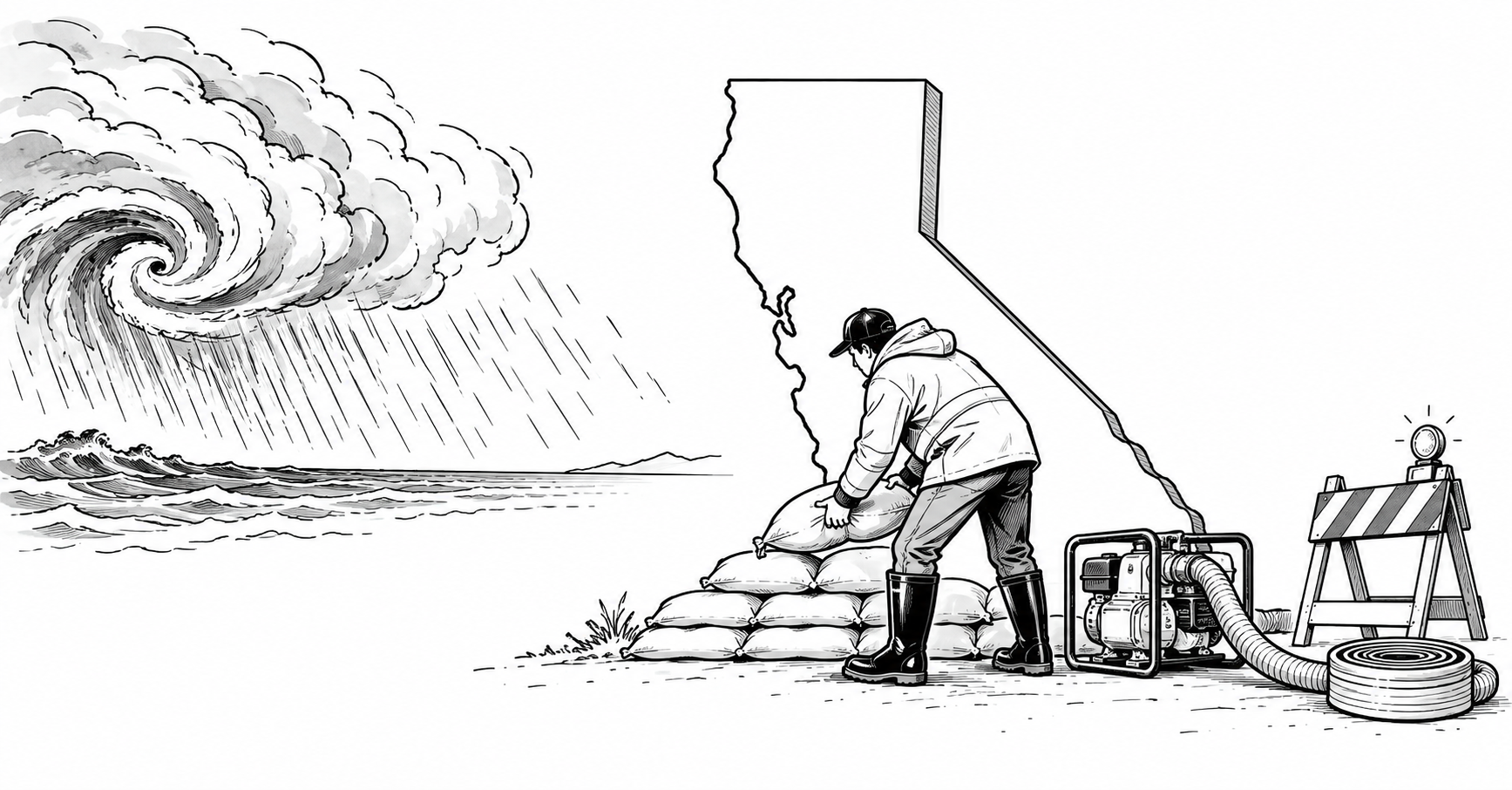
The declaration lets California agencies begin work normally associated with disaster response before severe weather arrives. It directs state agencies to lead flood-risk-reduction efforts, stage flood-fighting supplies such as sandbags and pumps, and pre-position critical equipment. Caltrans will stage traffic-control, road-closure and snow-removal equipment along the highways most at risk, and the California National Guard is being prepared for flood response, search-and-rescue, engineering and logistics missions. State environmental and natural resources agencies will fast-track permits and cut other red tape so local governments can prepare for flooding, landslides and debris flows.
The proclamation also addresses a part of disaster preparedness that often gets less attention: communication. Cal OES is directed to expand accessible, multilingual public messaging on severe weather, flooding, emergency alerts, evacuation readiness and power outages. That matters because a warning helps only the people who receive it and understand it. In a state as linguistically diverse as California, a staged pump does little for a household that never hears the evacuation order.
That represents a subtle change in what an emergency declaration can do. Disaster governance tends to become most visible after a wildfire, hurricane, earthquake or flood. California is using emergency authority to shorten the time between forecast and preparation, acting while the hazard is still a probability.
The officials leading the effort have described it in those terms. Cal OES Director Caroline Thomas Jacobs said the state is “not waiting for this season’s storms to be on our doorstep,” and that her agency is identifying potential needs before impacts occur.
The Emergency Has Already Begun at the Coast
In one sense, the disaster has not waited either. This year California has already seen coastal flooding attributed to El Niño, as Kelvin waves raise sea levels and offshore Pacific hurricanes fueled by warm eastern Pacific water send strong waves into the coast. Homes from south Orange County to Malibu were flooded and severely damaged, and erosion ate away the coastline from Carlsbad to Long Beach. Laguna Beach, Dana Point and Carlsbad declared local emergencies, citing erosion and sand loss from a south swell driven by Hurricane Marie.
Orange County then declared its own emergency and formally asked for state and federal help to rebuild and prepare coastal communities for a storm season that could begin as soon as October. Local officials had been urging Newsom to issue an executive order to speed coastal work before winter, including debris and sediment removal, channel maintenance and bridge protection.
That sequence complicates the story in a useful way. The statewide proclamation is anticipatory, but it did not come from nowhere. Local governments were already absorbing damage and asking Sacramento to act, and they were first to notice the gap between a forecast and the resources needed to prepare for it.
The Uncertainty Is the Point
There is an important caveat. El Niño does not guarantee a wet winter or any particular storm, even though it raises the risk of strong storms in California. The state’s own explanation acknowledges that specific local impacts are unpredictable while noting that El Niño often brings more frequent and intense storms. The proclamation describes a range of risks, including repeated heavy rain, strong winds, mountain snow, landslides, debris flows, large waves and coastal flooding. It does not predict that every region will experience them.
That uncertainty is exactly what makes anticipatory emergency management difficult. Acting too late can leave agencies scrambling after a forecast becomes reality. Acting early means committing personnel, equipment and administrative authority to risks whose location and severity cannot yet be known. It also means accepting that if the worst does not happen, some of that preparation will look unnecessary afterward, even though it was the right call when it was made.
Climate change raises the stakes of that calculation. The governor’s office cited a study published last month in the journal Science finding that El Niño events are now more than 36% stronger than before the industrial era, with the trend accelerating over the past 40 years. If the baseline for these events is shifting, historical experience is a weaker guide to what preparation is enough.
Climate Risk Is Changing the Government Clock
The same day, Newsom signed another proclamation that received less attention. After consulting with the affected counties, he terminated 34 open states of emergency for fires, storms and other events from 2023 and 2024 that no longer needed emergency status for response and recovery. He also declared new emergencies to support recovery from earlier severe weather in Glenn, Humboldt, Kern, Mendocino and Santa Barbara counties. Taken together, these actions show how emergencies now overlap. The state is recovering from past disasters, closing out older ones and preparing for the next one at the same time.
California’s approach reflects a broader shift toward treating forecasts as operational information rather than only as public warnings. The question is increasingly not whether government can predict the exact disaster, but whether the probability is high enough to justify moving resources before certainty exists.
The coming winter will determine how much of the forecast turns into actual damage. But the institutional change is already visible. California has moved the official start of an emergency from the moment infrastructure fails to the moment credible evidence says failure is plausible enough to prepare for.
Sources: Office of Gov. Gavin Newsom, “Governor Newsom proclaims state of emergency to bolster statewide El Niño preparedness, protect California,” September 21, 2026; NOAA Climate Prediction Center ENSO Diagnostic Discussion, September 10, 2026; Los Angeles Times via Yahoo News; Long Beach Current.