UK Home Office Deports Asylum Seekers to Rwanda as Court Challenges Stall, Revealing Labor Policy Operating Through Exclusion
Britain cancelled the Rwanda scheme. Then it built something that works the same way.
The UK’s Rwanda deportation plan is officially dead. The Labour government cancelled it after taking office in July 2024, and on June 1, 2026, the Permanent Court of Arbitration ruled in Britain’s favour when Rwanda sued for £50 million, or about $68.8 million, in damages from the contract’s termination. Four people went to Rwanda under the scheme — all voluntarily. The government spent an estimated £700 million, or about $957 million, to move four people. Home Secretary Shabana Mahmood has been direct about her reasoning for ending it: it was extortionately expensive and covered only 1% of arrivals.
What replaced it is worth examining carefully, because the architecture is similar even where the branding is not. Since taking office, the Labour government has removed or deported nearly 70,000 people — a 41% increase over the comparable period under the Conservatives, according to the Home Office. Refugee status, which previously placed people on a direct route to permanent settlement, now becomes temporary and subject to review every 30 months, with those who arrived without authorisation potentially waiting up to 30 years before qualifying for settlement. Financial and accommodation support for asylum seekers was made discretionary in March 2026, with support withdrawn from those who can work, have broken the law, or are deemed not to genuinely need it. The statutory duty to provide asylum support — introduced in 2005 — has been ended.
The labor dimension of this policy shift has received less attention than the immigration enforcement numbers. In March 2026, following litigation brought by two asylum-seeking doctors who had completed NHS-funded training, the Starmer government abolished the rule restricting asylum seekers to shortage occupation jobs once eligible to work after 12 months. Asylum seekers can now apply for any higher-skilled role, including doctors and nurses — a reform that Garden Court Chambers described as welcome but still far short of the Migration Advisory Committee’s recommendation that there should be no restriction on jobs once eligible to work. The UK retains one of the most restrictive right-to-work policies among comparable countries: 12 months before eligibility, compared to six months in the EU, immediate eligibility in Canada, and six months in the United States.
The House of Commons Library has documented that successive governments justified the 12-month waiting period as a deterrent — preventing what they characterized as economic migrants from choosing the UK for its employment conditions. The same Library research notes there is no evidence this deterrent works: the available data shows no relationship between work restriction policy and the decision to seek asylum in a particular country. The UK maintains a policy that demonstrably does not achieve its stated purpose, imposes measurable harm on people waiting in legal limbo, and keeps qualified professionals — doctors, nurses, engineers — out of the workforce for a year before they can contribute to the economy they are already living in.
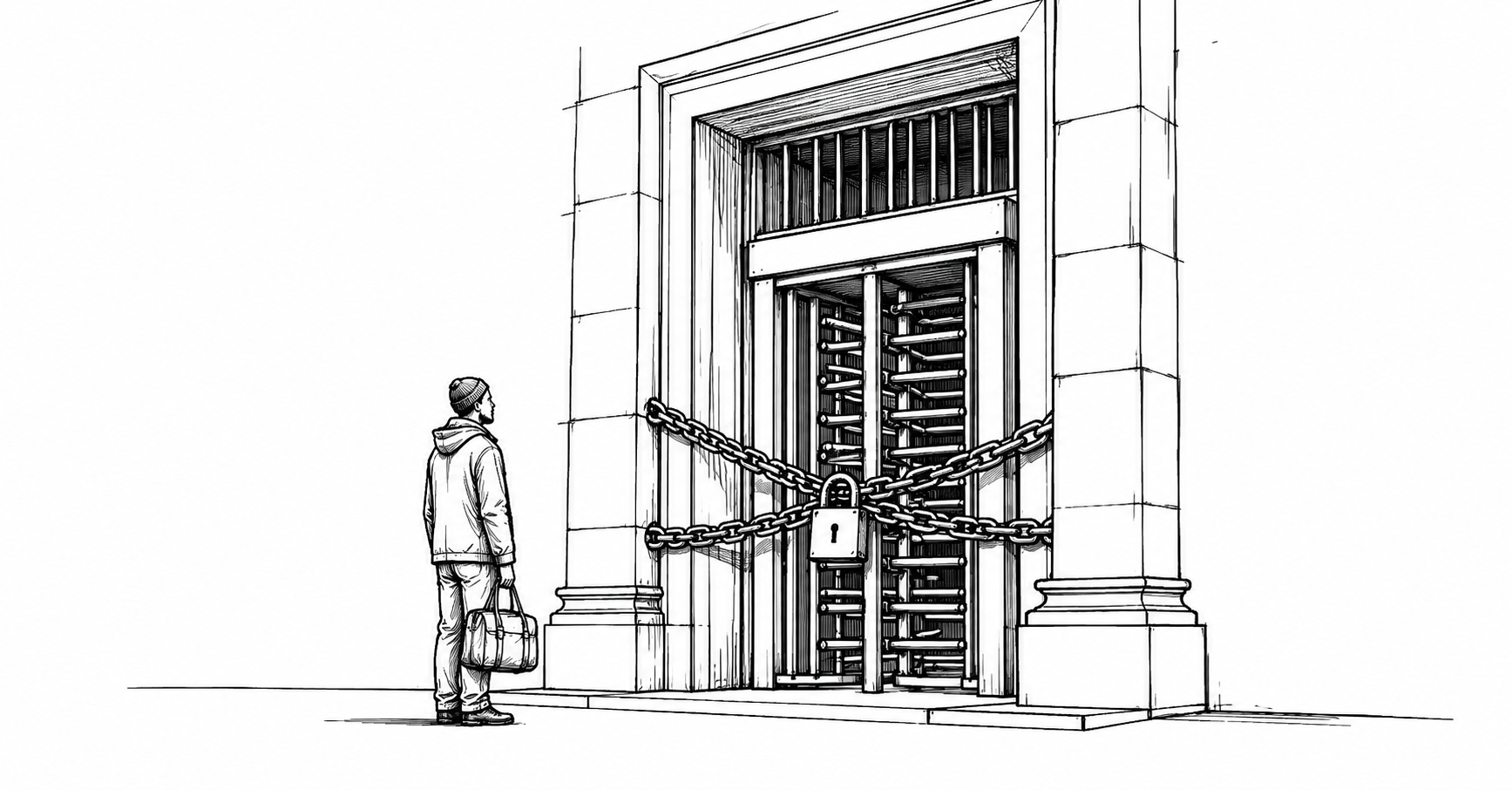
Labor’s immigration architecture is not the Rwanda scheme. It is also not a departure from the logic that produced it. The core operating principle — that restricting access, increasing the cost of staying, and accelerating removal deters future arrivals — survived the change of government. The delivery mechanism shifted from spectacle to administration. Power moved from asylum seekers toward a state that now controls housing, income, employment eligibility, and settlement timelines simultaneously, with review periods that guarantee years of uncertainty for people who have already been granted protection.