Texas Has Only 17 Affordable Homes for Every 100 Extremely Low-Income Households
When Texas ranked as the country’s top domestic migration destination for the third consecutive year, the economic case was simple: no state income tax, lower cost of living than coastal metros, job markets expanding across Houston, Dallas, Austin, and San Antonio. What that case does not include is a housing supply designed to absorb the full income spectrum of that growth.
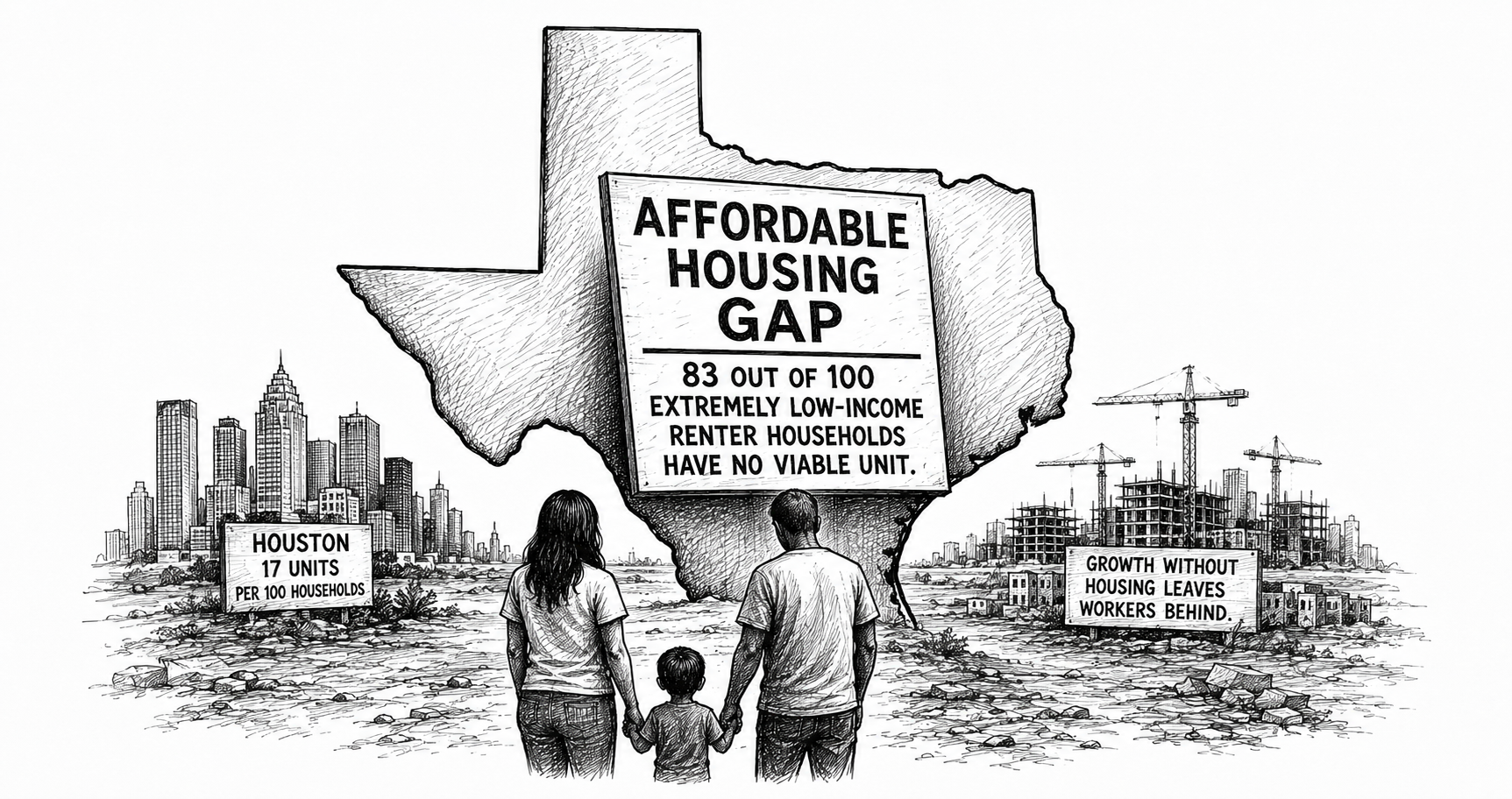
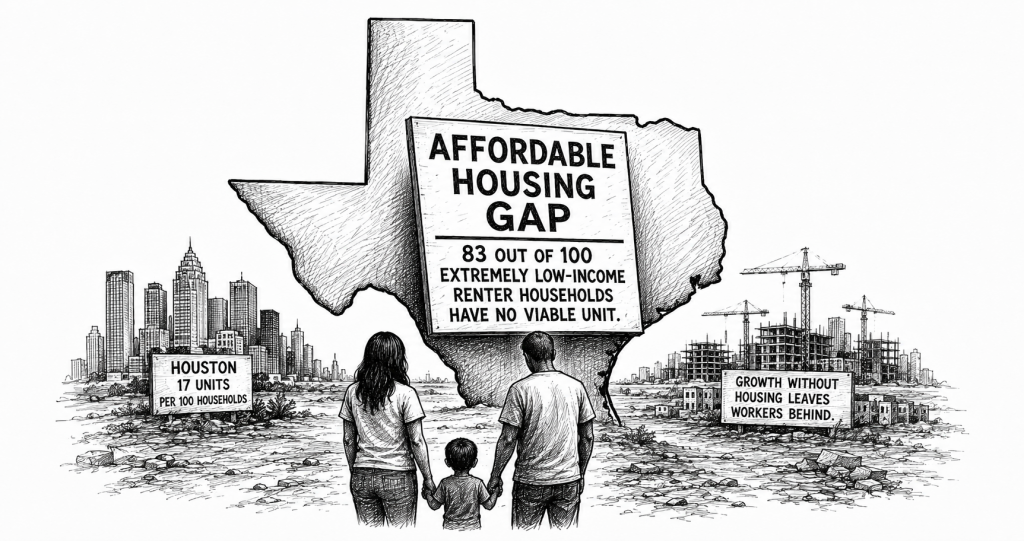
According to the National Low Income Housing Coalition’s Gap 2026 report, published March 2026 in partnership with Texas Housers, the state has just 54 affordable and available rental units for every 100 extremely low-income renter households statewide. In Houston, the figure falls further: 17 units per 100 households. That is not a market preparing to correct. It is a structural condition in which 83 out of every 100 extremely low-income renter households in the state’s largest city have no viable unit.
Texas has been building. Permits are up. Multifamily construction has concentrated along the Dallas–Fort Worth suburban corridors and the Austin–San Antonio axis. But market-rate construction expands supply for the upper income tiers of the rental market — it does nothing for households earning at or below 30% of area median income, the threshold defining extremely low-income renters. Serving that population requires subsidized units, income-restricted developments, or project-based housing vouchers that the Texas legislative environment has not prioritized funding at the scale the gap requires.
The underlying math has been compounding for 15 years. Texas median rent climbed 55% between 2010 and 2026, according to data compiled by Texas Housers. Median household incomes over the same period rose 45%. That 10-percentage-point gap in purchasing power does not show up in construction permit tallies or absorption rates. It shows up in the distance between what workers in hospitality, healthcare support, warehousing, and food service earn and what a market-rate unit costs them to rent each month.
The workers sitting inside that 83-unit gap are the same workers who make Texas metro economies function — the hotel room attendants during major conventions, the school cafeteria staff who arrive at 6 a.m., the healthcare aides commuting 90 minutes each way because the neighborhoods near the hospitals they work in have no units at prices they can reach. When these workers cannot find stable housing near their jobs, employers absorb it as turnover. Transit systems absorb it as ridership instability. Schools absorb it as student mobility. The housing shortage and the workforce stability problem are the same problem, tracked in different spreadsheets.
Texas has marketed itself as the pro-business, low-overhead alternative to coastal metros for a generation of domestic migrants and corporate relocations. That positioning requires a functional workforce. A functional workforce requires housing it can afford to rent. The NLIHC and Texas Housers data shows the current supply architecture producing 17 units for every 100 households at the bottom of the income ladder in the state’s largest city.
That number does not represent a warning signal about what’s approaching. It is the condition the economy is already operating inside. Each year the gap compounds — as households that cannot afford housing near the urban core move outward, extending commutes, thinning transit ridership, and withdrawing from the labor markets they were recruited to fill — the distance between Texas’s growth story and the workers who make that story possible grows wider. The state’s zoning and land-use architecture, combined with the absence of a dedicated affordable housing finance mechanism at the state level, will continue producing the same result as long as in-migration outpaces subsidized supply. Texas is not building its way out of this gap. It is growing into it.