
The U.S. 250th Is Becoming a Fight Over National Belonging
The same week the country marks 250 years of independence, its highest court is deciding who gets to be born into it.
The Supreme Court ruled 6-3 on June 30 that the Constitution guarantees automatic citizenship to children born in the United States, striking down the executive order President Trump signed on his first day in office that would have denied citizenship to children of undocumented or non-permanent-resident parents. Chief Justice John Roberts wrote for the majority, joined by the court’s three liberal justices along with Justices Barrett and Kavanaugh: “Citizenship, then and now, was the right to have rights — to freely participate in our political community. The Framers of the Fourteenth Amendment extended that promise to ‘every free-born person in this land.’ We keep that promise today.” The ruling landed four days before the country’s 250th birthday.
That timing is not incidental to how the anniversary is being experienced. The federal government has spent the past year building an elaborate commemorative infrastructure for the 250th, a White House task force, six mobile “Freedom Truck” museums touring 48 states, a Washington Monument light show tracing American history from Discovery through Innovation. It is a celebration engineered from the top down, and historians studying past milestone anniversaries say that engineering is itself notable. Marc Stein, a historian who wrote about the 1976 bicentennial, has pointed to “eerie parallels” between this year and 1976: both anniversaries arriving amid presidential controversy, contested claims about executive power, and a country whose confidence in its own institutions was visibly cracking even as the fireworks went up.
The birthright citizenship case is where the celebration and the argument about the celebration collide most directly. A 250th anniversary is, among other things, a story a country tells about who belongs to it and on what terms. The executive order the Court struck down would have redefined that story for children born after its effective date, making citizenship conditional on parental immigration status rather than birthplace. The ruling preserved the version of belonging that has governed the country since the 14th Amendment: birthplace, not parentage, not documentation status, not anyone’s judgment about who deserves to belong.
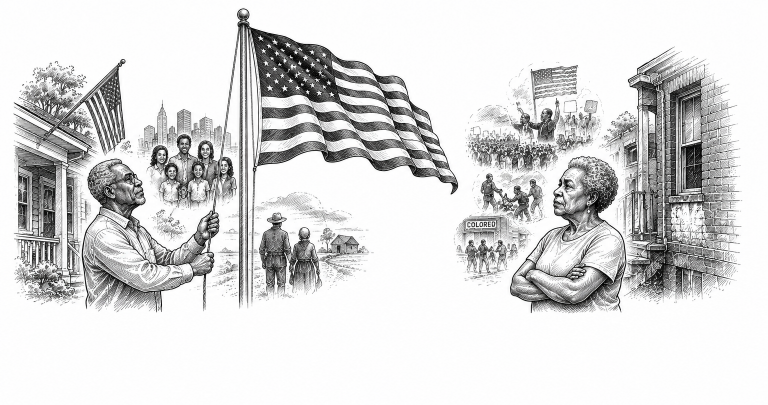
That legal outcome sits inside a louder cultural argument about what the anniversary should mean. Princeton historian Eddie Glaude Jr. released a book timed to the anniversary, America, U.S.A.: How Race Shadows the Nation’s Anniversaries, arguing that every major U.S. birthday, 1876, 1926, 1976, and now 2026, has been accompanied by an official narrative that minimizes the injustice built into the country’s founding. Glaude has been direct about what he sees happening with this particular anniversary: a version of American history he calls a “storybook version,” built around a presidential-led commemoration that bypassed the existing bipartisan planning committee. Separately, a Cherokee podcaster has drawn attention to the phrase “merciless Indian savages” in the Declaration of Independence itself, a reminder that the founding document being celebrated contains its own contested history of who counted as a full participant in the nation it created.
Those two threads, the Court’s ruling and the cultural argument over how to narrate the anniversary, are not separate stories. Both are fights over the same underlying question: who gets included in the story America tells about itself, and who decides. A birthright citizenship case is a legal answer to that question for people not yet born. A commemorative anniversary is a cultural answer to the same question for people already here, deciding whether the history being celebrated includes them or asks them to celebrate around the edges of their own exclusion.
America’s 50th anniversary, in 1826, was remembered as one of the rare moments partisanship didn’t dominate the day, a generation paying homage to the last surviving founders. Its 250th arrives instead as a live argument, decided in real time by a divided court, about who the country’s founding promise actually covers. That the ruling came down days before the anniversary itself isn’t a coincidence of scheduling. It’s the same debate the country is having about its birthday, just moved from the parade route to the courtroom.