
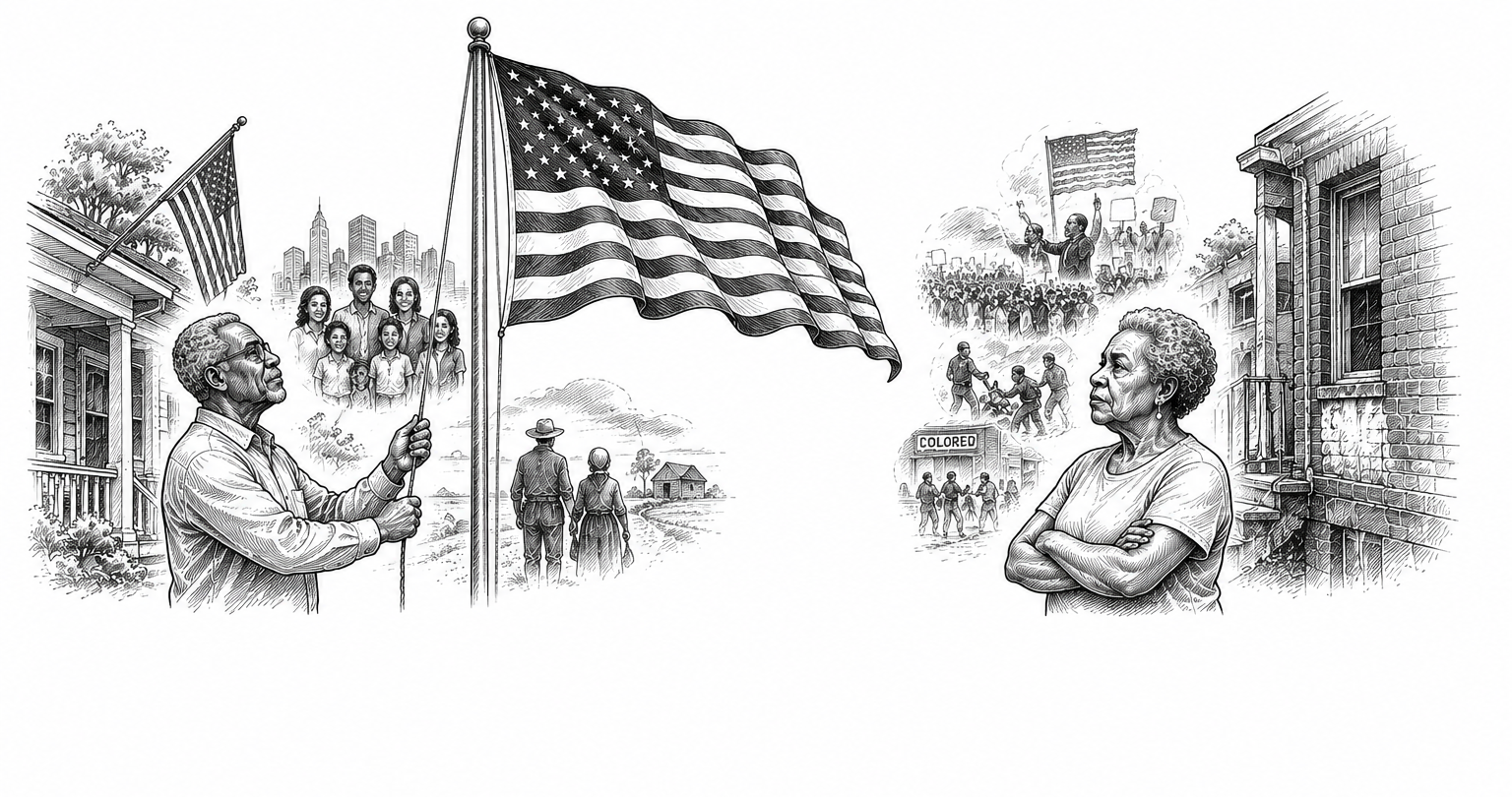
Why the American Flag Means Different Things to Different Americans
Patriotism becomes personal when national symbols carry different historical memories.
AP reporters Corey Williams, Linley Sanders, and Simran Parwani reported June 30 that Americans’ views of the flag are divided by politics, age, and race, according to a new survey from The Associated Press-NORC Center for Public Affairs Research conducted ahead of the nation’s 250th birthday. The poll of 2,596 adults found that about 7 in 10 Republicans and about 6 in 10 Americans 60 and older fly the flag at least during holidays, while about 6 in 10 Democrats and independents say they never fly it. Only about 3 in 10 Black adults say they ever display the flag, compared with roughly half of white and Hispanic adults.
The gap is not necessarily about patriotism itself. It reflects a distinction between identifying with the country’s ideals and believing those ideals have been consistently extended to everyone.
For many Americans, displaying the flag communicates pride, service, family tradition, or gratitude for opportunity. For others, the same flag evokes a history of slavery, segregation, discrimination, and ongoing inequality. The symbol remains the same. The historical experiences attached to it do not.
The AP’s reporting captured both sides directly. In Detroit, Jerry Esters flies the flag outside his home every day; for him, it represents the opportunity that let him, a great-great-grandson of enslaved people, build a life his ancestors could not have had. A few miles away, Yvonne Pistochini, 79, says there is no scenario in which she would let the flag fly over her home — the America the flag represents, she says, is not the country she grew up in. Both are Black.
Matthew Delmont, a professor of American history at Dartmouth College, told the AP that Black Americans often see the flag as a symbol of both inclusion and exclusion at once. “Black Americans, more so than white Americans, also understand the flag can be used to justify a version of patriotism that is rooted in exclusion, with the flag being used to say ‘you don’t belong here,'” Delmont said.
The findings illustrate a broader reality about national identity. Countries often rely on symbols to create a shared civic culture, but those symbols are interpreted through personal and collective history. A flag cannot separate itself from the experiences people associate with it.
That helps explain why debates over flags, monuments, anthems, and public rituals often become debates about history rather than patriotism. The disagreement is frequently less about the symbol itself than about whether the nation has fulfilled the values the symbol is intended to represent.
National unity depends not only on shared symbols but on shared confidence that those symbols represent everyone’s experience. When groups attach different meanings to the same flag, the challenge is not really about changing the symbol. It is about narrowing the gap between what the country says it stands for and how differently that promise has landed across generations and communities.