21,000 Workers Died Building Saudi Arabia’s Vision. The Cause Wasn’t the Height of the Towers. It Was a Law That Made Leaving a Crime.
A documentary broadcast on ITV alleged 21,000 migrant workers have died since Saudi Arabia’s NEOM project began. Saudi authorities dispute the figure. The conditions that produced it are documented across multiple credible investigations.
Saudi Arabia’s Vision 2030 was announced in 2016 as a plan to restructure the country’s economy away from oil dependency through a series of giga-projects: NEOM, the Red Sea Project, Qiddiya, Diriyah. Executing those projects required labor on a scale the domestic Saudi workforce could not provide. The country recruited migrant workers from South Asia, Southeast Asia, and East Africa under the kafala sponsorship system.
A documentary broadcast on British channel ITV alleged that 21,000 migrant workers have died since construction began on Saudi megaprojects — more than eight deaths per day over eight years, with the majority of the deceased from Nepal, India, and Bangladesh. Saudi Arabia’s government safety body has called the figure misinformation. An exact death count remains disputed and uninvestigated by any independent authority.
What is documented is less contestable than any single number.
Human Rights Watch published a report in December 2024 titled “Die First, and I’ll Pay You Later” — detailing systematic abuses across Saudi giga-project construction: workers logging 84-hour weeks in violation of Saudi law’s 60-hour cap, wages withheld for months, recruitment fees trapping workers in debt before they arrived, employers confiscating passports, workers unable to leave the country or change employers without sponsor approval.
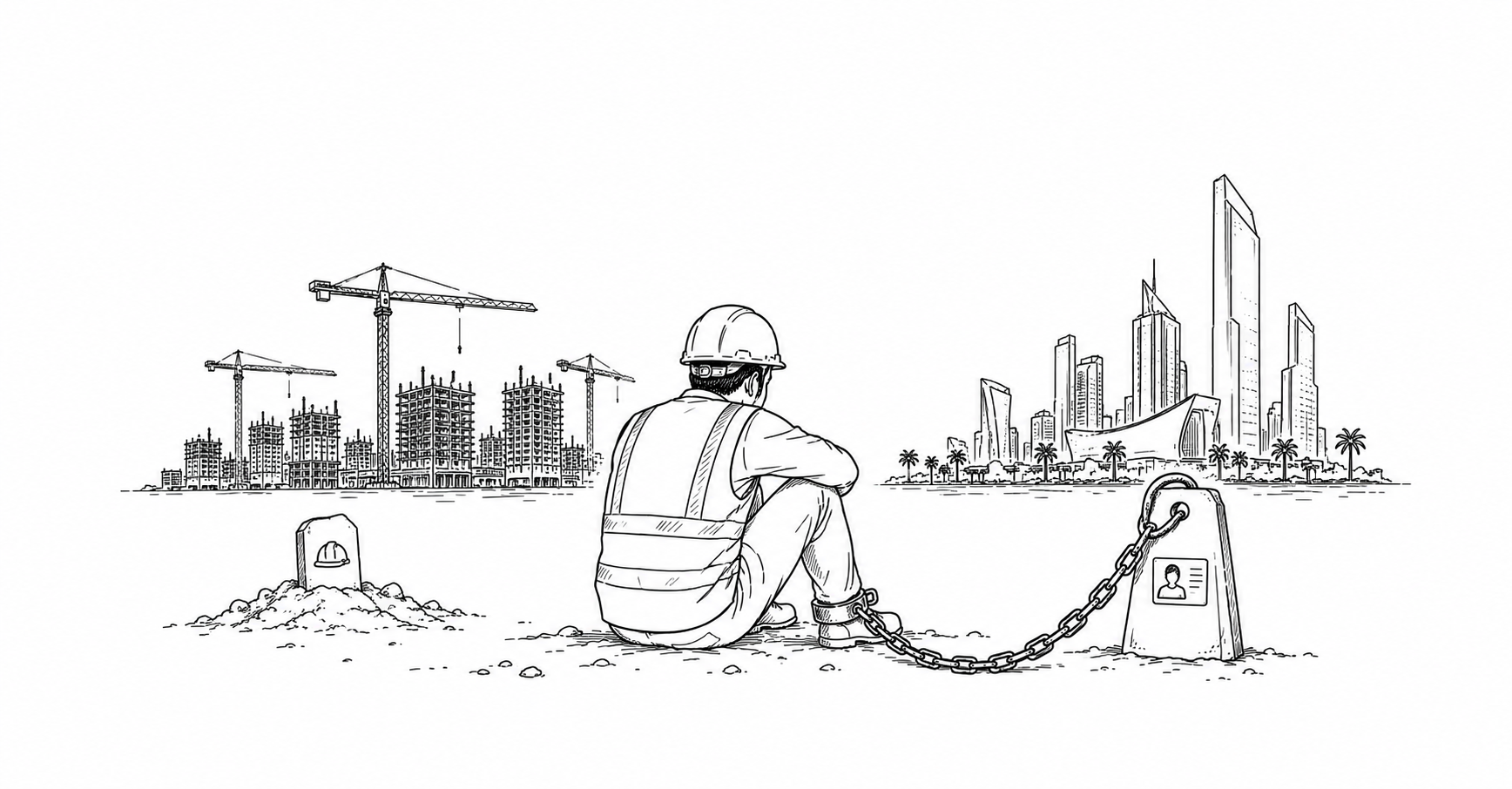
The kafala system is the mechanism that made those conditions sustainable. Under kafala, a migrant worker’s legal presence in the country is tied to a specific employer. Leaving an abusive employer without permission was not simply a labor dispute — it exposed workers to arrest and deportation. The law made leaving dangerous enough that workers stayed.
Saudi Arabia announced kafala reforms in 2021 removing the formal requirement for employer permission to change jobs or leave the country. Reporting from labor rights organizations through 2025 found implementation uneven, enforcement limited, and employer leverage over workers structurally intact in many sectors.
The 21,000 figure will remain disputed until an independent investigation either confirms or revises it. What cannot be disputed is that an unknown number of migrant workers died building infrastructure for a city that was subsequently cancelled, under a legal system that limited their ability to protect themselves, in conditions that multiple credible organizations documented as dangerous, abusive, and in violation of Saudi labor law.
The towers did not kill them. The legal structure that made it costly to leave did.
—
Sources: ITV Kingdom Uncovered documentary; Human Rights Watch, “Die First, and I’ll Pay You Later,” December 2024; Newsweek and The B1M reporting on Saudi megaproject worker deaths; Walk Free migrant worker analysis, 2025.