The Passport Wealth Gap Is a Mobility Story
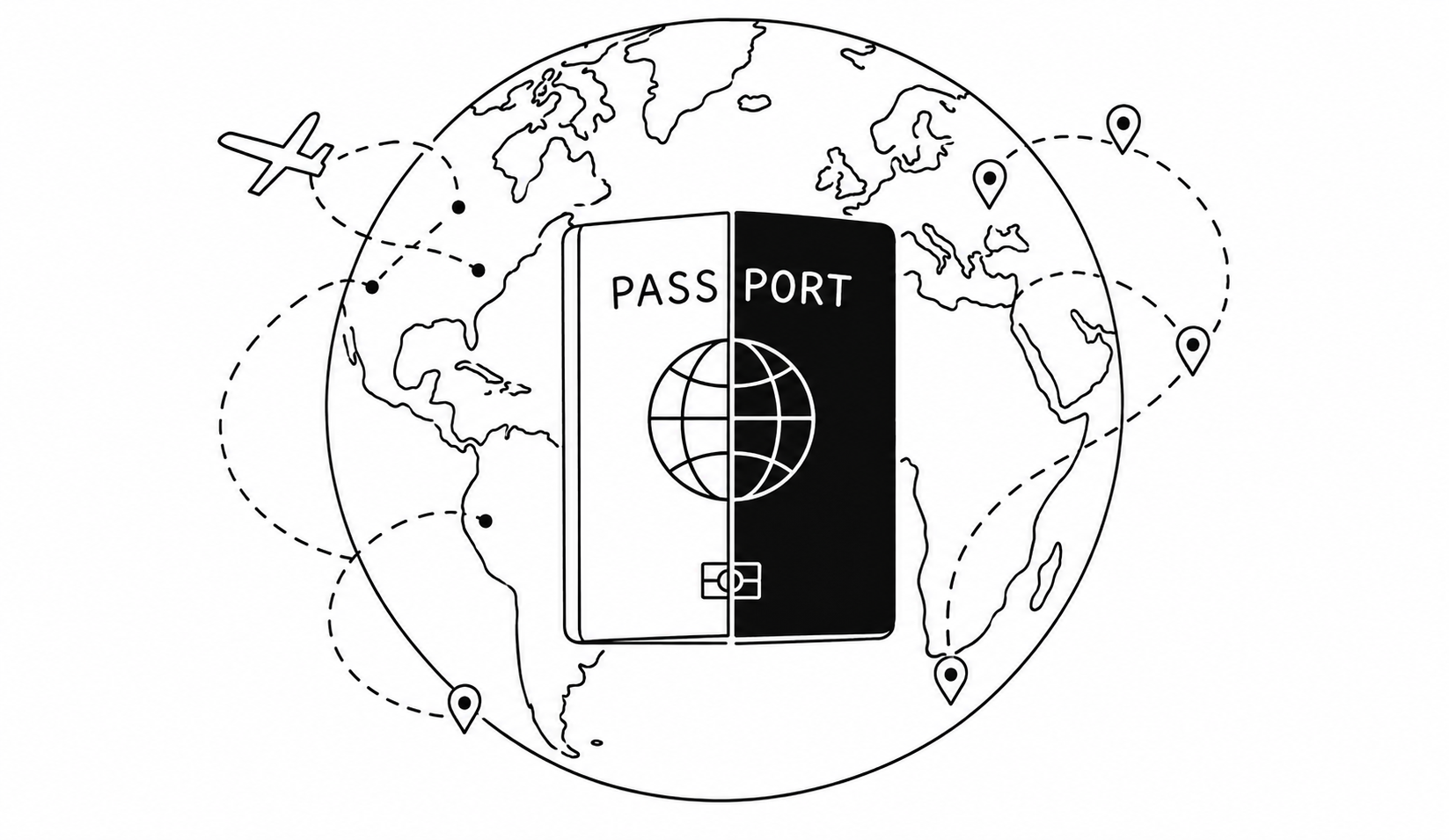
Roughly half of Americans have a passport. The geography of passport ownership closely mirrors the geography of income, revealing who can easily participate in a world built around mobility.
SSC News Desk | Social Storytellers Collective
The 2026 World Cup opened this week with 48 nations competing across 16 host cities in the most globally expansive tournament in the competition’s history. The United States is one of three host countries, with matches spread across cities including Houston, Dallas, Miami, Atlanta, Kansas City, Los Angeles, Philadelphia, Seattle, Boston, and the New York/New Jersey region. For American fans, access should be easier than almost anywhere else.
Yet the tournament also highlights a quieter divide. Roughly half of Americans do not hold a valid passport, limiting participation in a world increasingly organized around mobility.
The U.S. Department of State issued 24.5 million passports in fiscal year 2024. About 170 million valid U.S. passports are currently in circulation, meaning only about 45% to 50% of Americans possess one. The distribution is not random. States with the lowest passport ownership rates are overwhelmingly states with lower household incomes.
Mississippi has the nation’s lowest passport ownership rate at 20.6%, followed by West Virginia at 20.8%, Alabama at 25.3%, Arkansas at 26.2%, Kentucky at 27.4%, and Louisiana at 29.1%. At the other end of the spectrum are New Jersey at 68.1%, New York at 64.6%, Massachusetts at 64.3%, and California at 62.7%. The correlation between state median household income and passport ownership is approximately 0.81, an unusually strong relationship.
That suggests passport ownership functions as more than a travel preference. It acts as a wealth signal. A first-time adult passport costs $165 once application and execution fees are included. The expense itself is modest, but obtaining a passport also assumes disposable income, time, and a realistic expectation that international travel is possible. A document meant to facilitate movement first requires enough economic stability to justify acquiring it.
Those assumptions are not distributed equally. According to the National Community Reinvestment Coalition, the median Black household holds $44,100 in wealth compared with $284,310 for the median white household. Median liquid savings show an even sharper divide. Those gaps are not about passports themselves. They reflect decades of unequal wealth accumulation that determine which households can absorb discretionary expenses and which must prioritize immediate needs.
The map of low passport ownership overlaps with regions that have experienced persistent poverty, weaker infrastructure, and long histories of economic exclusion. Race is part of that story, but so are geography, income, and access to opportunity. International mobility, like many forms of participation, rests on conditions accumulated over generations rather than choices made in a single year.
The World Cup is a global celebration taking place in American cities. But the larger question it raises extends beyond soccer. In an economy where opportunity increasingly assumes the ability to move, travel, and connect across borders, who gets access to mobility—and who is expected to remain local?
— SSC News Desk | Social Storytellers Collective