The Credit Card Distress Story Depends on Which Number You Read

There are two defensible ways to measure whether Americans are falling behind on their credit cards, and right now they tell opposite stories.
The first is the stock measure: what share of outstanding credit card balances is ninety or more days delinquent at a given moment. By that measure, distress has climbed sharply. Between the third quarter of 2022 and the first quarter of 2026, the figure rose from 7.6 percent to 12.8 percent — a move large enough to prompt comparisons to the Great Recession and to generate a steady run of coverage arguing that the American consumer is buckling.
The second is the flow measure: the rate at which balances newly enter delinquency. By that measure, almost nothing has happened. The flow rate has held relatively stable for nearly two years.
Both numbers come from the same institution. The New York Fed’s Center for Microeconomic Data published the divergence in a Liberty Street Economics analysis accompanying its Quarterly Report on Household Debt and Credit last month, explicitly framing the piece as an attempt to reconcile the gap between delinquency as measured from credit bureau data and from lender data. The Fed is, in effect, publishing a caution about how its own headline statistic is being read.
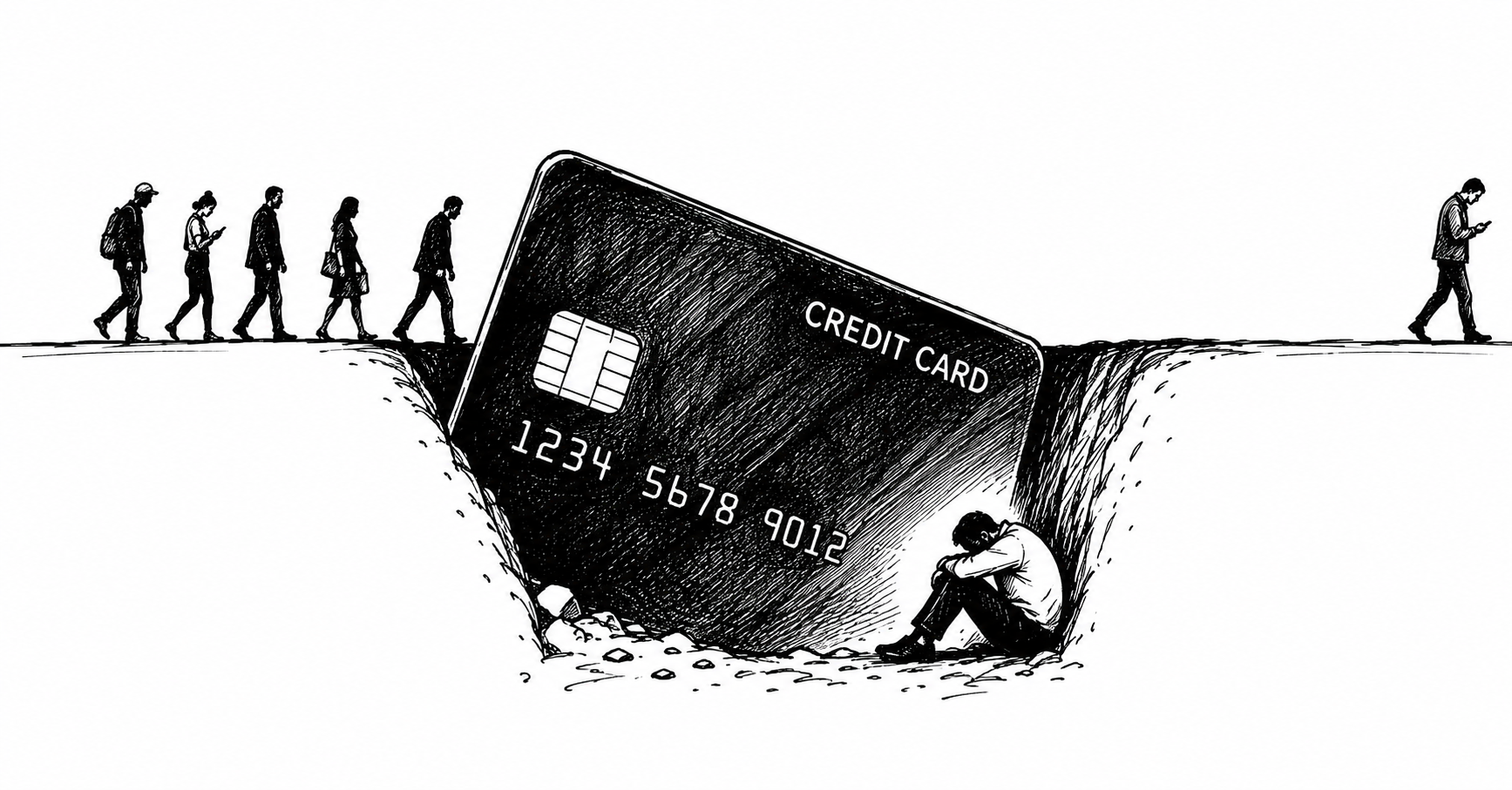
The reconciliation is not complicated once you see it. A stock measure counts everyone currently stuck. A flow measure counts everyone newly falling. If very few new borrowers are going delinquent but the borrowers who went delinquent in 2023 and 2024 are still delinquent — not curing, not charging off, not exiting the denominator — the stock rises while the flow stays flat. The stock number is not describing an accelerating crisis. It is describing an accumulating one.
That distinction determines almost everything downstream. A flow story says the economy is generating new distress and calls for macroeconomic response. A stock story says a specific cohort entered a hole several years ago and has not been able to climb out, which calls for something else entirely: attention to cure rates, to how long collections and charge-off cycles now run, to whether the borrowers in that 12.8 percent have any realistic path back to current. Those are different policy questions with different constituencies, and the second one has almost no political champion because it describes people who are already stuck rather than people who are newly at risk.
The aggregate picture underneath both measures is quieter than either headline. Total household debt fell by $13 billion in the second quarter of 2026, a 0.1 percent decline, to $18.8 trillion. Aggregate delinquency improved slightly, with 4.7 percent of outstanding debt in some stage of delinquency, down a tenth of a point from the prior quarter. Serious delinquency across all household debt fell to 3.3 percent from 3.4 percent. Joelle Scally, an economic policy advisor at the New York Fed, noted that delinquency rates across most products have held steady over the past two years, while flagging that new delinquencies for auto loans and credit cards remain at elevated levels.
So the honest summary is layered: total balances slightly down, aggregate delinquency slightly improved, new delinquencies elevated but not accelerating, and a stock of long-term card delinquency that keeps climbing because the people inside it are not getting out. None of those four facts is the story that ran.
What makes this a structural story rather than a statistical one is that the choice between measures is not neutral and is not made by the public. Lenders reading flow data tighten or loosen accordingly. Regulators reading stock data assess systemic risk. Reporters, reasonably, reach for the number with the larger move and the cleaner narrative arc, which is almost always the stock number. The measurement that wins is the one that best fits the format of the coverage, and the households described by the losing measurement effectively disappear from the conversation about them.
The New York Fed noticed this and published a correction to its own reception. Whether the correction travels as far as the original number is the open question, and the early evidence is not encouraging.