The Company That Buys Your Favorite Apps and Runs Them With Almost Nobody
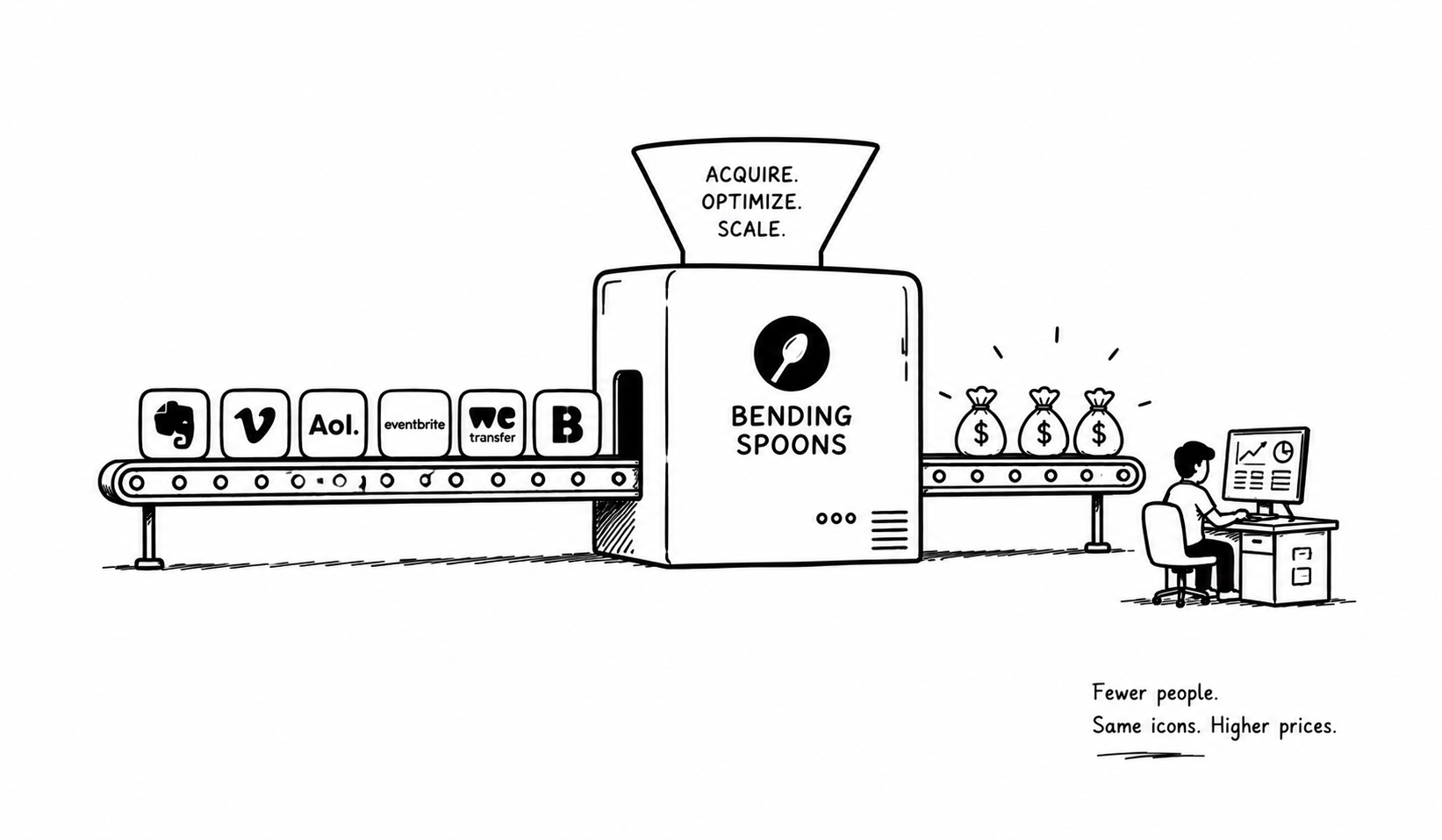
Bending Spoons has acquired Evernote, Vimeo, AOL, and Eventbrite. It employs a few hundred people to run all of them. That’s the point.
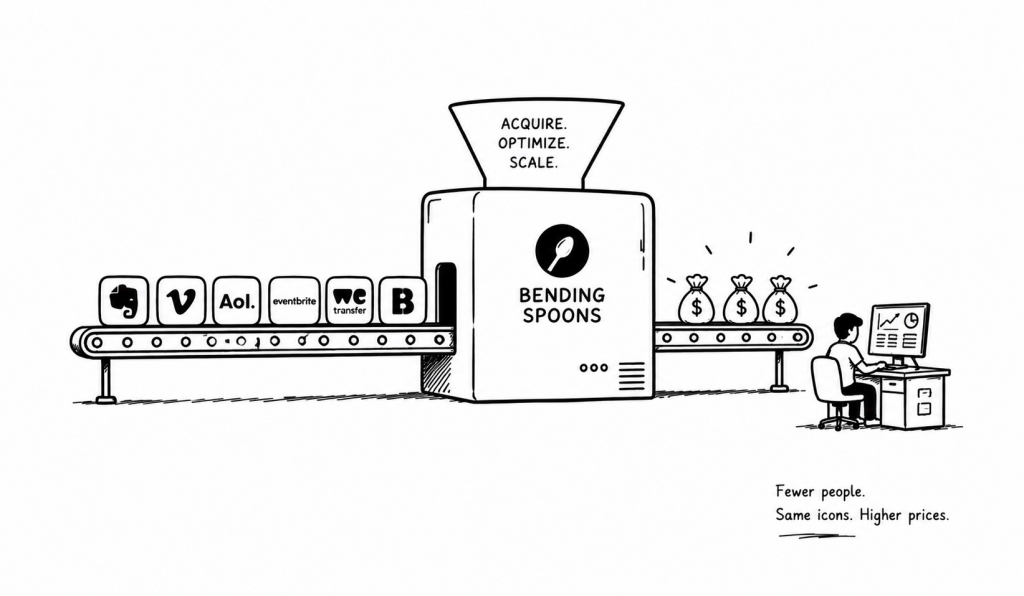
Bending Spoons does not look like a company managing billions of dollars in software brands. It looks like a very selective Italian startup that happens to own the internet’s back catalog.
The Milan-based company went public on July 1, 2026, raising $1.68 billion and reaching an $18 billion valuation. Its portfolio includes Evernote, Meetup, Vimeo, AOL, Eventbrite, WeTransfer, and Brightcove — names that collectively represent a significant share of how a generation built the early internet. Revenue hit $1.31 billion for 2025 and $601 million in the first quarter of 2026 alone.
The workforce running all of it: approximately 620 people, known internally as “Spooners.”
That ratio is not an accident. It is the entire model.
The Playbook
Bending Spoons targets software products that have hit a ceiling — popular enough to have large user bases, troubled enough that their owners are ready to sell. It acquires them, cuts staff dramatically, raises subscription prices, limits free-tier access, and deploys its in-house technology and AI infrastructure to run operations lean. Nearly all of Evernote’s original staff were let go after acquisition. WeTransfer lost 75% of its workforce. Brightcove lost roughly two-thirds.
CEO Luca Ferrari, who is in his early 40s, does not soften the description of what the company does. The cuts, he has argued publicly, are what make the model work — consolidating operations in Milan and running acquired products through Bending Spoons’ own technology stack rather than inheriting the organizational complexity that came with them.
The result is a company that looks less like a traditional tech acquirer and more like a private equity firm that decided to keep the assets instead of flipping them. The key distinction Bending Spoons draws is permanence: it holds what it buys, with plans for 1,000 more acquisitions.
The Workforce
Out of roughly 800,000 job applications received in 2025, Bending Spoons made 286 hires — a 99.9% rejection rate that the company does not advertise as a boast so much as a structural reality. The selection process is multi-stage and deliberate. The company pays competitively to attract candidates who might otherwise go to hedge funds or major tech firms.
The resulting workforce is young — mostly in their 20s and 30s, with leadership in their 30s and early 40s. Many have never worked anywhere else. Some are younger than the brands they now manage.
That demographic profile is, again, not incidental. Running Evernote without having used Evernote at its peak means no institutional memory of what it was supposed to be, no attachment to product decisions made by people who are no longer there, and no hesitation about the distance between the original vision and what the spreadsheet requires. Emotional distance from legacy products makes transformation faster.
What the Model Has Not Answered
Bending Spoons has built an exceptionally efficient machine for one specific operation: acquiring distressed or plateaued software brands and extracting value through cost reduction and pricing power.
What it has not yet demonstrated is whether the same model can produce growth. Cutting a workforce from hundreds to dozens and raising prices can improve margins on an existing user base. Expanding that user base — rebuilding a product that users actively choose rather than continue using by inertia — requires a different set of capabilities. Creation and optimization are not the same muscle.
The IPO gives the company capital for the next wave of acquisitions. The plan for 1,000 more targets suggests the model scales by volume: more brands, same playbook. Whether any of the acquired products eventually grow beyond what they were when Bending Spoons found them is the question the company has not had to answer yet.
The brands are iconic. The team is small, young, and deliberate. The machine is clearly working.
What it is working toward is the more interesting question.
Sources: TechCrunch; Wikipedia; Quasa; TechTimes; ValueAdd VC; The Pragmatic Engineer.